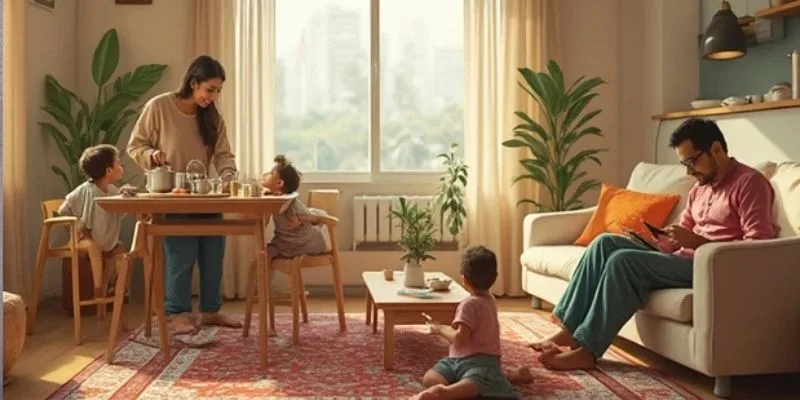

Choosing the right living arrangement is a pivotal decision for expatriates moving to East Asia. In the context of Japanese urban planning, the 2LDK apartment for small family Japan is a strategic choice. It balances economic efficiency with functional living space. This layout includes two private bedrooms. It also has a combined Living, Dining, and Kitchen area. This combination makes it a staple for households that prioritize centralized family interaction.
A 2LDK apartment for small family Japan provides a compact yet versatile environment where every square meter serves a purpose. While it may seem smaller than Western standards, the architectural design of apartments in Japan often uses every available inch. This design choice accommodates modern lifestyles. Understanding how to navigate this space is crucial. It ensures that each family member maintains a sense of privacy and comfort.
Detailed Breakdown of the 2LDK Layout and Characteristics
The term “2LDK” is more than just a real estate classification; it is a blueprint for Japanese urban life. The “2” signifies two independent rooms that are traditionally separated by sliding doors (fusuma) or standard hinged doors. The “LDK” signifies the heart of the home, where the family gathers for meals, entertainment, and relaxation.
Defining the Living, Dining, and Kitchen (LDK) Area
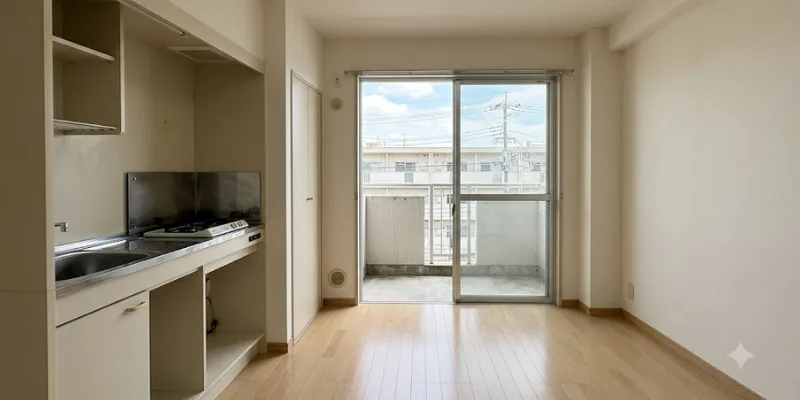
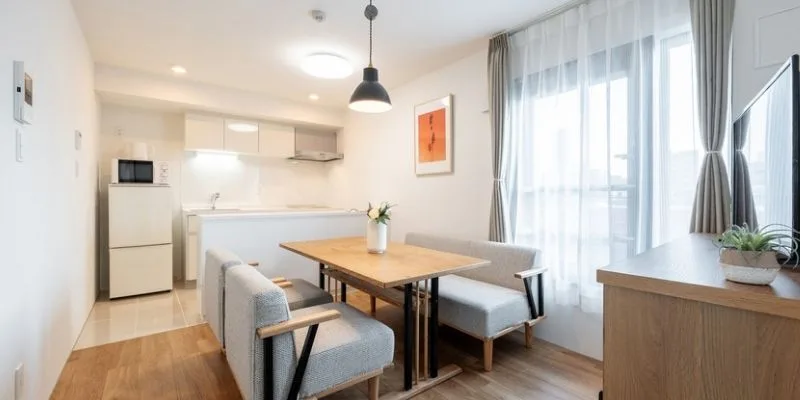
The LDK is the largest room in the unit, designed to be multifunctional. In many apartments in Japan, this area acts as the primary social hub. The layout is considered “open-concept” in modern buildings. This design allows the person in the kitchen to remain part of the family conversation in the living room.
Square Footage and Realistic Expectations
The actual size of these units can vary dramatically depending on the age and location of the building. Prospective tenants will find that newer developments often have smaller, more efficient footprints. In contrast, older “mansion” style buildings may offer more generous proportions.
- Compact Units (50–60 sqm): These are standard for japan tokyo apartment rent listings in central districts like Minato or Shibuya.
- Mid-Sized Units (60–75 sqm): These are typically located in residential wards such as Setagaya or Nerima.
- Large Units (75–95+ sqm): These are rare but can be found in luxury developments or suburban areas.
The quality of life improves significantly if you select a unit with a layout that minimizes long hallways. Larger living zones are preferable.
Meeting Space Standards for a Family of Four
The Japanese Ministry of Land, Infrastructure, Transport and Tourism (MLIT) sets clear guidelines. These guidelines specify the space required for healthy living. These standards are divided into “Minimum” and “Target” levels to help families gauge their needs.
Minimum Living Area Standards
For a family of four, the absolute minimum area required is 50 square meters. This space is necessary to maintain a “healthy and civilized life.” Living below this threshold can lead to significant stress and lack of privacy. Most apartment for rent Japan options in the 2LDK category meet this basic requirement.
Urban Target Living Area Standards
In dense cities, the target for a comfortable lifestyle for four people is 95 square meters. Achieving this in a 2LDK is difficult in central Tokyo. Most units of that size are converted into 3LDK or 4LDK layouts. Families must often compromise by choosing high-quality apartments in tokyo japan that are smaller but exceptionally well-designed.
Families often find that they can thrive in 60 square meters. They utilize smart storage solutions like vacuum-seal bags for bedding. They also use stackable plastic organizers and over-the-door hanging racks.
Core Advantages of the 2LDK Configuration
Choosing a 2LDK layout offers several benefits that extend beyond simple rent savings. This configuration is particularly suited to the “compact city” lifestyle prevalent in Japan.
Centralized Family Interaction
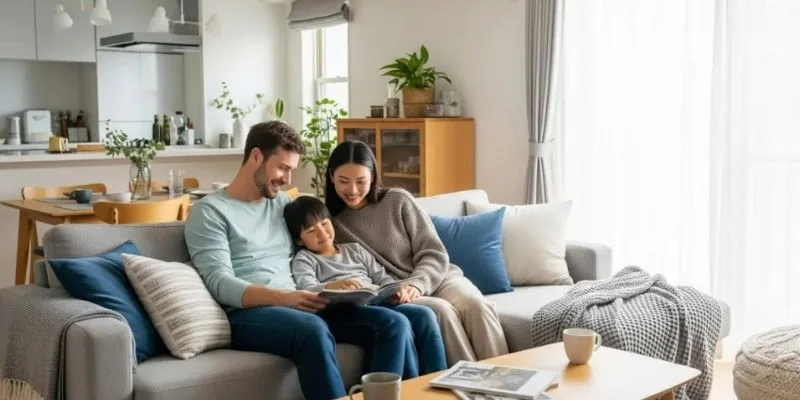
A 2LDK naturally brings family members together. The LDK area is the primary source of light and space. Children and parents spend more time in the same room because of this. This layout encourages constant communication and shared experiences.
- Siblings interact more frequently through shared play and study sessions.
- Parents can monitor children’s progress easily while attending to household chores.
- The family develops a cohesive daily rhythm centered around the shared dining table.
Economic Efficiency and Utility Savings
Maintaining a smaller footprint results in lower monthly overhead. Heating and cooling a 2LDK is significantly cheaper than managing a larger 3LDK house. You will notice a reduction in your carbon footprint and your bills if you reside in a modern, well-insulated 2LDK.
- Monthly electricity costs remain manageable even during the humid summer months.
- Water bills are lower due to the concentrated plumbing layout of these units.
- Initial move-in costs, such as the “Key Money” (reikin), are calculated based on lower monthly rent.
Streamlined Household Management
Cleaning and maintaining apartments in Japan is less time-consuming when the space is compact. This allows parents to spend more time on their careers or hobbies rather than domestic labor.
- The total surface area requiring vacuuming or mopping is limited.
- Fewer rooms mean fewer windows to clean and fewer air conditioning filters to replace.
- General organization is easier to maintain because there is no room for “junk rooms” to develop.
Strategic Room Allocation for Different Life Stages
The biggest challenge for a family of four in a 2LDK is how to divide the two bedrooms. This strategy must be fluid and adapt as children age.
The “All-in-One” Sleeping Arrangement
Many families choose to use one bedroom as a “family sleeping room” when children are toddlers or in early elementary school. In this scenario, everyone sleeps on futons or side-by-side beds. The second room is then free to be used as a dedicated hobby or storage space.
Transitioning to Private Zones
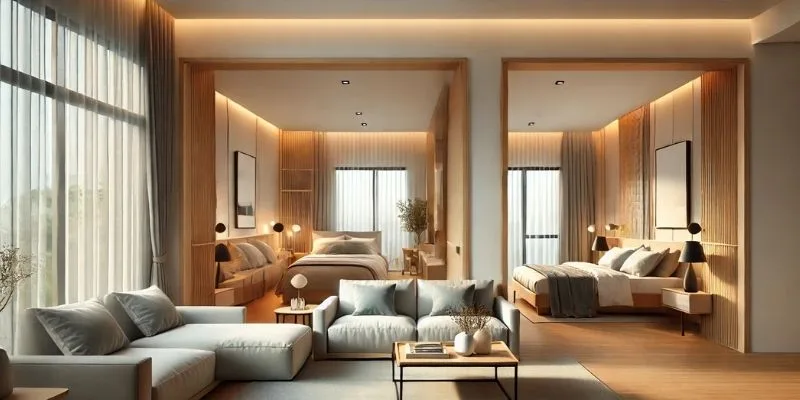
As children reach puberty, the need for privacy becomes a priority. You should consider partitioning the larger bedroom into two separate zones if you have a brother and sister. This can be achieved using freestanding wardrobes, decorative folding screens, or heavy blackout curtains.
Accommodation for High School and University Students
When children are preparing for major entrance exams, they require absolute quiet. During these years, parents may choose to sleep in the LDK area on a foldable sofa bed or high-end futon. This sacrifice allows each child to have their own private room for study and rest.
Strategic Room Allocation Examples for Four Residents
Effective room allocation is the key to comfort in a 2LDK apartment for small family Japan. Families can look at the Prime Urban Shinkawa unit as a model. They can adapt their space based on the age of their children.
Scenario 1: Families with Young Children (Preschool to Early Primary)
During these years, the family typically sleeps together, and the second room can be repurposed for daytime utility.
- Bedroom 1 (The Sleep Zone): Use this room as a shared family bedroom. Everyone can sleep on futons or side-by-side beds.
- Bedroom 2 (The Utility Zone): Convert this space into a dedicated playroom and storage area for children’s items (e.g., toy boxes, picture books, and seasonal gear).
- LDK Area: The large southwest-facing living room serves as the primary hub for meals and evening bonding.
Scenario 2: Families with School-Aged Children (Middle to Late Primary)
As children grow, they begin to seek independence and a quiet place to study.
- Bedroom 1 (The Children’s Room): Designate this as a shared room for both children. Use bunk beds and twin desks to maximize the floor area.
- Bedroom 2 (The Parents’ Room): This becomes the private sanctuary for the parents, housing their wardrobe and bedding.
- LDK Area: The system kitchen allows parents to prepare meals while children finish homework at the dining table.
Scenario 3: Families with Teenagers
Privacy becomes the highest priority when children reach middle or high school.
- Bedroom 1 & 2 (Individual Rooms): Each child is allocated one of the two private rooms. This ensures they have a quiet environment for exam preparation.
- LDK Area (The Parents’ Sleep Zone): Parents utilize the LDK area as their sleeping quarters. They use a high-quality sofa bed or foldable futons. This allows the room to function as a living space during the day. At night, it serves as a bedroom.
Case Study: Prime Urban Shinkawa – 801
We analyze the Prime Urban Shinkawa – 801 listing in Chuo-ku, Tokyo. This illustrates how a family of four can utilize a 2LDK. This unit represents a premium example of apartments in Tokyo Japan suitable for a small family.
Technical Specifications
- Layout: 2LDK with two private bedrooms and one LDK area.
- Size: 59.68 m^2, which comfortably exceeds the MLIT minimum for four people.
- Building Structure: Steel Reinforced Concrete (SRC), offering superior soundproofing and earthquake resistance.
- Orientation: Facing Southwest, which ensures maximum natural light during the afternoon.
- Location: Shinkawa, Chuo-ku, located 6 minutes from Hacchobori Station on the JR Keiyo and Tokyo Metro Hibiya lines.
Financial Breakdown
The japan tokyo apartment rent for this unit is $¥300,000$ per month (total fee). The initial cost is estimated at ¥1,393,100, covering several standard Japanese fees:
- Deposit (Shikikin): ¥288,000.
- Key Money (Reikin): ¥288,000.
- Agency Fee: ¥316,800.
- Guarantee Fee: ¥144,000.
A-Realty: Expertise in Finding Your Ideal Tokyo Home
Navigating the complexities of the Japanese real estate market requires professional assistance. This is especially true for those seeking high-quality apartments in Tokyo, Japan. A-Realty is a premier real estate consultancy. It is dedicated to helping international families find the perfect 2LDK apartment for a small family in Japan.
Our team specializes in identifying properties that offer the best balance of location, space, and price. We understand that finding an apartment for rent Japan involves more than just looking at floor plans. It requires an understanding of neighborhood vibes. Knowing about school districts is also essential. Commuting routes need to be considered as well.
A-Realty offers end-to-end support, including:
- Multilingual contract negotiation to ensure your interests are protected.
- Detailed walkthroughs of properties in prime wards like Minato, Meguro, and Shibuya.
- Assistance with utility setup and local ward office registration.
Finding a home is easier if you have a partner. They should understand your cultural expectations. They should also know the local market realities. A-Realty bridges that gap with transparency and professionalism.
Are you planning your move to Tokyo? Contact A-Realty today to access our exclusive database of family-friendly 2LDK units and experience a seamless transition to Japanese life.
Maximizing Every Inch: Practical Tips for 2LDK Living
To live comfortably in a 2LDK, you must adopt a proactive approach to organization. The goal is to maximize floor space by utilizing vertical and hidden areas.
Furniture Selection for Compact Living
You should invest in multifunctional furniture if you want to avoid a cluttered environment. Every piece of furniture should serve at least two purposes.
- Storage Beds: Choose bed frames with built-in drawers to store seasonal clothing.
- Extendable Dining Tables: Use a table that can seat four daily but expands to six for guests.
- Nest of Tables: These provide extra surface area when needed but tuck away to save space.
The Utility of the “S” Room
Some listings are labeled as “2LDK+S.” The “S” stands for a Service Room. This room lacks sufficient natural light to be legally called a bedroom. This extra space is a lifesaver for families of four. It can be used as a walk-in closet, a soundproofed home office, or a dedicated pantry for bulk groceries.
Vertical Storage Solutions
In apartments in Japan, the walls are often underutilized. You can create significant storage capacity if you install vertical shelving systems. Use “tension pole” shelves that do not require drilling into the walls, as this is often prohibited in rental agreements.
Financial Realities of Japan Tokyo Apartment Rent
Understanding the financial structure of the rental market is crucial for budgeting. When searching for apartments in japan, you must account for several upfront and recurring costs.
Upfront Costs (Initial Investment)
The initial cost to move into a 2LDK in Tokyo can be four to six times the monthly rent. This includes:
- Deposit (Shikikin): Usually 1-2 months’ rent, partially refundable.
- Key Money (Reikin): A non-refundable gift to the landlord, usually 1 month’s rent.
- Agency Fee: 0.5 to 1 month’s rent plus tax.
- First Month’s Rent: Paid in advance.
Recurring Monthly Expenses
Aside from the base rent, you will encounter additional fees that are standard in Japanese building management.
- Management Fee (Kanri-hi): This covers common area maintenance and trash removal.
- Fire Insurance: A mandatory biennial payment.
- Guarantor Company Fee: An annual or monthly fee to a company that guarantees your rent.
Choosing the Right Neighborhood for Your Family
The location of your 2LDK apartment for small family Japan will dictate your daily experience. Different wards in Tokyo offer varying levels of family-friendly amenities.
Setagaya and Nerima: The Green Belts
These wards are famous for their parks and quiet residential streets. You will find more spacious apartments in tokyo japan here compared to the city center. These areas are ideal for families with young children who need access to playgrounds and safe walking paths.
Minato and Shibuya: The International Hubs
If your lifestyle revolves around international schools and western-style amenities, these central wards are the best choice. While the japan tokyo apartment rent is higher here, you gain proximity to global corporate headquarters and high-end shopping districts.
Koto and Edogawa: Modern and Affordable
The eastern side of Tokyo offers newer constructions with modern earthquake-proofing and larger LDK areas. These neighborhoods are popular among young families due to the abundance of new shopping malls and childcare facilities.
Conclusion
Living in a 2LDK apartment for small family Japan is an exercise in intentionality. While the space is compact, it provides a unique opportunity for families to live a minimalist, focused, and connected life. By prioritizing a large LDK area, a family can create more living space. Utilizing smart storage solutions is also essential. Choosing the right neighborhood completes the transformation. This is how a family of four can turn a 2LDK into a warm and functional sanctuary.
The transition to living in apartments in Japan is successful. You must embrace the local architectural philosophy of “efficiency over excess.” With the right mindset, your search for a 2LDK apartment for small family Japan will lead you to a home. It will perfectly suit your urban lifestyle. The professional support of a firm like A-Realty ensures you find the perfect match.

Real estate advisor at Arealty Japan, specialising in helping foreign residents navigate the Tokyo and Osaka rental markets. Lucy has guided hundreds of international renters — from Working Holiday visa holders to corporate relocations — through Japan’s apartment application process. Her writing draws on firsthand experience with landlord screening, guarantor companies, and foreigner-friendly listings across all 23 Tokyo wards and major Kansai cities.