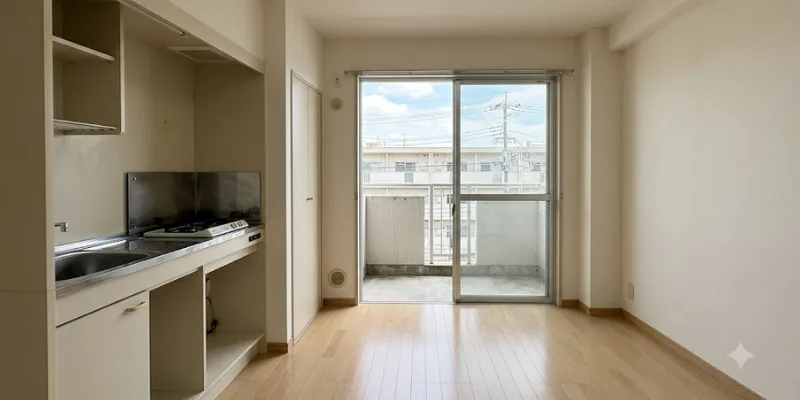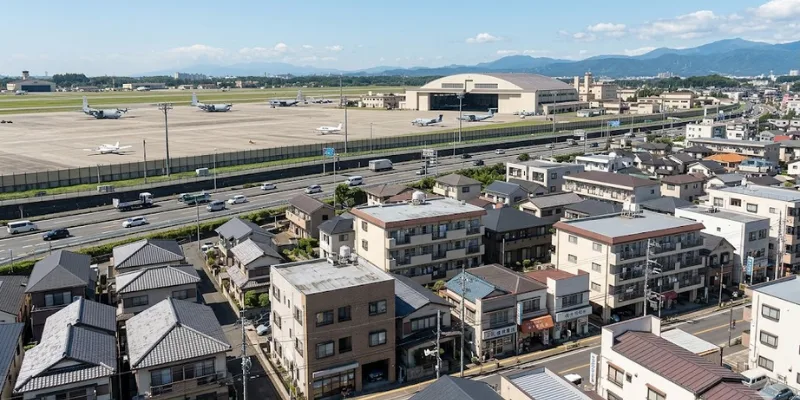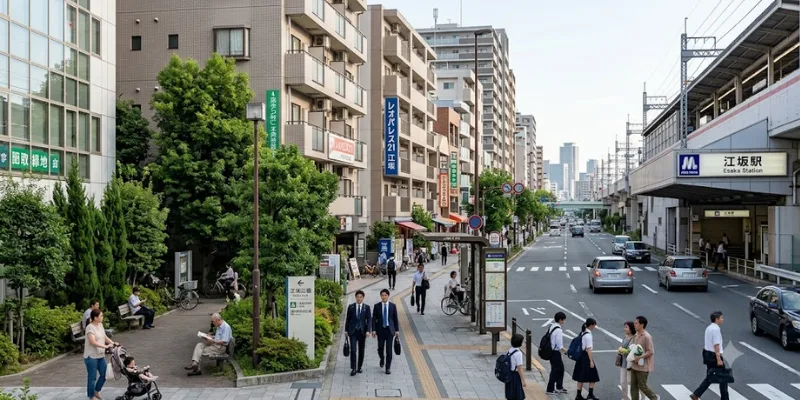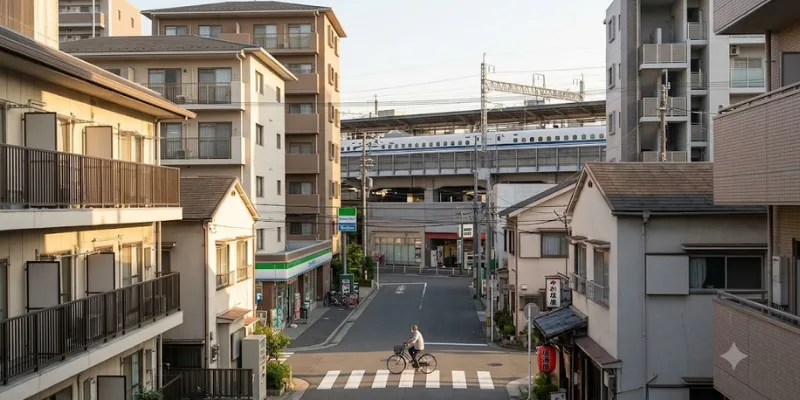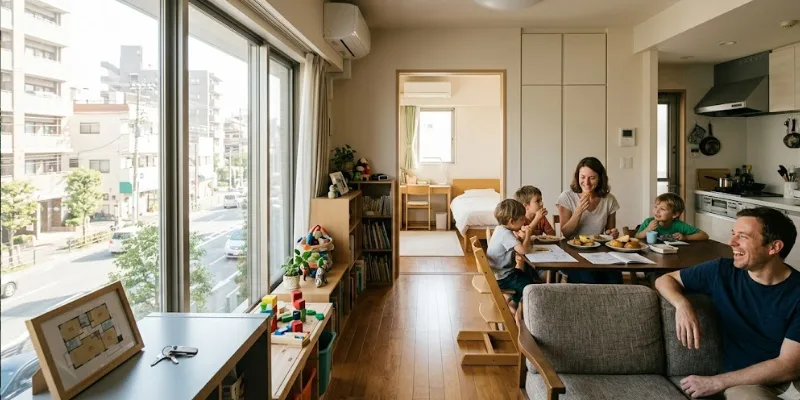

3LDK apartments in Japan — three bedrooms plus a living/dining/kitchen room — rent for an average of ¥150,000 to ¥320,000 per month depending on city and ward, according to SUUMO’s Q1 2026 rental market data. For families relocating to Japan, 3LDK apartments are the most common layout for households with two or more children, offering enough separation for each child to have a private room while keeping a shared family space.
This guide covers what a 3LDK actually includes, realistic prices across Tokyo and other major cities, move-in costs, and how foreigners go through the application process for this apartment type.
What Is a 3LDK? Layout Explained
Japanese apartment notation follows a consistent logic. The number indicates room count, the letters indicate room types:
- 3LDK = 3 bedrooms + 1 Living/Dining/Kitchen room. Total floor area typically 60–85㎡.
- 3DK = 3 bedrooms + Dining/Kitchen, no separate living room. Smaller and cheaper, 50–70㎡.
- 3SLDK = 3LDK + a Service room (windowless, used for storage, study, or a small fourth room).
For families with school-age children, the distinction between 3LDK and 3DK matters significantly: the L (living room) gives the family a shared space distinct from where children sleep and study, which most families relocating internationally consider close to non-negotiable.
3LDK Apartment Prices in Japan by City and Ward (2026)
| Location | Avg. 3LDK rent/month | Notes |
| Minato-ku, Tokyo | ¥280,000–¥380,000 | Roppongi, Azabu — international school proximity |
| Setagaya-ku, Tokyo | ¥220,000–¥290,000 | Popular with expat families, quieter residential |
| Suginami-ku, Tokyo | ¥190,000–¥250,000 | Good value, family-oriented |
| Yokohama, Kanagawa | ¥170,000–¥230,000 | Strong schools, 30 min to central Tokyo |
| Osaka (Kita/Chuo wards) | ¥150,000–¥210,000 | Lower cost base than Tokyo equivalent |
| Fukuoka | ¥110,000–¥160,000 | Most affordable major city option |
Source: SUUMO and Homes.co.jp rental market data, Q1 2026.
For families specifically targeting Tokyo, Setagaya-ku consistently offers some of the best value among inner wards for 3LDK apartments, combining quiet residential streets with strong school access.
3LDK vs 2LDK: When Do Families Need the Extra Room?
The jump from 2LDK to 3LDK in Japan isn’t only about square footage — it’s about whether each child needs a separate room. A rough guide:
- One child under 6: A 2LDK is often sufficient, with the second bedroom serving as both nursery and guest room.
- Two children, or one child over 10: Most families find a 3LDK necessary at this point, particularly if the children are different genders or have different sleep schedules.
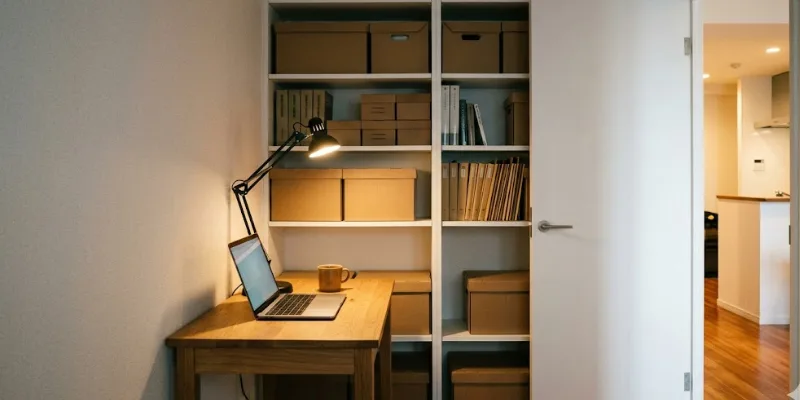
- Remote work + children: Many relocating professionals use the third bedroom as a home office rather than a child’s room, especially in the first year before children are old enough to need full independence.
For households still deciding between sizes, see our 2 bedroom apartments in Tokyo for foreigners guide for a detailed 2LDK breakdown, or our guide on how much a 2-bedroom apartment costs in Japan for a national price comparison.
Move-In Costs for a 3LDK Apartment
Initial costs scale with monthly rent. For a ¥220,000/month 3LDK in Tokyo:
| Cost item | Typical amount |
| Security deposit (敷金) | ¥220,000–¥440,000 (1–2 months) |
| Key money (礼金) | ¥0–¥220,000 — many listings now waive this |
| First month’s rent | ¥220,000 |
| Agency fee | ¥220,000–¥242,000 |
| Guarantee company fee | ¥110,000–¥220,000 |
| Fire insurance (2-year policy) | ¥18,000–¥25,000 |
| Total | ¥788,000–¥1,367,000 |
This is a substantial upfront cost for any family. See our apartment move-in cost in Japan guide for a full national breakdown, and our Japan rental deposit and key money explained guide for what’s refundable and what isn’t at move-out.
How Foreigners Apply for 3LDK Apartments in Japan
The application process for 3LDK apartments follows the standard Japanese rental procedure, with a few practical notes specific to larger family units:
Documents required:
- Residence Card (在留カード) + passport copies for all adult occupants
- Proof of income — employment contract, 3 months’ payslips, or company-issued income certificate
- Guarantor — personal Japanese guarantor or rental guarantee company (保証会社)
- Emergency contact in Japan
- Often: children’s school enrollment confirmation, if applicable to the building’s family-friendly policies
Income requirement: The standard rule across most Japanese landlords is that monthly rent should not exceed one-third of monthly household income. For a ¥220,000/month 3LDK, that means demonstrating combined household income of ¥660,000/month (¥7.9M/year).
See our apartment financial proof in Japan guide for what documentation satisfies this requirement when your income is paid overseas or through a foreign employer.
Tokyo Metropolitan Government — Housing for Foreign Residents — official guidance on rental rights and procedures for foreign residents.
Best Areas in Tokyo for Families Renting 3LDK Apartments
Minato-ku has the highest concentration of international schools and English-speaking medical and retail services — the default choice for many expat families despite the premium rent. See our Minato apartments for rent guide.
Setagaya-ku offers a quieter, more residential character with strong public schools and good value relative to Minato or Shibuya. See our Setagaya City guide.
Suginami-ku is increasingly popular with both Japanese and foreign families for its parks, lower density, and family-oriented community feel. See our Suginami apartments for rent guide.
Furnished 3LDK Options
The vast majority of private 3LDK apartments in Japan are unfurnished, including kitchen appliances beyond the built-in stove and sink. Budget ¥300,000–¥600,000 to furnish a 3LDK from scratch for a family, or significantly less by sourcing secondhand furniture. See our used furniture in Japan guide for where to shop and what to expect on pricing.
Furnished 3LDK options exist primarily through corporate relocation packages and select monthly mansion operators, though availability at this size is limited and pricing runs ¥450,000–¥700,000/month — a premium most families only consider for the first 1–3 months after arrival while searching for a permanent unit.
FAQ: 3LDK Apartments in Japan
Is a 3LDK big enough for a family of four? Yes — a 3LDK with 65–85㎡ comfortably houses two parents and two children, particularly when one bedroom is used by the children jointly while young, then separated as they grow older.
Can foreigners rent a 3LDK without a Japanese guarantor? Yes. Rental guarantee companies are accepted by the large majority of landlords offering 3LDK units, including those in family-oriented buildings.
What’s the difference between 3LDK and 3SLDK? The S indicates an additional service room — typically windowless, used for storage or as a study. It’s not legally classified as a bedroom due to lack of natural light access, but many families use it as one regardless.
How long does the application process take for a 3LDK? The same as smaller apartment types: typically 10–21 days from document submission to key handover, with guarantor screening taking 2–5 business days.
→ Browse 3LDK and family apartments in Tokyo
Negotiating and Timing Your 3LDK Search
Families searching for 3LDK apartments in Japan benefit from understanding the seasonal rhythm of the rental market. Japan’s two major moving seasons — March to early April (fiscal and academic year start) and September (some school transitions) — see the highest demand and least negotiating room. Families relocating internationally on a fixed work-transfer timeline don’t always have flexibility here, but if your move date has any flexibility, targeting November–January or June–August can yield better availability and occasionally room to negotiate on key money or the renewal fee structure.
Larger units like 3LDK apartments also tend to sit on the market slightly longer than compact 1K or 1LDK units simply due to a smaller pool of qualified renters, which can work in your favor when negotiating through an experienced agency.
What to Check When Viewing a 3LDK for a Family
Bedroom sizes relative to furniture needs. Japanese bedroom sizes are often measured and advertised in tatami mat units (畳, jō) — a 6-jō room is roughly 9.9㎡, sufficient for a single bed and small desk but tight for a double bed plus storage. If you’re shipping furniture from overseas, measure everything against the floor plan before signing.
Sound insulation between bedrooms. With three separate bedrooms, sound transfer between rooms matters more than in a 1LDK. Reinforced concrete (RC) construction generally offers better sound insulation than wood-frame (mokuzō) buildings — ask about construction type, particularly if you have children with different bedtimes or a home office that needs quiet.
Storage capacity. Family-sized apartments accumulate more belongings, and Japanese closets (押入れ) are often smaller than what international families are used to. Check the closet count and size in each bedroom, plus any additional storage like a genkan shoe cupboard or balcony storage unit.
School district boundaries. If you intend to use the local public school system, confirm which specific elementary or junior high school catchment area the building falls within — this can vary even between buildings on the same street, and switching mid-year is disruptive for children.
Internal Resources for Families Renting in Japan
- Cost of living for two people in Japan / Tokyo rent — household budget planning beyond rent alone
- Working visa Japan: guide to bringing family — visa-specific considerations for dependents
- Best neighborhoods to live in Tokyo — broader ward comparison for families weighing multiple areas
- Ideal children’s room size in Japan — practical guidance on what room size actually works for children at different ages
Renewal and Long-Term Costs for 3LDK Apartments
Standard Japanese leases run on a 2-year cycle, with a renewal fee (更新料, kōshinryō) typically equal to 1 month’s rent if you choose to extend. For a ¥220,000/month 3LDK, that’s ¥220,000 roughly every 2 years on top of regular rent — a cost families should budget for separately rather than treating as a surprise. Some larger management companies have moved away from renewal fees as a competitive differentiator, so it’s worth asking your agency to flag renewal-fee-free buildings if long-term cost predictability is a priority for your household.

Real estate advisor at Arealty Japan, specialising in helping foreign residents navigate the Tokyo and Osaka rental markets. Lucy has guided hundreds of international renters — from Working Holiday visa holders to corporate relocations — through Japan’s apartment application process. Her writing draws on firsthand experience with landlord screening, guarantor companies, and foreigner-friendly listings across all 23 Tokyo wards and major Kansai cities.