
Japan is known for its advanced technology and beautiful culture. It also sits on one of the world’s most seismically active zones. For anyone looking for apartments in Japan, securing a safe living space is paramount. This guide provides essential information about Earthquake Resistant House Japan. It explains what they are and how they are rated. Understanding this is key in your search for apartment for rent Japan or a property to purchase.
What Defines an Earthquake Resistant House Japan?
An Earthquake Resistant House Japan is a structure specifically engineered and built to mitigate damage. It is designed to prevent collapse during significant seismic events. This includes large-scale earthquakes. These buildings integrate specific design features to withstand the lateral (side-to-side) forces generated by ground shaking. They are also designed to reduce sway caused by other lateral forces, such as strong winds from typhoons.
Key Characteristics of Earthquake Resistant Buildings
The core objective is to ensure the building remains standing and habitable even after a major earthquake. This is achieved through various structural methods that increase the building’s robustness and flexibility:
- Weight Reduction: Decreasing the overall weight of the building helps lessen the impact of shaking. The seismic force transmitted to a structure is proportional to its weight. Lighter structures, like those utilizing steel frame or certain wood construction methods, often perform well in this regard.
- Shear Walls and Bracing: Installing appropriate shear walls (rigid walls designed to resist lateral forces) and bracing systems is fundamental. These elements distribute the forces across the structure.
- Dampers: The strategic installation of earthquake dampers (shock absorbers) can absorb or dissipate the energy from ground motion. This action further reduces the overall sway and stress on the main structure.
Distinguishing Seismic Resistance from Standard Construction
All houses built in Japan after 1981 must adhere to minimum seismic resistance standards, known as the “New Earthquake Resistance Standard” (Shintaishin). Therefore, it is inaccurate to assume that ordinary houses are inherently weak against earthquakes.
However, standard conventional housing typically meets Earthquake Resistance Level 1, the lowest certification level. This level is designed to prevent collapse during a major earthquake (one occurring once every few hundred years, such as a Magnitude 6+ or 7). However, the structure is still highly likely to sustain significant damage. The damage may necessitate major renovations. It may even require complete rebuilding. This situation illustrates the difference between surviving an earthquake and maintaining functionality afterward.
Tiers of Seismic Resistance: Understanding Performance Levels
The capability of a Japanese home to withstand an earthquake is formally assessed using Earthquake Resistance Levels (or Seismic Resistance Grades). These standards were established under the Act on Promotion of Quality Assurance in Housing. They are the most widely used and easily understood benchmarks for a building’s seismic performance. There are three tiers, with Level 3 representing the highest degree of resistance.
Level 1: The Minimum Standard
- Performance: A building is constructed to prevent collapse or total destruction during a rare, severe earthquake (e.g., Magnitude 6+ to 7). It can also prevent damage during moderate earthquakes (e.g., Magnitude 5), which occur once every few decades.
- Implication: This is the baseline required for all post-1981 conventional housing. Crucially, while the building won’t collapse, it may suffer extensive damage rendering it uninhabitable without costly repairs.
Level 2: Enhanced Resilience
- Performance: Engineers design buildings at this grade to withstand seismic forces that are 1.25 times stronger than those required for Level 1.
- Application: Regulations often mandate this enhanced resilience for essential public facilities designated as evacuation shelters in a disaster, such as:
- Public Schools
- General Hospitals
- Community Centers
- Benefit: Properties certified as Level 2 or higher are eligible for designation as “Long-Term Excellent Housing.” This status provides various tax benefits. These benefits include mortgage deductions and property tax reductions.
Level 3: The Highest Degree of Safety
- Performance: This is the highest level of seismic resistance, certified to withstand forces 1.5 times stronger than those required for Level 1.
- Functionality After Disaster: Engineers design a Level 3 house to remain safe and fully habitable for residents immediately following a major earthquake.
This is a critical distinction from Level 1, which only guarantees non-collapse. - Application: Engineers often design structures vital for post-disaster response and public safety to this standard, including:
- Police Stations
- Fire Departments
- Emergency Operations Centers
Choosing an apartment or house certified as Level 3 provides the highest assurance of safety and post-disaster functionality.

Three Major Advantages of Earthquake Resistant House Japan
Selecting an earthquake-resistant home offers distinct advantages beyond mere compliance with minimum safety regulations. These benefits are particularly relevant for those seeking long-term accommodation in areas like Tokyo.
Robust Typhoon and Wind Resistance
Engineers design the structural systems in earthquake-resistant homes to manage powerful lateral forces. This engineering provides resilience not only against ground shaking but also against other severe weather events, notably typhoons.
- The same bracing and reinforced shear walls resist seismic forces. They also effectively counter the high-speed, sustained lateral pressures of strong winds.
- Consequently, these homes can significantly reduce damage from natural disasters, allowing residents to feel secure during severe storms.
Cost-Effectiveness Compared to Alternatives
In terms of improving seismic safety, earthquake-resistant (Shintaishin) structures are typically the most budget-friendly option compared to other advanced seismic technologies:
- Vibration Control (Seismic Damping): Uses specialized devices (dampers) to absorb shaking energy.
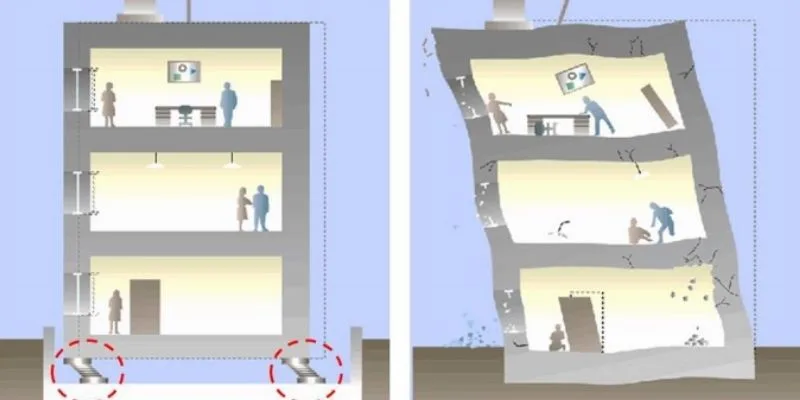
- Seismic Isolation (Base Isolation): This technique uses layers of bearings and springs. They are installed between the foundation and the structure. This setup helps to decouple the building from the ground movement.
- Earthquake-resistant construction achieves a high safety standard by simply integrating reinforced structural elements into the building frame. This approach avoids the need for expensive, specialized mechanical devices. This cost efficiency makes seismic safety more accessible for both new builds and necessary renovations.
High Degree of Design Freedom
The measures used in earthquake-resistant construction are built directly into the structure itself. This inherent structural integrity allows for greater flexibility in architectural design compared to other seismic mitigation methods:
- Adaptability: Designers can easily adjust the design to match the specific size and shape of the land plot, as well as the unique conditions of the soil type (e.g., soft ground versus bedrock).
- Basements:Designers can incorporate basements and subterranean features seamlessly. This is a significant advantage over base-isolated structures. Typically, these structures cannot accommodate a basement. Engineers must install seismic isolation devices between the ground and the building base, which is why this requirement exists.
- This freedom allows for more customized and desirable homes. Examples include multi-level residences, open-plan living spaces, or properties built on irregularly shaped lots.
Three Potential Drawbacks and Considerations
Earthquake-resistant homes offer superior protection. However, they come with specific considerations. Prospective residents of apartments in Tokyo Japan should be aware of these factors.
The Full Impact of Shaking is Transmitted
The design philosophy of earthquake resistance is to make the building strong enough to withstand the ground motion. The building does not necessarily need to reduce it.
- The shaking directly transfers energy into the building structure. While the building remains intact, the occupants will experience the full intensity of the tremor.
- In a major earthquake, the vigorous shaking inside the building can create hazardous situations for occupants. This is primarily due to unsecured internal objects.
Risk of Secondary Disasters
Even if the building structure itself is sound, the primary risk within an earthquake-resistant home often shifts to its contents.
- Falling Objects: Strong, direct transmission of shaking can cause furniture, appliances, and heavy objects to topple over or slide violently.
- Fire Hazard: A secondary disaster, such as a fire caused by overturned appliances or damaged gas lines, is a real possibility.
- Mitigation: To fully leverage the safety of the house, residents must take proactive in-house earthquake countermeasures. For example, they should secure tall furniture to walls. They also need to properly organize storage spaces.
Limited Resistance to Repeated or Long-Duration Shaking
Engineers primarily design Standard Level 1 and Level 2 earthquake-resistant houses to withstand a single, large shock event. They may not perform optimally during sustained, long-period shaking or a rapid succession of strong aftershocks.
- The stress on structural elements accumulates with repeated events.
- Engineers explicitly design only homes with the highest rating, Earthquake Resistance Level 3, to maintain their strength. They also maintain functionality against repeated seismic forces.
- For maximum resilience against repeated events, one might consider incorporating seismic damping devices alongside the basic earthquake-resistant structure.
Methods to Further Improve Seismic Safety
Engineers use established methods for existing buildings or when seeking optimal safety in new construction. These methods enhance a building’s seismic performance beyond the basic structural requirements.
Seismic Dampers (Shock Absorbers)
Installing seismic dampers (also called vibration control devices) adjacent to key structural points, such as walls and columns, is important. This placement helps to dissipate the energy of an earthquake.
- Mechanism: Dampers act like the shock absorbers on a car, absorbing the kinetic energy and slowing down the building’s movement.
- Types: They come in various forms, including:
- Oil/Hydraulic Dampers
- Viscoelastic Dampers (using rubber or similar materials)
- Steel/Metal Yield Dampers
- Their primary benefit is counteracting repeated seismic events, as the dampers repeatedly absorb energy, minimizing structural fatigue.
Earthquake-Resistant Frames
High-strength support frames can be installed in specific openings of an existing house. These openings include those occupied by windows and doors. This installation increases the overall wall rigidity.
- Advantage: This method allows for seismic reinforcement to be completed without major construction that affects natural light or ventilation.
- Efficiency: Construction can often be performed from the exterior. This approach provides a quick and less disruptive way to upgrade the seismic rating of an older property.
Financial Incentives and Support Systems
The Japanese government offers significant support systems. Various local municipalities also provide support to encourage the construction and renovation of seismically safe housing. This is particularly beneficial for those renting or buying in major hubs like Tokyo.
Tax Benefits
When you purchase or build a new apartment or house that meets the government’s earthquake-resistant standards, you qualify for substantial tax exemptions and reductions. These standards are especially relevant at Level 2 and Level 3. These often include:
- Property Tax Exemptions: A reduction in the fixed asset tax.
- Mortgage Deductions: Favorable income tax deductions related to housing loans.
Subsidies and Grants
Both national and local governments provide financial assistance for seismic renovations or rebuilding projects. While details vary by prefecture and city, these incentives can be very valuable:
- Free Seismic Audits: Some municipalities offer complimentary or heavily subsidized initial inspections of a home’s seismic resilience.
- Construction Subsidies: Grants may cover a significant portion of the renovation cost (e.g., up to 1 million Yen, or approximately half the construction cost), depending on local rules.
Leveraging these systems can significantly reduce the financial burden of ensuring a safe home. This makes Level 3 housing more accessible to a wider audience. For instance, the Tokyo Metropolitan Government’s Earthquake Countermeasures Portal offers detailed, up-to-date information on available subsidies and application procedures.
When Should You Prioritize an Earthquake-Resistant House?
An earthquake-resistant house, specifically one rated Level 3, is the ideal choice if any of the following conditions apply to you while searching for japan tokyo apartment rent:
Budget is a Primary Concern, but Safety is Non-Negotiable
You may require robust earthquake protection. However, you might find the costs of high-tech seismic control or base isolation systems prohibitive. In that case, consider a cost-effective structural reinforcement. An earthquake-resistant design is the best alternative.
Living in a High-Risk Zone Prone to Multiple Disasters
If your chosen location, such as central Tokyo or coastal regions, is susceptible to frequent natural disasters, you should consider a resilient home. These disasters include major earthquakes, strong aftershocks, and severe typhoons. A highly resilient Level 3 home offers continuous peace of mind.
You Desire Architectural Freedom and Functionality
If you need flexibility in design, choose earthquake-resistant design. This includes an open-plan apartment layout or the ability to include a basement. Its structural integrity accommodates these features better than base-isolated construction.
Securing Your Safe Haven: Focus on Arealty
Finding a safe, compliant, and comfortable living space is the most critical step for any expatriate moving to Japan. Arealty specializes in connecting international residents with certified, modern apartments in Japan. These apartments prioritize seismic safety. They also meet high-quality construction standards.
Our Commitment to Your Safety:
- Verified Listings: We ensure that all listed properties clearly state their seismic compliance. This is particularly important for properties in high-demand areas like Tokyo. We prioritize buildings that meet or exceed the Earthquake Resistance Level 2.
- Expert Consultation: Our bilingual experts provide detailed explanations of a property’s structural safety features. They differentiate between various seismic construction types. This helps you make an informed decision about your apartment for rent Japan.
Ready to find your safe, compliant home in Japan?
Contact Arealty Today to browse our exclusive listings of high-seismic resistance apartments and secure your peace of mind in Japan!
Conclusion
Choosing an Earthquake Resistant House Japan is an investment in safety, resilience, and long-term well-being. Understand the three core Earthquake Resistance Levels. Learn about the inherent advantages, including superior wind resistance and design flexibility. With this knowledge, you can confidently navigate the Japanese housing market. Prioritize a Level 3 property. Choose one that incorporates seismic dampening. This is the strongest action you can take to ensure your home remains safe and habitable. It will keep your home safe even after the largest seismic events. Your journey to finding the perfect apartment in Tokyo Japan must begin with safety as its foundation.

Real estate advisor at Arealty Japan, specialising in helping foreign residents navigate the Tokyo and Osaka rental markets. Lucy has guided hundreds of international renters — from Working Holiday visa holders to corporate relocations — through Japan’s apartment application process. Her writing draws on firsthand experience with landlord screening, guarantor companies, and foreigner-friendly listings across all 23 Tokyo wards and major Kansai cities.