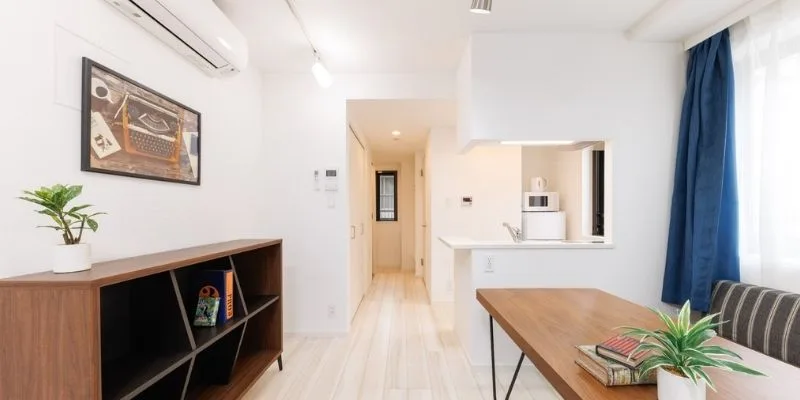

Looking for an apartment for rent japan? The 1DK (One Room + Dining Kitchen) apartment layout offers a perfect blend of space and affordability for single occupancy. It is often slightly more spacious than a standard studio or 1K unit. Although generally priced higher than smaller formats, savvy renters can find attractive apartments in tokyo japan. 1DK units can have rents comparable to studios in different locales. This comprehensive guide provides the average rent prices for 1DK units across Tokyo’s 23 wards. It also offers crucial advice for selecting your ideal home.
Understanding the Definitive Characteristics of a 1DK Apartment
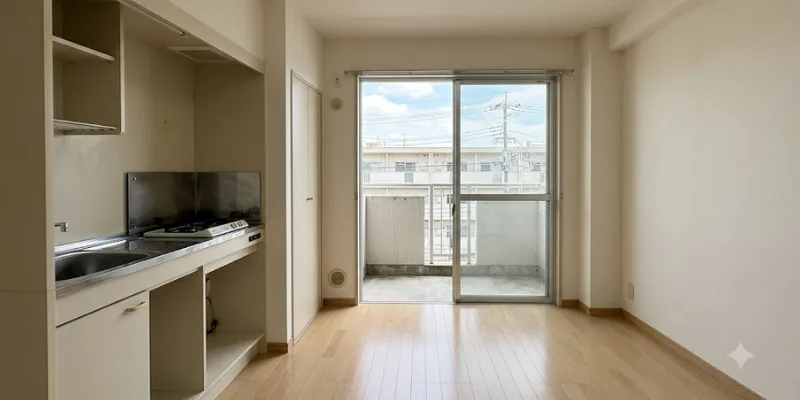
A 1DK unit, by definition, comprises one private room and a designated Dining Kitchen (DK) area. This classification is governed by industry standards related to the size of the kitchen component.
The key feature that defines the DK space is its size. It must be large enough to accommodate a dining table. This distinguishes it from the small K (Kitchen) space in a 1K unit. Specifically, the DK area typically measures between 4.5 and 8 tatami mats (approximately 7.5m^2 to 13.5m^2). If the combined kitchen/dining area exceeds 8 tatami mats, the property is usually categorized as a 1LDK (One Room + Living + Dining Kitchen).
Advantages of Choosing a 1DK over Other Formats
When evaluating japan tokyo apartment rent options for single occupancy, the 1DK format provides distinct functional benefits:
- Functional Separation: The primary benefit is the clear division between the food-related area and the resting area. This prevents cooking odors from permeating clothing and bedding, a frequent complaint among residents of studio apartments.
- Enhanced Social Space: The larger DK area can comfortably host a small dining table and chairs. This setup allows the occupant to entertain a guest or enjoy meals outside of their main room. It promotes a healthier psychological boundary between daily activities.
- Optimal for Storage: The layout often maximizes wall space for built-in closets or additional storage units. This is crucial for individuals with hobbies requiring equipment. It is also essential for those with extensive wardrobe collections, such as photographers, musicians, or fashion professionals.
The Eligibility for Dual Occupancy
1DKs are primarily designed for singles. Dual occupancy is sometimes possible for couples. Two roommates can also share, though this is less common. According to the “Housing Basic Plan” by the Ministry of Land, Infrastructure, Transport and Tourism, the required minimum living space is 30m^2 for two individuals.
- Verification is Essential: Many 1DK units may exceed 30m^2 in total area. This is especially true for those at the larger end of the 8m^2 to 12m^2 range. However, regardless of size, tenants must verify with the property management. They need to confirm with the landlord if the contract explicitly permits two residents. Violating occupancy limits is a serious breach of contract in Japan.
Average Rent Price 1DK Tokyo: A Regional Analysis Across 23 Wards
Understanding the geographic distribution of rental costs is the first critical step in managing your budget for apartments in japan. The following table shows the authoritative average monthly rent for 1DK apartments. This is calculated for properties within a maximum 10-minute walk from a train station. Practical Budgeting: Rent vs. Tokyo Average
| Area Group | Ward | Average Rent (Yen) | Notes on Area Profile |
| Central Business Hubs | Shibuya | 153,200 | Premier fashion, technology, and entertainment center. |
| Chiyoda | 151,400 | Home to the Imperial Palace and key government buildings. | |
| Minato | 146,800 | High-end residential and major business districts. | |
| Chuo | 136,200 | Traditional commerce and finance (Ginza, Nihonbashi). | |
| Bunkyo | 131,400 | Highly desirable educational district, known for universities and quiet residential areas. | |
| Shinjuku | 130,300 | Major transport and commercial hub with large administrative presence. | |
| South-West Popularity | Meguro | 132,400 | Affluent, trendy residential areas known for relaxed atmosphere and park access. |
| Shinagawa | 123,800 | Key Shinkansen and business hub. Good balance of city access and residential calm. | |
| Setagaya | 112,900 | Large, primarily residential area with suburban feel. Popular with families and young professionals. | |
| Ota | 100,400 | Contains Haneda Airport. Wide range of residential options, generally lower-priced near the coast. | |
| Eastern Value | Taito | 116,900 | Cultural center (Asakusa, Ueno). Mix of traditional and modern housing. |
| Sumida | 115,500 | Home to Tokyo Skytree. Developing area with modern complexes and traditional neighborhoods. | |
| Koto | 111,000 | Located on Tokyo Bay. Modern high-rise apartment complexes and large parks. | |
| Affordable East/North | Arakawa | 96,000 | Predominantly residential, close to the Taito area but with significantly lower rents. |
| Kita | 96,000 | Solid residential area in the north, offering excellent transport to central areas without the central price tag. | |
| Toshima | 115,900 | Includes Ikebukuro. Major commercial center with high residential density. | |
| Itabashi | 89,800 | Primarily residential, offering accessible commute times and affordable units. | |
| Nerima | 89,100 | Western suburban feel, known for green spaces and quiet neighborhoods. | |
| Edogawa | 81,100 | Eastern-most ward, highly accessible along the Tozai Line; residential and family-friendly. | |
| Adachi | 77,200 | Offers some of the lowest rents in Tokyo, ideal for budget-conscious renters. | |
| Katsushika | 75,700 | Historically residential, providing the greatest value in the 23 Wards for space-to-cost ratio. |
Who Should Choose a 1DK Apartment?
A 1DK apartment is ideal for renters who prioritize space efficiency and want to understand how the Average Rent Price 1DK Tokyo fits their budget. These individuals value functional separation and daily living comfort rather than minimal size. Such layouts are particularly beneficial for those who wish to maintain a distinct boundary between their culinary and sleeping areas.
This layout is particularly well-matched to renters who maintain structured routines or spend significant time at home. The separation between the dining kitchen and the private room helps residents organize their living space more effectively. The layout is optimized to function as a restorative “recharging station” while providing an inspired, quiet alcove for peak performance.
1DK apartments are ideal for:
- Individuals with large luggage or long-term belongings, including suitcases, sports equipment, musical instruments, or seasonal clothing storage.
- Tenants prefer a clear physical boundary between eating and sleeping areas. This helps maintain hygiene. It supports routine and mental separation between activities.
- Renters who prioritize floor space over building age, as many older 1DK properties offer generous layouts at competitive rent levels.
Foreign professionals working in Minato often choose 1DK apartments. Freelancers based in Nakano and graduate students studying in Bunkyo also prefer this option. These renters benefit from having a dedicated dining or work area. This setup keeps the bedroom quiet and uncluttered. It supports long-term stability in Japan.
Can Two People Live in a 1DK Apartment?
Yes, two people can live together in a 1DK apartment, which is a factor that often influences the Average Rent Price 1DK Tokyo. This is possible if the unit meets minimum space requirements, specifically a floor area of 30 square meters for dual occupancy. Every square meter is meticulously engineered for maximum utility, ensuring seamless ease in your daily transitions while maintaining a functional living environment.
The Ministry of Land, Infrastructure, Transport and Tourism (MLIT) states that the minimum recommended living space for two occupants is 30 square meters. This guideline focuses on maintaining basic comfort, movement, and daily usability rather than luxury.
Many 1DK apartments in Tokyo exceed this size threshold, especially in residential wards such as:
- Setagaya, known for spacious layouts and family-oriented planning
- Ota, which offers larger units at moderate rent levels
- Itabashi, where older but well-sized properties are common
For couples considering apartments in Japan, it is essential to evaluate the actual floor area. They should also consider room proportions and the storage layout. This is important rather than relying solely on the “1DK” label. Two apartments with the same layout classification can differ significantly in livability.
A well-designed 1DK with balanced room sizes and adequate storage can comfortably support two residents. Proper circulation enhances this setup, especially if daily schedules differ. It is also beneficial if the dining kitchen doubles as a shared living space.
Architectural Variations: The Five Key 1DK Types
The layout significantly impacts daily life and is a key factor influencing the Average Rent Price 1DK Tokyo in the current market. Understanding these distinct 1DK types is crucial when reviewing floor plans for apartment for rent japan listings, as functional design often dictates the overall value.
DK with Indirect Light (No Window):
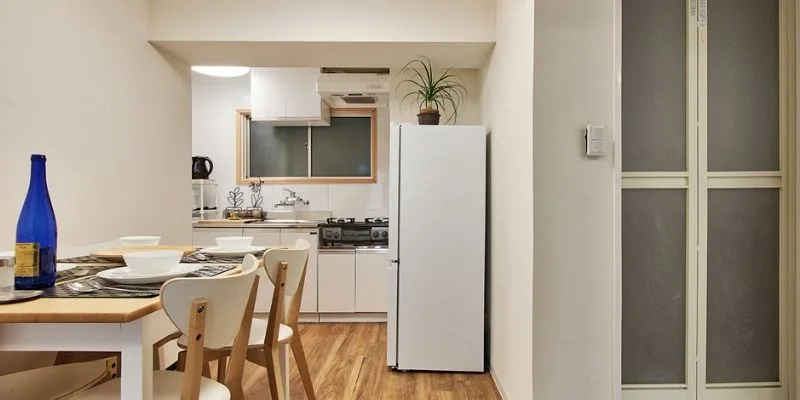
In the majority of non-corner 1DK units, the Dining Kitchen itself does not have an exterior window. To ensure adequate light and ventilation, a glass or partially translucent door is often used. These elements are crucial for Japanese building codes. This could be a sliding partition or Fusuma. This design allows light from the main room’s window to reach the kitchen.
K-Area Maximization (Size-Equivalent to 1K)
Some 1DK listings may have a total floor area that is only marginally larger than a large 1K unit. The key difference lies in the allocation of space. For instance, a 1DK might offer a 4.5-tatami room and a 4.5-tatami DK, while a 1K has an 8-tatami room and a small 2-tatami kitchen. The 1DK offers superior functionality even with similar total square footage.
Split/Separate Room Layout
In this configuration, the main room is located on one side of a short hallway from the entrance. The DK is located on the opposite side. This design maximizes privacy and noise separation. This configuration is a premium asset for those with irregular schedules, preserving a healthy circadian rhythm by minimizing environmental noise. It also benefits students or couples with varying sleep schedules. Noise from the kitchen activities is minimized.
1LDK-Functional Type
These are oversized 1DKs. The DK area is expansive. It often nears or exceeds the 8-tatami threshold but is still categorized as 1DK. This flexibility allows the DK to function as a secondary living room. It enables occupants to comfortably live side-by-side with distinct lifestyles. For example, one person may use the main room for working. Meanwhile, the other person might use the DK for reading or watching television.
Straight Room Type (In-Line Layout)
The main room and the DK are aligned in a straight line from the entryway. This is highly practical for moving furniture. It offers an open, seamless flow between the two areas when the partition doors are opened. It enhances the sense of space. This layout is generally preferred by those who enjoy a more open-plan feel. They still retain the option for separation.
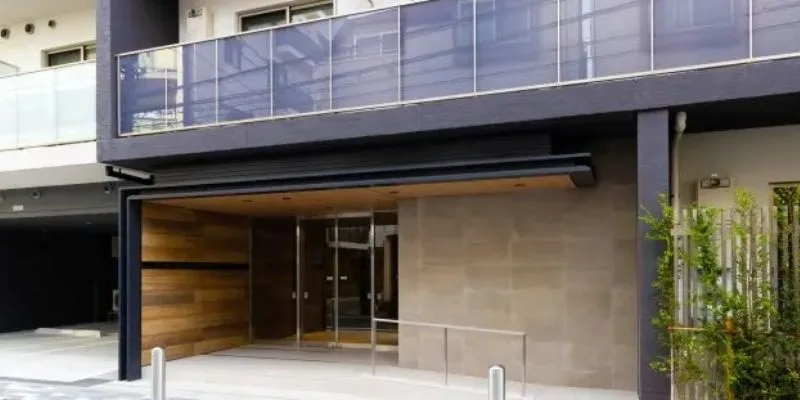
Featured 1DK Example at ARealty: PROUD FLAT Shinagawa Oimachi – 105
To illustrate what you can expect from a high-quality listing, here is a detailed look at a current property in our portfolio:
- Property Name: PROUD FLAT Shinagawa Oimachi – 105
- Location: Minamishinagawa, Shinagawa-ku, Tokyo
- Total Monthly Fee: 149,000 yen
- Breakdown: Rent (132,000 yen), Maintenance (15,000 yen), Other (2,000 yen)
- Initial Costs: Estimated at 548,500 yen
- Included: Deposit (132,000 yen), Agency Fee (145,200 yen), Guarantee Fee (66,000 yen), Fire Insurance (20,000 yen), and Lock Exchange (36,300 yen). Key Money is notably 0 yen for this property.
- Specifications:
- Layout: 1DK
- Size: 25.2 square meters
- Built: 2022 (Reinforced Concrete)
- Floor: 1st floor of a 5-story building
- Direction: Facing East
- Nearby Stations: * Aomono Yokocho (Keikyu Main Line) – 8 Minute walk
- Oimachi (JR Keihin-Tohoku, Tokyu Oimachi) – 8 Minute walk
- Top-Tier Amenities: This modern unit includes appliances and features, such as air conditioning, a system kitchen, and a washlet. It also provides convenient facilities, including delivery boxes, bicycle parking, and motorcycle parking.
This property is an excellent choice for students or professionals seeking a newly built home in a convenient location. The transition to Tokyo will be much easier if you choose a managed property like PROUD FLAT. It is explicitly student and pet-friendly.
ARealty: Your Specialist for Apartments in Japan
Navigating the unique customs and complex paperwork associated with securing an apartment for rent japan can be challenging. Specialized assistance is required, especially for foreign residents. ARealty is dedicated to providing transparent, professional, and efficient services to help you find the optimal japan tokyo apartment rent.
Our Commitment to Foreign Renters:
- Verified Listings: We exclusively feature listings with landlords and management companies open to foreign residents. This avoids the frustration of rejection based on nationality or visa status. Our focus includes high-quality 1DK and 1LDK apartments in tokyo japan.
- Initial Cost Breakdown: We provide a comprehensive and itemized explanation of all initial fees. These fees can typically be 4 to 6 times the monthly rent. This includes Key Money (Reikin), Security Deposit (Shikikin), agency fees, and guarantee company charges, ensuring no hidden costs.
- Bilingual Contract Support: Our specialists offer full bilingual support throughout the negotiation and contract signing process. Crucial lease terms regarding cleaning fees, penalty clauses, and renewal conditions are fully explained before signing.
- Efficient Move-In: We assist with utility activation, including electricity, gas, and water. This process is often complex in Japan. We ensure you have services immediately upon moving in.
Finding the ideal 1DK unit is our expertise. We balance the Average rent price 1DK Tokyo with your desired location and lifestyle. Our market-savvy specialists are committed to demystifying the rental process, transforming your property search into a seamless journey.
Don’t let the complexity of the Japanese rental market delay your move. Contact ARealty now to schedule a personalized property consultation and secure the perfect apartment in Tokyo!
Conclusion
The Average rent price 1DK Tokyo shows the functional value of the layout. It also reflects the strong influence of location within the 23 wards. Compared to Tokyo’s overall average rent, 1DK apartments generally command higher prices. This is due to their larger floor area. They also have a clearer separation of living spaces. However, this price difference varies widely by ward, creating meaningful opportunities for renters who choose their location strategically.
Foreign renters can confidently secure a 1DK apartment by understanding regional rent trends. Matching lifestyle needs with the right ward is also important. Setting a realistic budget helps ensure strong value within the competitive Japan Tokyo apartment rent market. Are you ready to stop searching and start living? Contact ARealty today to speak with a bilingual specialist and secure your ideal 1DK apartment in the heart of Tokyo!

Real estate advisor at Arealty Japan, specialising in helping foreign residents navigate the Tokyo and Osaka rental markets. Lucy has guided hundreds of international renters — from Working Holiday visa holders to corporate relocations — through Japan’s apartment application process. Her writing draws on firsthand experience with landlord screening, guarantor companies, and foreigner-friendly listings across all 23 Tokyo wards and major Kansai cities.