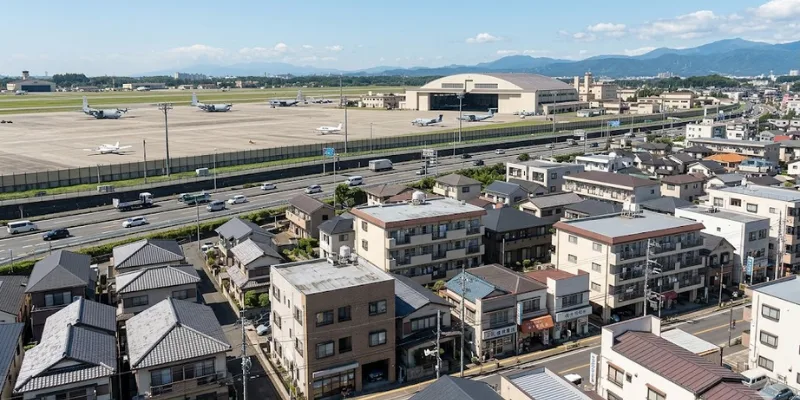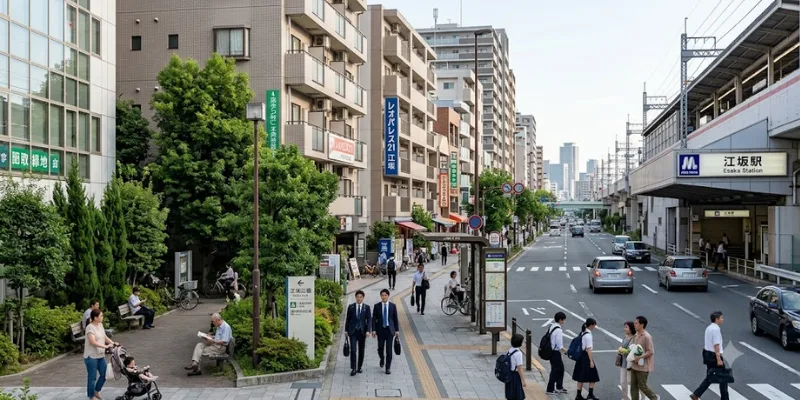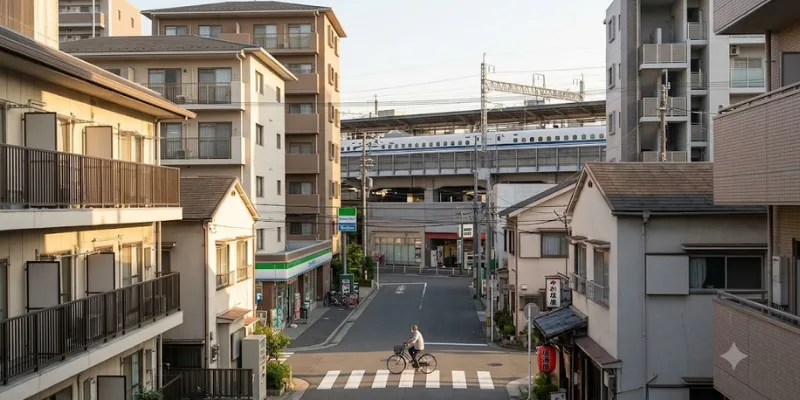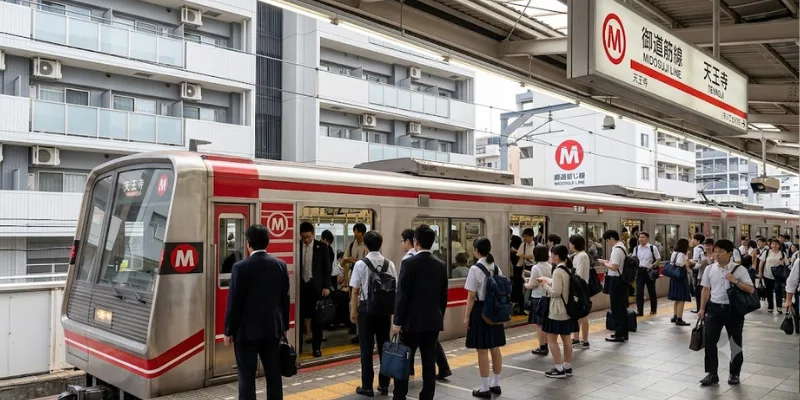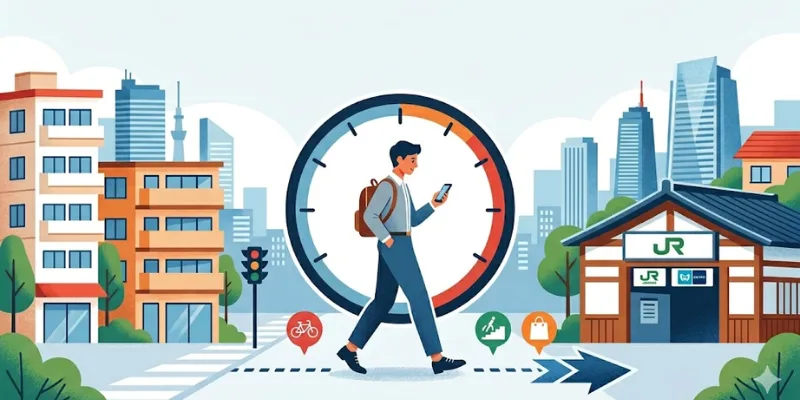

In the meticulously organized society of Japan, time is the most valued currency. For anyone navigating the real estate market—whether you are looking for an apartment for rent Japan or scouting high-end apartments in Tokyo Japan—the metric of Walking distance to train stations serves as the ultimate benchmark for property value, convenience, and lifestyle.
In Japanese real estate listings, proximity is not a subjective estimate; it is a legally regulated calculation that follows strict national standards. However, for an expatriate or a first-time renter, these numbers can be deceptive if not interpreted with professional insight. This comprehensive guide provides a deep dive into the technical rules of “minutes-to-station,” the environmental factors that impact your actual commute, and how to strategically choose a Japan Tokyo apartment rent that optimizes your daily life.
The Technical Foundation: How Walking Distance is Calculated
Japan’s real estate industry operates under the “Fair Competition Codes Concerning Representation of Real Estate.” This legal framework ensures that every property listing, from a rural cottage to a luxury apartment in Tokyo Japan, uses a standardized formula to describe its distance to transit hubs.
The 80-Meter Rule: The Golden Standard
The cornerstone of the Japanese property market is the “80-meter rule.” According to the regulations, one minute of walking time is equivalent to 80 meters of road distance. This specific figure was established based on the average walking pace of a healthy adult.
- Rounding Up: Crucially, any fraction of a minute is rounded up to the next full minute. Even if a property is 81 meters away, it must be listed as a 2-minute walk.
- Examples of Calculation:
- 5 Minutes: Represents a distance of 321 to 400 meters (80 m \times 5 = 400 m).
- 10 Minutes: Indicates a distance of 721 to 800 meters ($80 \text{ m} \times 10 = 800 \text{ m}$).
- 15 Minutes: Signifies a distance of 1,121 to 1,200 meters.
- The “0-Minute” Ban: Under current laws, authorities can never list a property as “0 minutes” from a station, even if it is physically adjacent to the entrance. The minimum listing allowed is 1 minute.
Road Distance vs. Straight-Line Distance
The distance used for these calculations must be the actual walking path on public roads, not a “as the crow flies” straight line. If there is a massive shopping mall, a private residential complex, or a fence between your apartments in Japan and the station, the measurement must follow the legal pedestrian route around these obstacles. This ensures that the distance reflects the true path a tenant will take every morning.
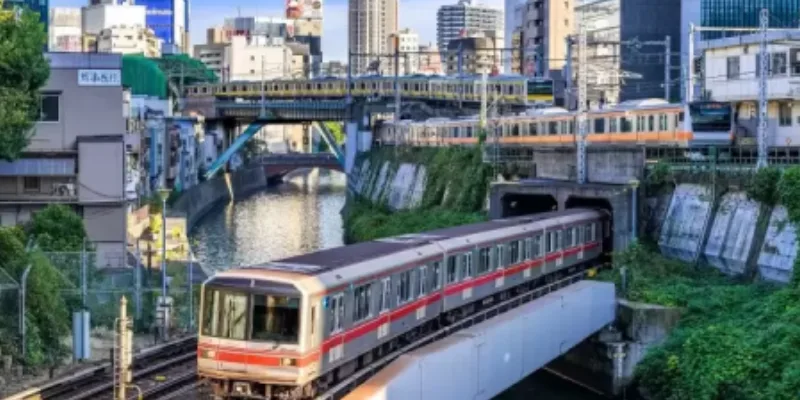
The “Invisible” Factors: Why the Listing Might Be Wrong
While the 80-meter rule provides consistency, it is a theoretical measurement that assumes a flat, unobstructed path. In the real world, several factors can turn a “5-minute walk” into a 10-minute journey. When searching for a Japan Tokyo apartment rent, you must account for these variables.
Traffic Signals and Crossings
The legal standard does not include time spent waiting at stoplights or train crossings. In central Tokyo, where traffic volume is immense, a single long signal at a major intersection can add 90 to 120 seconds to your commute. Furthermore, some ground-level train tracks feature “unopened crossings” (akazu no fumikiri) where the gates stay closed for long periods during peak hours, significantly delaying your access to apartments in Tokyo Japan.
Topography and Elevation
The standard 80-meter-per-minute pace assumes flat terrain. However, Japan’s geography is famously hilly.
- Slopes (Saka): Areas like Azabu-juban or Kagurazaka have steep inclines. Walking up a hill naturally reduces your speed, yet real estate agents still list the distance as if it were flat ground.
- Staircases: Real estate standards measure pedestrian overpasses and outdoor public stairs by their horizontal length, meaning they effectively ignore the physical effort and time spent climbing them in the “minutes-to-station” count.
Station Depth and Exit Locations
The “station” in a listing refers to the nearest official exit, not the ticket gate or the platform.
- Subway Depth: The Toei Oedo Line, for example, is buried over 40 meters underground in some areas. It can take 5 minutes just to navigate the escalators from the station entrance to the platform.
- Large Hubs: In massive terminals like Shinjuku Station, which has over 200 exits, being “5 minutes from the station” might place you on the opposite side of the specific train line you need, resulting in a much longer total commute.
Economic Value: The “Station Proximity” Premium
In Japan, Walking distance to train stations is the primary driver of property value. This is especially true for apartments in Tokyo Japan, where public transit is the primary mode of transportation.
The Rent Hierarchy
Rents in Japan typically follow a predictable curve based on walking minutes.
- The Premium Zone (Under 5 Mins): These properties are the most sought after by busy professionals and frequent travelers. They maintain the highest occupancy rates and command premium prices.
- The Golden Zone (5 to 10 Mins): This is considered the ideal balance. It is close enough for convenience but far enough to avoid the noise and congestion directly adjacent to a station hub.
- The Savings Zone (Over 15 Mins): Rent prices drop significantly once a property exceeds a 15-minute walk. These are excellent for those who work from home or are willing to use a bicycle.
Investment Stability
If you are looking at apartments in Japan as a long-term investment, proximity to a station is your best protection against market volatility. Properties within a 7-minute walk of a major line (like the Yamanote Line) rarely experience significant drops in value, even as the building structure ages, because the demand for that specific location is perpetual.
ARealty: Your Professional Partner for Apartments in Japan
Selecting the right apartment for rent Japan requires more than just reading a flyer; it requires a deep understanding of the local urban fabric. ARealty is a premier real estate and marketing specialist dedicated to helping international residents find their ideal home in Japan.
At ARealty, we understand that for a newcomer, a “10-minute walk” can be the difference between a pleasant morning and a stressful commute. Our team of experts provides:
- Real-World Verification: We don’t just trust the listing; we physically walk the routes to identify hills, signals, and lighting conditions.
- Neighborhood Insights: We help you find apartments in Tokyo Japan that are near essential amenities like supermarkets, medical clinics, and quiet parks.
- Multilingual Support: We handle all negotiations and legal paperwork, ensuring your transition into a Japan Tokyo apartment rent is seamless and professional.
Are you ready to find a home that fits your lifestyle? Contact ARealty today to receive a curated list of properties within a 5-minute walk of Tokyo’s major transit lines. Would you like a consultation on which neighborhoods best fit your office commute?
Strategies for Evaluating Your Commute Like an Expert
When comparing different apartments in Tokyo Japan, use these three professional strategies to ensure the Walking distance to train stations meets your expectations.
The “Night and Day” Walkthrough
A path that looks vibrant and safe at 2:00 PM might feel isolated and dark at 11:00 PM. Always walk the route from the station to your potential apartment for rent Japan after sunset.
- Check for Streetlights: Ensure the route is well-lit and passes through populated areas.
- Observe Businesses: Are there 24-hour convenience stores or late-night pharmacies along the way?
The Bicycle and Parking Audit
If an apartment in Japan is more than 12 minutes away, check for “Churinjyo” (bicycle parking) at both the station and the apartment.
- Station Parking: Many Tokyo stations offer automated underground bike storage. This can turn a 20-minute walk into a 6-minute ride.
- Apartment Parking: Confirm if the building has a designated bike area, as parking on the street can lead to your bicycle being impounded by city authorities.
The “Platform-to-Door” Calculation
Don’t just measure from the station entrance. Time yourself from the actual train platform to the apartment door. This “Total Commute” figure is the most honest representation of how much time you will spend traveling each day. For a Japan Tokyo apartment rent, a “10-minute” listing often translates to a 15-to-18-minute total journey.
Walking Experiences in Different Tokyo Wards
The experience of Walking distance to train stations varies wildly depending on which part of the city you choose for your apartments in Tokyo Japan.
- Chuo-ku and Chiyoda-ku: These central business districts are very flat and feature wide, well-maintained sidewalks. The 80-meter rule is highly accurate here, making it ideal for those who prefer a predictable walk.
- Setagaya-ku: Known for its charming, narrow residential streets. While the walks are peaceful, the lack of sidewalks in some areas and the winding nature of the roads can make a 10-minute walk feel longer.
- Minato-ku: This is the most prestigious ward for a Japan Tokyo apartment rent, but it is also the hilliest. Be prepared for steep inclines if you live in neighborhoods like Roppongi, Akasaka, or Azabu.
Conclusion
The search for the perfect apartment for rent Japan is ultimately a search for balance. While the Walking distance to train stations is the most powerful indicator of convenience and value, it is not the only factor. A property that is slightly further away might offer a larger layout, a newer building, or a more peaceful environment.
By understanding the technical “80-meter rule,” accounting for environmental “invisible minutes,” and utilizing the professional expertise of ARealty, you can navigate the Japanese real estate market with confidence. Whether you are seeking a high-energy life in a central Tokyo hub or a quiet residence in the suburbs, knowing exactly how far you are from the station is the first step toward a successful life in Japan.
Don’t leave your commute to chance. Reach out to ARealty today and let us find you the perfect apartments in Tokyo Japan that truly match your pace of life.

Real estate advisor at Arealty Japan, specialising in helping foreign residents navigate the Tokyo and Osaka rental markets. Lucy has guided hundreds of international renters — from Working Holiday visa holders to corporate relocations — through Japan’s apartment application process. Her writing draws on firsthand experience with landlord screening, guarantor companies, and foreigner-friendly listings across all 23 Tokyo wards and major Kansai cities.