
Why you need mats in a Japanese rental
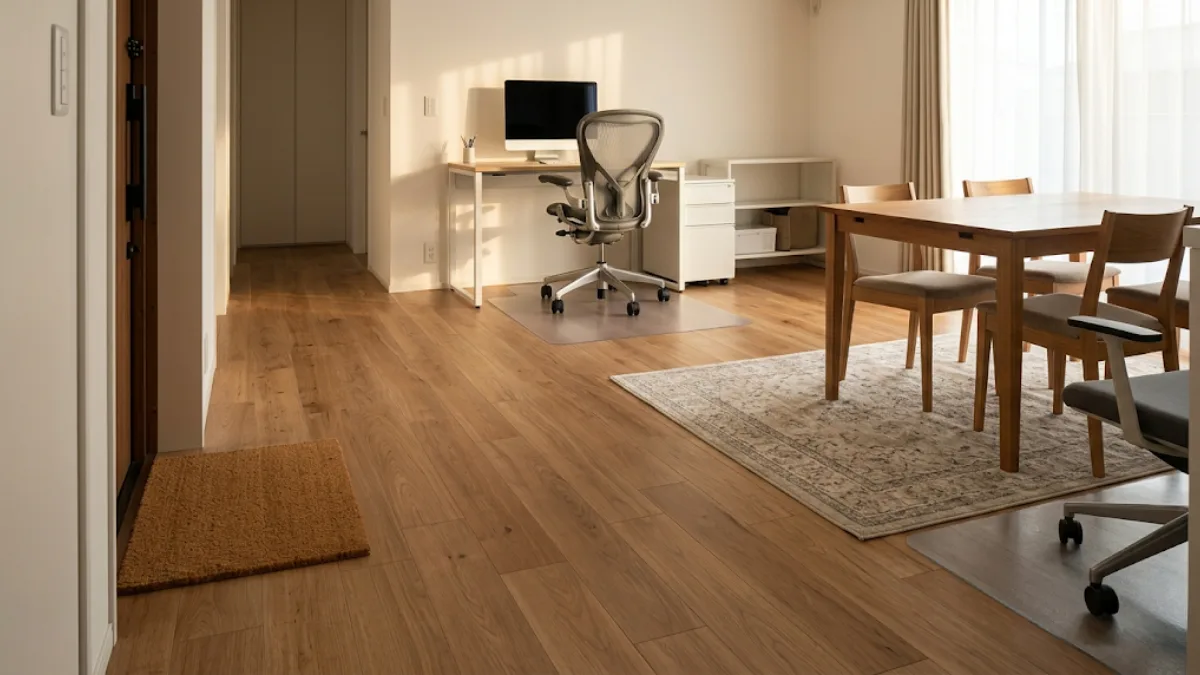
In many Japan rentals, the floor looks durable until you actually start living on it. A dining chair gets pulled out twice a day. A desk chair rolls over the same spot for hours. A wet umbrella sits by the entrance. Over time, those small habits create visible wear.
That is why Rental floor mats Japan renters choose are not only about decoration. They solve three practical problems at once: scratch prevention, winter comfort, and noise reduction. A well-placed mat can protect the floor from friction, make hard flooring feel warmer, and soften everyday impact noise from chairs, footsteps, and dropped items.
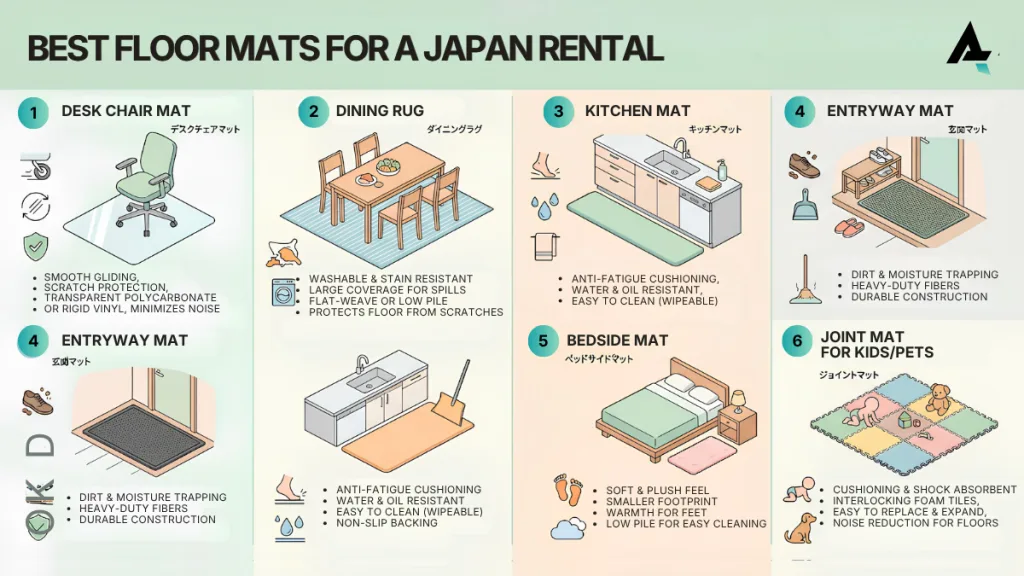
The better rule is simple: targeted mats work better than one big carpet. You do not need to cover the whole apartment to get good protection. In most homes, the real damage zones are under desk chairs, under dining chairs, beside the bed, in the kitchen, and at the entrance.
There is also a cost reason to act early. If a floor is damaged through avoidable use, that can become part of your move-out discussion. A few mats and furniture pads cost much less than arguing over scratches later.
What kind of floor do you have?
Before buying anything, identify the floor.
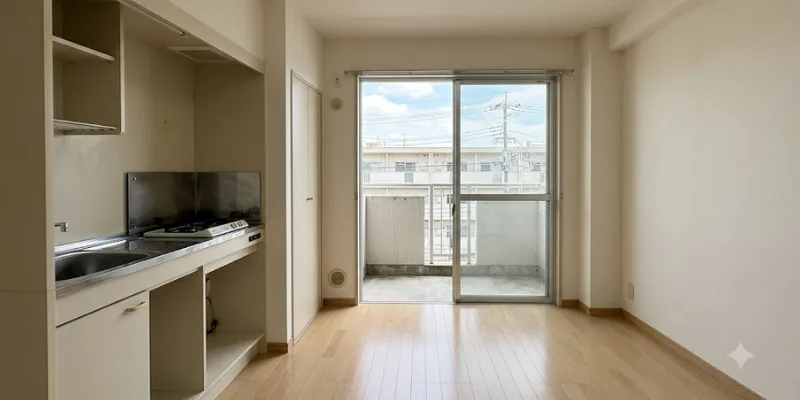
The most common type in a Japan rental is engineered wood flooring (複合フローリング). In practice, this covers most ordinary rentals, including newer apartments with a clean, modern finish. It looks like wood, feels firm, and is easier to mass-install than solid timber.
Solid wood flooring (無垢) is rarer and usually appears in more premium or design-led homes. It feels warmer and more natural, but it is also more sensitive to moisture and pressure.
Cushion floor (CF / クッションフロア) is common in kitchens, toilets, and utility areas. It is softer, more water-friendly, and usually lower-risk for daily spills.
Then there is tatami. A tatami mat room is a different category entirely, so it is better handled in a dedicated guide rather than treated like standard flooring.
A quick way to tell them apart:
- Engineered wood: wood-look planks, smooth finish, harder feel
- Solid wood: richer grain variation, warmer feel, more premium
- Cushion floor: softer, vinyl-like surface, often in wet zones
- Tatami: woven surface, soft underfoot, clearly traditional
Rug vs carpet vs mat — when to use what
| Type | Best use | Why it works |
| Rug | Living room, bedroom | Flexible coverage, easy to move, better for comfort |
| Carpet | Rare in rentals | Broad coverage, but higher cleaning burden |
| Chair mat | Under desk chair | Highest ROI for scratch prevention |
| Entrance mat | 玄関 | Dirt and moisture control |
| Kitchen mat | Kitchen front | Spill and drop protection |
| Joint mat (ジョイントマット) | Kids or pet zones | Cushioning, partial replacement, easier spot cleaning |
A rug for rental japan setups is usually the best middle ground. It protects the floor without locking you into full-room maintenance.
A full carpet can work, but it adds cleaning burden and traps more dust. In most Japan rentals, that is more effort than renters actually want.
A chair mat under a desk chair is often the best-value purchase in the whole apartment. If you work from home, this one item can prevent the fastest type of repeated floor wear.
Shopping guide by use case
Here is a practical buying guide by room and lifestyle.
| Use case | Best product | Budget | Why |
| Remote worker desk | Chair mat | ¥3,000–8,000 | Best protection against repeated caster-wheel friction and one of the highest-ROI floor-protection items in a rental. |
| Couple with dining table | Rug or area mat | ¥5,000–15,000 | Helps reduce scratches from chair movement and softens some everyday impact noise. |
| Family with toddler | Joint mat tiles | ¥3,000–10,000 | Adds cushioning, helps with small impact noise, and lets you replace only one damaged section if needed. |
| Pet owner | Washable rug | ¥4,000–12,000 | Easier to clean, better for fur and small accidents, and more practical than a full carpet for regular maintenance. |
| Bedroom | Bedside mat | ¥2,000–5,000 | Adds warmth and softness in winter without covering the whole room. |
| Entryway | 玄関マット / entryway mat | ¥1,000–3,000 | Helps stop dirt and moisture at the entrance before they spread across the flooring. |
| Kitchen | Kitchen mat | Varies | Useful for spill protection and long standing comfort, especially in front of the sink or stove. |
The right apartment floor mat Japan renters choose should match the actual pressure point in the room. Buy for the problem first, then for the look.
The backing material trap
Most rug problems in Japan come from the underside, not the top.
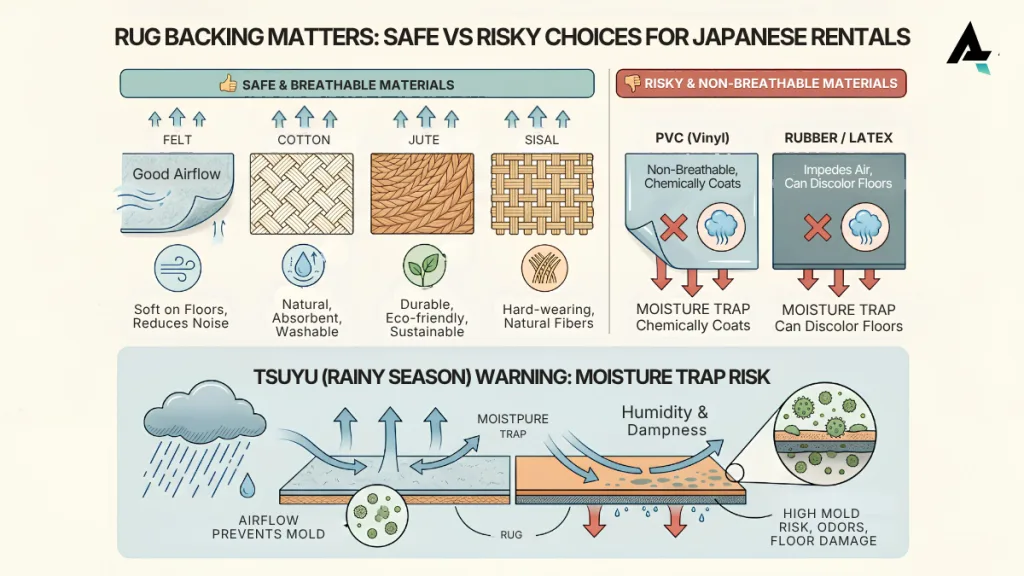
PVC and rubber backings can trap moisture, especially in humid rooms or during June–July, when the tsuyu rainy season makes indoor dampness harder to ignore.
Felt and cotton backing are usually safer because they breathe better and hold less moisture against the floor.
Natural rugs such as jute, sisal, or wool tend to offer the best airflow, although they still need regular lifting and cleaning.
Be careful with “anti-slip backing.” A light anti-slip layer can be useful, but thick sealed rubberized backing is riskier in humid apartments. If you need anti-slip support, a removable mesh underlay is often safer than a fully sealed synthetic underside.
Mold prevention checklist:
- Vacuum rugs weekly
- Lift and air them at least once a month
- Do not leave damp mats trapped under low furniture
- Increase ventilation during humid months
- Check the floor underneath after rainy periods
Installation and placement rules
How you place a mat matters almost as much as the mat itself.
For area rugs that slide, a light 養生テープ workaround can help around the edge area if used carefully on the rug side or over a protective layer, not directly in a risky way on delicate flooring.
Use this schedule:
- Weekly: vacuum rug and floor edge
- Monthly: lift rug and air the floor underneath
- Seasonally: do a deeper clean and inspect for hidden moisture
Combine mats with furniture pads. A rug helps with broad protection, but it does not replace felt pads under chairs, tables, or shelves. A mat is not a substitute for proper contact-point protection.
For robot vacuums, choose rugs that are heavy enough to stay flat. Lightweight rugs with curled edges are more likely to fold or jam.
For tatami mat room setups, avoid thick heavy mats unless the product is clearly intended for tatami-safe use. Tatami needs airflow and can mark more easily under trapped pressure.
Sizing and measurement
This section covers tatami mat measurement without replacing a full tatami guide.
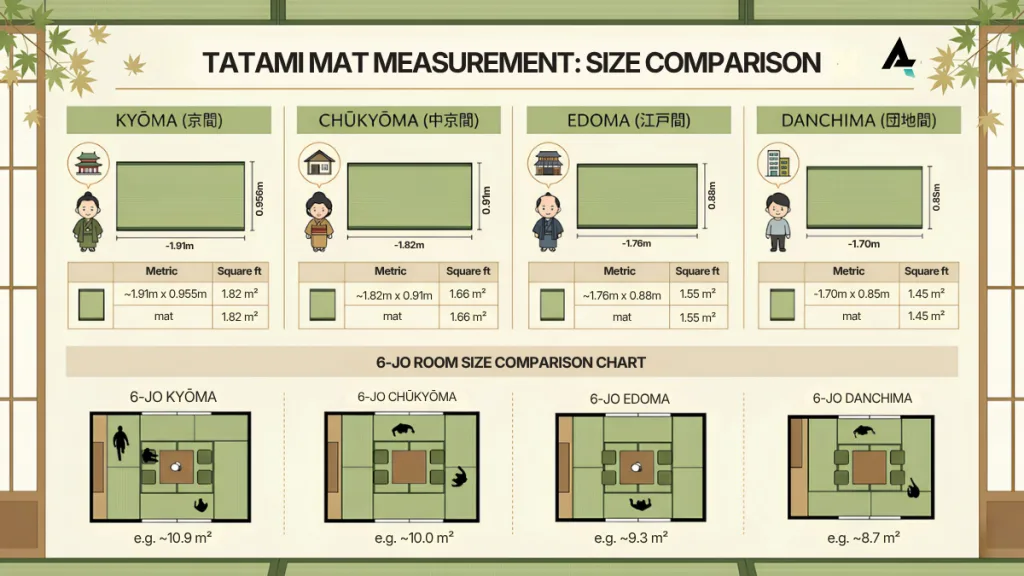
Tatami-based room labels are useful, but they are not perfectly standardized across Japan. These are the four common sizes:
| Type | Size per mat |
| Edoma (江戸間) | 88 × 176 cm |
| Kyōma (京間) | 95 × 191 cm |
| Chūkyōma (中京間) | 91 × 182 cm |
| Danchima (団地間) | 85 × 170 cm |
That is why a 6畳 room can vary, roughly 9.7–10.9 m² depending on the region and standard used.
Why this matters: if you buy a rug or floor covering based only on “6-jo,” you may end up with the wrong size. Always measure the real usable floor area before buying.
Move-out protection
Keep this part simple.
Four quick rules:
- Lift mats before move-out and check the floor underneath
- Photograph any hidden areas once the rug is removed
- Clean dust and moisture before the final inspection
- Keep proof that you used floor protection if damage is questioned
5 mistakes renters make
1. Leaving a rug down for 6+ months without lifting it
Even a good rug can create hidden moisture trouble if it never gets aired.
2. Using PVC backing in humid rooms
This is especially risky during June and July.
3. Buying cheap rugs with weak anti-slip performance
A sliding rug causes its own friction problem.
4. Waxing no-wax floors without checking the finish
Some renters think wax is automatic protection. It is not. In many newer rentals, the floor is UV-cured at the factory. These floors often have a very even, sealed-looking finish and are usually described as no-wax or maintenance-light. Older wax-treated floors are more likely to accept periodic wax. If you are unsure, test in an invisible corner only after checking with management.
5. Forgetting furniture pads
A mat protects the area, but direct furniture pressure still needs its own buffer.
FAQ
Will my landlord deduct from my deposit if my rug damages the floor?
Possibly, if the damage looks avoidable rather than normal wear.
Are PVC mats safe for Japanese rentals?
Not always. They are the main moisture-risk option in humid rooms.
Can I use a Roomba on a thick rug?
Yes, if the rug is heavy enough and the edge stays flat.
How often should I lift and air my rugs?
Monthly is a good minimum. More often during tsuyu.
Do floor mats really help with noise complaints?
They help with impact and friction noise, especially in dining or play zones, but they do not solve every structural sound issue.
Where can I buy rental-safe rugs in Japan?
Nitori, MUJI, and Amazon Japan are the easiest starting points.
Talk to Arealty
Arealty helps foreign renters think about flooring before move-in, not only after a scratch appears.
That means comparing floor type, room layout, and lifestyle fit together. A renter working from home may need chair protection from day one. A family with children may need better cushioning and easier cleaning. A couple who prefers a tatami mat room may want a different approach entirely.
Need help finding a Japan rental with flooring that matches your lifestyle? Arealty helps foreign renters compare apartment interiors, understand floor materials, and choose homes that are easier to protect and maintain.

As a real estate professional with 10 years of living and working in Japan, I write from the intersection of property expertise and lived experience. My perspective is rooted not only in an understanding of the Japanese rental market, but also in the nuances of building a life here as a foreigner, where practical decisions often carry personal meaning.
I see a home as more than a place to stay. It is part of how we move through the city, shape our routines, and create a sense of ease in everyday life. That is why my writing goes beyond surface-level advice, offering guidance that is informed, considered, and attuned to both lifestyle and reality. My goal is to make renting in Japan feel less overwhelming, more intentional, and ultimately more human.