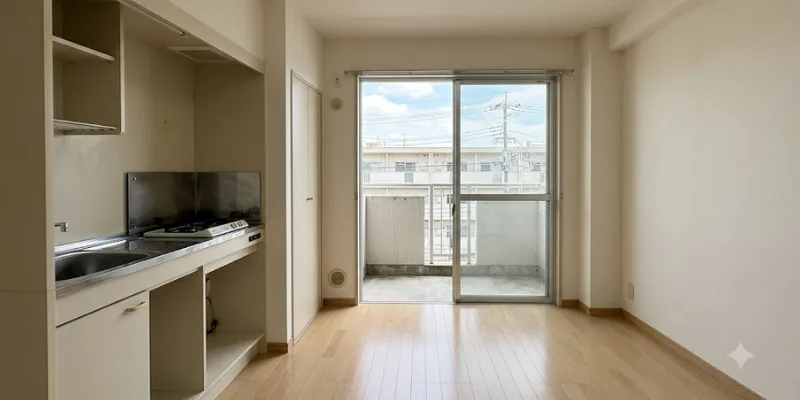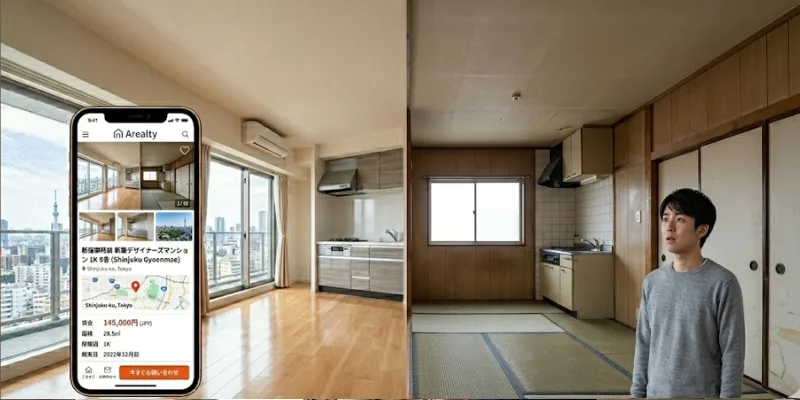

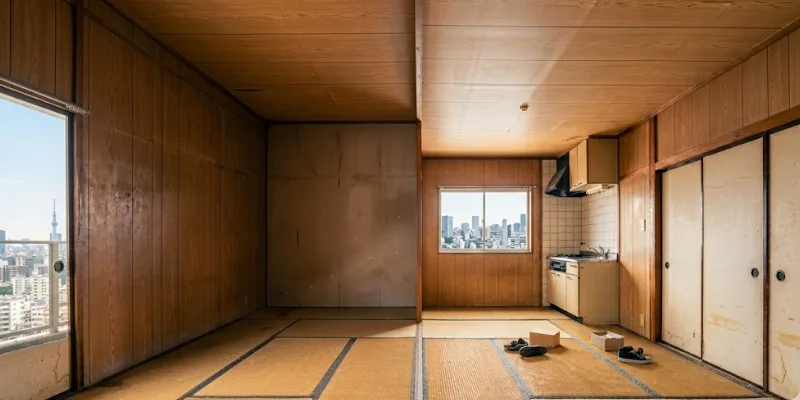
You found a listing. The photos show a bright apartment with a modern kitchen, generous windows, and clean white walls. The price looks reasonable. You arrange a viewing, walk in, and the room is noticeably darker, smaller, and older than what you saw online.
This is not a rare complaint. It comes up regularly enough in Japan that it is worth understanding why it happens — and what questions to ask before you apply for anything.
If you are currently searching for an apartment, browse Tokyo listings on Arealty — where each listing notes whether photos show the actual unit and whether a video walk-through is available for overseas renters. Or read on first to understand the problem properly.
Why Listing Photos in Japan Often Do Not Show the Real Room
Sample Unit Photos Are Standard Practice (サンプル写真)
Many apartment buildings in Japan are developed by a single company that constructs multiple nearly identical units. When the building is first listed, the developer photographs one representative unit — a sample (サンプル写真, sanburu shashin) — and uses those images across all listings for similar units in the building.
The problem is that individual units age differently. A unit on the third floor with southern exposure gets good light. One on the first floor facing a neighbouring wall gets very little. One was renovated last year; another still has its original 1990s fittings. The listing shows the same bright, renovated sample room for all of them. This is disclosed — in Japanese, in small text below the photo — but a foreign renter browsing listings they cannot read fully will often miss it entirely.
Wide-Angle Photography Makes Small Rooms Look Larger
Wide-angle interior photography is standard in real estate globally, but the effect is especially pronounced in Japan’s small apartments. A 20 sqm 1K room photographed with a 16mm lens can look like a spacious studio. The same room in person feels considerably tighter.
Floor plan measurements in Japanese listings are accurate and legally required to be — but a number like “20.5 sqm” is abstract without a reference point. If you are not sure how to read a Japanese floor plan or what the measurements translate to in practice, the Japanese apartment floor plan guide is worth reading before you shortlist anything.
Model Unit Photos Are Not the Unit You Are Renting
Some newer buildings show photos of a fully furnished model unit — styled with furniture, plants, and carefully arranged décor. The actual unit is an empty shell. This is disclosed in the listing, but only in Japanese.
Listings Are Not Always Kept Current
Some listings circulate on portals for months without being updated. A unit photographed after a 2019 renovation may now look quite different. Some platforms do not require landlords or agencies to refresh photos when a unit turns over. The photos you are looking at may reflect a condition that no longer exists.
This Is Systemic, Not a Scam
The photo practices above are legal in Japan and standard across the industry. They are not attempts to deceive in the way that term implies. They are the result of how the Japanese real estate listing system evolved — building-level photography, model units, and sample disclosures that assume the viewer can read Japanese and understands the conventions.
For Japanese renters, this is largely fine because the system assumes you will view the unit in person before applying. The viewing is where you confirm the actual room. The listing photos are to get you through the door.
For foreign renters searching from overseas, the assumptions break down. If you are in Vietnam, Australia, or the UK trying to secure housing before landing in Tokyo, you cannot view in person, you may not read the Japanese disclaimer text, and you are making decisions based on images that may not represent what you will walk into on move-in day.
This is one of the main reasons Arealty’s guide to renting from overseas recommends not committing to an apartment — or paying any upfront costs — before a video walk-through has been completed.
The Questions to Ask Before You Apply
Before committing to an application:
- Are these photos of the specific unit or a representative unit? A trustworthy agency will answer plainly. “These are sample photos — we can arrange a video walk-through of the actual unit” is acceptable. Vague reassurance without clarification is worth pressing on.
- When were the photos taken? A 2020 photo for an unrenovated unit tells you much less than a recent one.
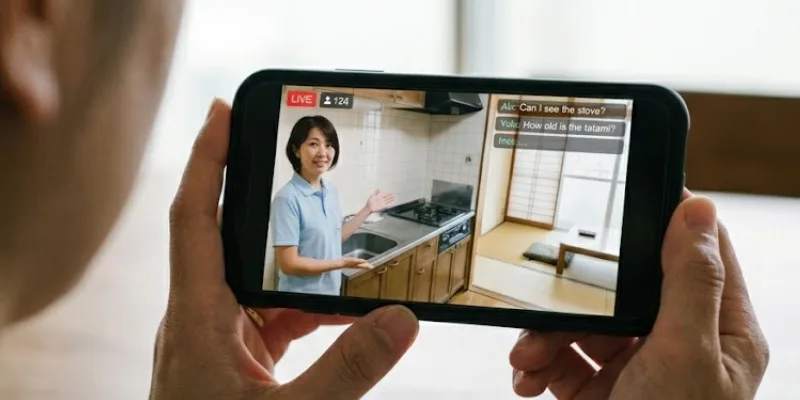
- Can I get a video walk-through? For overseas renters, this has become a standard request. A short video of the actual room — bathroom, storage, views from windows, natural light — is far more useful than any styled photograph. If an agency cannot or will not provide this, that is meaningful information.
- Which floor and which direction does the unit face? 南向き (minami-muki, south-facing) gets the best natural light in Japan. 北向き (kita-muki, north-facing) can be significantly darker than photos suggest. First-floor units often have less light and less privacy than the listing implies.
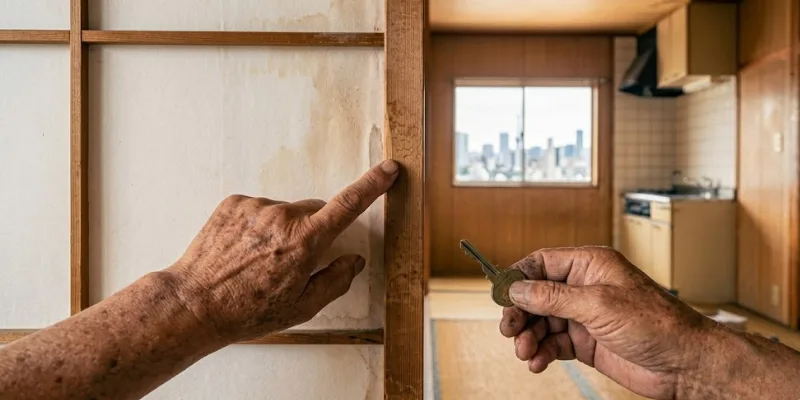
- Has the unit been recently renovated? Ask specifically about kitchen and bathroom — these are the areas that age most visibly in older Japanese buildings, and where the gap between photo and reality tends to be widest.
Why Japan Designed Viewing Before Application
The structure of the Japanese rental process — view first, then apply — exists to handle the gap between listing and reality. Both sides are supposed to see and confirm the unit before either commits. The application and contract come after the viewing, not before.
For renters already in Japan this works well. For overseas renters it creates a problem — you cannot view before arriving, but you also cannot arrive without somewhere to stay. The practical options:
- Request a video walk-through — most reputable agencies provide this as standard for overseas renters. Not a perfect substitute for in-person, but far better than photos alone.
- Have a trusted contact view on your behalf — a friend or colleague in Japan doing an in-person proxy viewing is worth arranging if possible.
- Plan for short-term housing on arrival — spending the first 2–4 weeks in a monthly mansion or share house while you view apartments in person consistently produces better outcomes than committing from overseas. It costs more per month temporarily, but eliminates the risk of spending ¥400,000+ in move-in costs on a unit that does not match expectations. See the short-term Tokyo rental guide for options.
For a full breakdown of how to approach the apartment search before arriving in Japan, the overseas renter guide covers the step-by-step process including video walk-through requests and document preparation from abroad.
Red Flags Worth Knowing
- No photos of the bathroom or kitchen: these rooms reveal the most about condition and age. If only the living space is shown, ask why.
- Below-market rent with no obvious explanation: first-floor unit, north-facing, older building, or a layout issue are common reasons. Ask specifically what the trade-off is.
- Listing has been available for several months: in a tight market like Tokyo, a unit that has not moved in 90 days often has a reason. Worth asking.
- “Book now or lose it” pressure: legitimate Japanese rentals do not require instant decisions. Pressure to apply without viewing is a signal to slow down.
For a broader checklist of what to verify before signing any Tokyo lease, see our step-by-step guide to renting in Japan as a foreigner.
How Arealty Handles This
Most portals aggregate what landlords submit without independent verification of whether photos reflect the actual unit. When a renter is disappointed after moving in, the portal has no role in resolving that.
Arealty confirms with the managing agency or landlord whether listing photos show the specific unit or a sample unit. For overseas renters, we arrange video walk-throughs as a standard part of the inquiry — not a special request. Listings note clearly when actual room condition should be confirmed before applying.
The reason is practical: a renter who moves into an apartment that matches their expectations is a better outcome than one who spends ¥400,000 in move-in costs on a unit they are disappointed with from day one. Browse current Tokyo listings on Arealty to see listings with confirmed photo status — or visit Arealty to get in touch with our advisory team before you start your search.
Further Reading
- How to rent an apartment in Japan from overseas
- Short-term rental options in Tokyo when arriving without a long-term apartment
- Japanese apartment floor plans — what the measurements actually mean
- Renting in Japan as a foreigner — step by step
- No-deposit apartments in Tokyo — what is available and what to watch out for
- Working Holiday visa rental guide — documents, budget, guarantors
- Average apartment rent in Tokyo — 2026 data

Real estate advisor at Arealty Japan, specialising in helping foreign residents navigate the Tokyo and Osaka rental markets. Lucy has guided hundreds of international renters — from Working Holiday visa holders to corporate relocations — through Japan’s apartment application process. Her writing draws on firsthand experience with landlord screening, guarantor companies, and foreigner-friendly listings across all 23 Tokyo wards and major Kansai cities.