
Flexible lease options in Japan for foreign renters cover a wider range than most guides explain — and choosing the wrong type for your situation is one of the most common and expensive mistakes in the Japan rental market. The decision is not simply “short-term vs. long-term.” It is a question of which specific contract structure matches your visa status, income stability, and how long you are actually likely to stay.
This guide covers every flexible lease option available in Japan, what each actually costs, and the framework for deciding which fits your situation. For specific guidance by visa type, the Working Holiday lease decision guide and the student visa screening guide go deeper on those specific cases. Browse current flexible-lease listings in Tokyo on Arealty, or read on for the full framework.
Why a Flexible Lease in Japan Matters More for Foreign Renters
Most Japanese renters sign a standard 2-year lease and renew it — a flexible lease in Japan for foreigners serves a very different set of needs. Their visa status, employment, and residence plans are stable. The standard system was built for them.
Foreign renters in Japan face a different set of variables. A Working Holiday visa expires in 12 months. A student visa runs on an academic calendar. A work visa tied to a specific employer can change with a job change. A tourist visa cannot enter any standard lease at all. Each of these situations creates a mismatch between the standard 2-year lease and the foreign renter’s actual planning horizon.
The consequences of getting this wrong are financial and practical. Sign a 2-year lease and leave at month 10 — you pay 1–2 months of early termination penalty plus potential deposit forfeiture. Stay in monthly mansion housing longer than necessary — you pay ¥30,000–¥60,000 per month more than a private lease would have cost. Understanding every flexible lease option in Japan for foreigners — not just the standard two poles of “2-year lease” or “monthly mansion” — is where most foreign renters find a better path.
The Four Main Options in Japan
1. Standard 2-Year Lease (普通借家契約, Futsu Shakuya)
Lowest monthly rent. Highest commitment. Automatic renewal at end of term. Early termination penalty typically 1–2 months’ rent.
2. Fixed-Term Lease (定期借家契約, Teiki Shakuya)
Defined end date — typically 6 months, 1 year, or 2 years. Does not auto-renew. Monthly rent 5–15% higher than a standard lease for the same unit. Early termination terms vary by contract — some have no penalty with 1-month notice; others mirror standard lease penalties. Increasingly available in buildings targeting international renters.
3. Monthly Mansion (マンスリーマンション)
Furnished, all-inclusive (rent + utilities + Wi-Fi + furniture), 30-day minimum. No long-term commitment. Monthly cost typically 40–70% higher than a private apartment of comparable size. No screening or guarantor required for most providers.
4. Share House (シェアハウス)
Furnished, semi-private (own bedroom, shared common areas), 1–3 month minimum contracts. ¥45,000–¥80,000/month all-inclusive in Tokyo. Minimal documentation required. Social environment; privacy is limited.
Fixed-Term Lease — The Flexible Japan Option Most Foreign Renters Miss
The fixed-term flexible lease in Japan for foreigners is the option most renters do not know exists, and the one that resolves the most common flexible lease problem: you want a private apartment at private-apartment prices, but you cannot commit to a full 2-year standard lease.
How it works: The lease has a defined end date. At the end of that term, the lease simply expires — the landlord gets their unit back without the standard renewal obligations, and you leave without penalty (assuming no damage). There is no automatic continuation. If both parties want to continue, they sign a new fixed-term lease.
Why landlords offer it: Fixed-term leases exist because some properties have defined plans — a landlord planning to sell or renovate, for example — and because some landlords in international-tenant buildings prefer them as a way to manage shorter-stay residents more cleanly.
What it costs: Monthly rent on a fixed-term lease runs approximately ¥5,000–¥15,000/month more than a standard lease for the same unit. Over a 12-month stay, this premium is ¥60,000–¥180,000 — substantially less than the cost of a monthly mansion for the same period.
Early termination: Varies by contract. A fixed-term lease with a “中途解約可” (chuto kaiyaku ka — early cancellation permitted) clause and 1-month notice is the most flexible version. A fixed-term lease without this clause may require paying the remainder of the term. Read this clause carefully before signing anything. For the full cost comparison vs standard and short-term options, see the short-term vs 2-year lease guide.
Best for: Working Holiday holders who want private apartment living but cannot commit to 2 years, students on fixed enrollment terms of 1–1.5 years, corporate rotations with defined assignment lengths.
Monthly Mansion — The Flexible Japan Lease Option for Foreigners With Maximum Flexibility
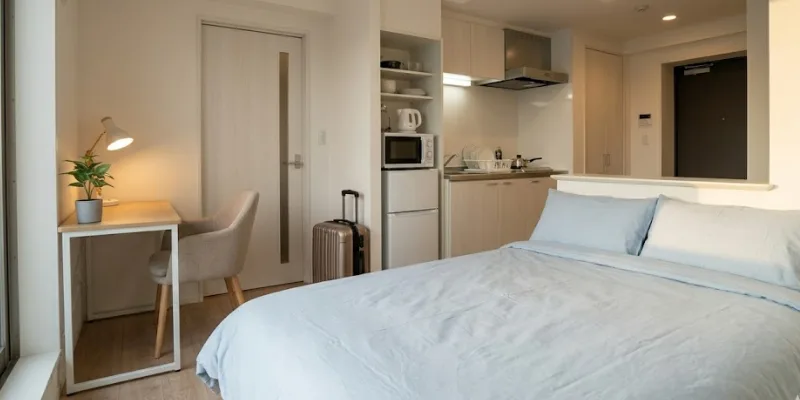
Monthly mansions are Japan’s furnished short-stay apartment product. They are the correct option when you need somewhere to live immediately, with zero commitment, zero documentation burden, and zero upfront cost beyond the first month.
What they include: furnished unit, all utilities, Wi-Fi, and building amenities. You bring clothes and personal items. Nothing else is needed.
What they cost: ¥90,000–¥180,000/month in Tokyo for a 1K unit; ¥120,000–¥250,000/month for 1LDK. In Osaka Kita-ku, ¥70,000–¥140,000/month for 1K. In Kanagawa suburban areas, ¥65,000–¥110,000/month.
When they make sense:
- Arriving in Japan without documents ready for a standard application
- Bridge housing while your private apartment application processes
- Tourist visa — the only legal long-stay option for tourist visa holders
- Short assignments of 1–3 months where total cost is lower than private lease + setup
When they do not make sense: stays longer than 3–4 months, where the monthly premium over a private apartment compounds into a large total overspend. For the break-even calculation, see the Working Holiday lease comparison. For current Tokyo short-term options, the Tokyo short-term rental guide has current availability.
Share House — Lowest Entry Point, Social Trade-off
Share houses are the entry-level flexible option in Japan — lowest barrier to entry, lowest monthly cost, least privacy. They are the right choice for a specific type of renter in a specific situation, and the wrong choice for most others.
What they cost: ¥45,000–¥80,000/month all-inclusive in Tokyo (¥35,000–¥65,000 in Kanagawa and Osaka). This is the lowest monthly cost of any flexible option.
What you give up: a private living space. You have your own bedroom; the kitchen, bathroom, and common areas are shared. Building quality and management vary enormously across share house providers — from purpose-built modern buildings to converted older houses with minimal maintenance.
When they make sense:
- First arrival in Japan with no employment, no documents, no savings for private apartment upfront costs
- Working Holiday holders with income under ¥150,000/month
- Students on strict budget who will be out most of the day and use the room primarily for sleeping
- Renters who actively want a social environment and network-building in Japan
When they do not make sense: anyone who values quiet, privacy, or control over their home environment. The cost savings are real but the lifestyle trade-off is significant.
Standard 2-Year Lease — When Commitment Is Worth It
Despite the flexibility theme of this guide, the standard 2-year lease is still the right answer for a significant portion of foreign renters. The criteria:
- Your visa is stable for 2+ years (work visa with established employer, spouse visa, PR)
- Your employment and income are documentable and stable
- You have no credible plans to leave Japan in the next 12 months
- You can cover the upfront costs (¥250,000–¥500,000 depending on rent level)
If all four of these apply, the standard lease gives you the lowest monthly rent of any option, the most stable and private living environment, and the lowest total cost over 2 years. The flexibility you give up is real — early termination is costly — but if your situation is stable, you are not planning to use that flexibility anyway.
Cost Comparison: What Each Option Actually Costs Over 12 Months
Assumption: 1K apartment in outer Tokyo, standard equivalent rent ¥80,000/month.
| Option | Monthly cost | Upfront | 12-month total | Early exit cost |
| Standard 2-year lease | ¥80,000 | ¥280,000 | ¥1,240,000 | ¥80,000–¥160,000 |
| Fixed-term lease (1yr) | ¥88,000 | ¥280,000 | ¥1,336,000 | ¥0–¥88,000 |
| Monthly mansion | ¥130,000 | ¥0–¥30,000 | ¥1,590,000 | ¥0 |
| Share house | ¥58,000 | ¥50,000–¥100,000 | ¥746,000–¥796,000 | ¥0–¥58,000 |
Standard lease upfront includes deposit (1 month), first month, guarantor fee, and insurance. Monthly mansion upfront is first month only. Share house upfront includes registration fee and deposit.
The share house total cost is dramatically lower — but reflects shared living, no privacy, and the other trade-offs described above. For a private living space, the fixed-term lease at 12 months costs approximately ¥350,000 less than monthly mansion for the same period.
Flexible Lease Japan: Decision Matrix by Visa Type and Situation
| Visa / Situation | Recommended option |
| Work visa, stable employment, 2+ year plan | Standard 2-year lease |
| Working Holiday, job confirmed, 12-month plan | Fixed-term 1-year lease |
| Working Holiday, no job yet on arrival | Share house → reassess month 2–3 |
| Student visa, 1–2 year course | Fixed-term lease matching enrollment period |
| Student visa, under 6 months | Monthly mansion or share house |
| Tourist visa, any duration | Monthly mansion only |
| Corporate relocation, defined assignment length | Fixed-term lease matching assignment |
| Uncertain — may stay or leave at 6–12 months | Fixed-term with early cancellation clause |
For visa-specific application strategy, see the Working Holiday visa rental guide and student visa screening guide.
What to Ask Before Signing Any Lease
Regardless of which option you choose, these questions protect you before you commit:
Fixed-term lease: Does this contract include a 中途解約可 clause? What is the required notice period? What happens if I need to leave before the end date?
Monthly mansion: Is the quoted price all-inclusive (utilities, Wi-Fi, furniture)? What is the minimum stay? What is the cancellation notice period?
Share house: Who manages the property? How are disputes between residents handled? What is the bathroom-to-resident ratio? When were the common areas last renovated?
Standard lease: What is the exact early termination penalty? Is key money required? What restoration standards will be applied at move-out?
Contact Arealty before signing any flexible lease in Japan as a foreigner — a 15-minute conversation at this stage prevents the most common and expensive mistakes.
Further Reading
- Working Holiday Japan — short-term vs 2-year lease cost comparison
- Student visa Japan — apartment screening and landlord requirements
- Short-term rental options in Tokyo — monthly mansion and share house
- Renting in Japan as a foreigner — full step-by-step process
- How to rent before arriving in Japan — overseas application guide
- No-deposit apartments in Tokyo — zero upfront cost options
- Average apartment rent in Tokyo — set your budget before searching

Real estate advisor at Arealty Japan, specialising in helping foreign residents navigate the Tokyo and Osaka rental markets. Lucy has guided hundreds of international renters — from Working Holiday visa holders to corporate relocations — through Japan’s apartment application process. Her writing draws on firsthand experience with landlord screening, guarantor companies, and foreigner-friendly listings across all 23 Tokyo wards and major Kansai cities.