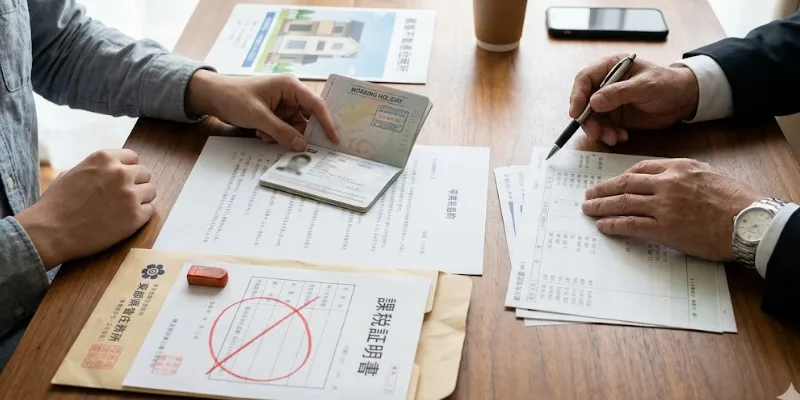

Working Holiday Japan no tax document situations block more apartment applications than any other single documentation issue. The tax certificate (課税証明書, kazei shōmeisho) — issued by the ward office and showing the previous year’s Japan income — is a standard landlord request. If you have just arrived in Japan on a Working Holiday visa, you do not have one. You may not have one for your entire stay if you did not file Japanese taxes the previous year.
This guide covers specifically what to use instead. Not general advice about the WH rental process — that is covered in the Working Holiday visa rental guide. This guide is the document-level answer: which substitutes work, with which landlords and guarantor companies, and how to present them.
Browse WH-friendly apartments on Arealty — all listings are pre-confirmed for WH visa acceptance and paired with guarantor companies that accept the documentation alternatives below.
Working Holiday Japan: Why the No Tax Document Problem Exists
Japan’s rental screening system was built around the assumption that applicants have a history of income in Japan. The standard income verification document — the tax certificate — is issued annually by the ward office and shows exactly what you earned in Japan in the previous calendar year. It is reliable, standardised, and easy for landlords and guarantor companies to verify.
Working Holiday arrivals break this assumption cleanly. You have no previous-year Japan income because you were not in Japan. Even if you have been in Japan for 6 months and have been working, your Japanese tax certificate will not exist until you file taxes in January of the following year (filing period January–March for the previous calendar year).
The result: the standard income verification document is unavailable for most of a Working Holiday stay, and landlords and guarantor companies have to decide what to accept instead. Whether they do accept alternatives — and which alternatives they accept — varies significantly. This is the variable that actually determines whether a WH applicant gets approved.
Document Substitute 1: Home-Country Bank Statements
What to provide: 3–6 months of bank statements from your home country, translated into Japanese or with a cover statement in Japanese explaining the amounts.
What landlords and hoshō gaisha check: that the balance represents financial stability — specifically, enough to cover approximately 6 months of the target rent. For an ¥80,000/month apartment, a running balance of ¥480,000+ (approximately) demonstrates the financial floor they need to see.
Translation: a full certified translation is not required by most landlords and hoshō gaisha. A one-page summary in Japanese — written by the applicant or agency, stating the bank name, account currency, average balance over the period, and what this represents — is accepted by most WH-experienced hoshō gaisha when submitted with the original statements.
Format matters: bank statements in English are readable to some hoshō gaisha; statements in other languages need at minimum a summary sheet. Arealty provides a standard bank statement summary format for overseas accounts that is accepted by the guarantor companies we work with.
Limitations: home-country bank statements work with landlords and hoshō gaisha that have WH experience. They do not work with hoshō gaisha that have a blanket policy requiring Japanese income documentation regardless of visa type.
Document Substitute 2: Employment Contract or Offer Letter
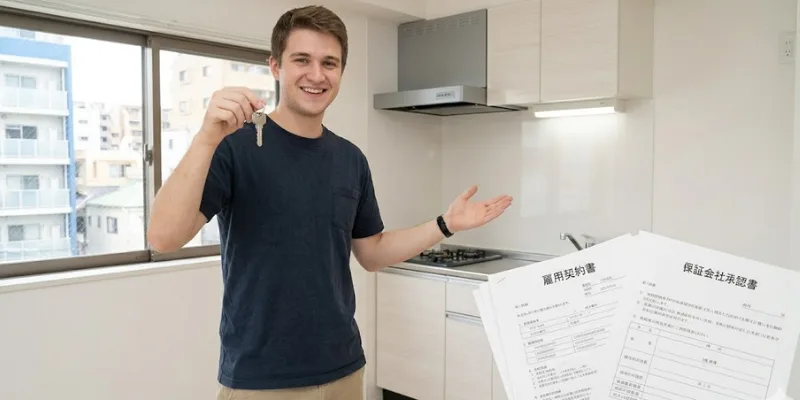
What to provide: a current employment contract (雇用契約書, koyō keiyakusho) or letter of employment stating your employer, your monthly salary or hourly rate and expected weekly hours, and your contract start date.
Why this helps: even a part-time contract converts income from unverifiable (cash-in-hand or informal) to documented. A hoshō gaisha processing your application can see that you have ¥140,000–¥180,000/month coming in from a named employer. This directly addresses the income threshold concern (standard 3× monthly rent).
Part-time contracts: fully accepted by WH-experienced hoshō gaisha. The income threshold for a part-time income can still be met — for an ¥80,000/month apartment, you need documented income of ¥240,000/month. Two part-time contracts from two employers, combined, satisfy this threshold if both are provided.
Before your first payslip: an employment offer letter or pre-commencement contract is less strong than a contract plus 1–2 payslips, but it is substantially better than nothing. Most WH applications submitted with an offer letter plus bank statements proceed to screening. Applications with no income documentation at all are declined at almost all hoshō gaisha regardless of landlord willingness.
Freelance or remote work: a client contract showing monthly retainer or expected monthly billings, combined with bank statements showing payment history, functions similarly to an employment contract for the hoshō gaisha assessment.
Document Substitute 3: The Right Guarantor Company
This is the most important variable in a Working Holiday no-tax-document application — more important than which documents you have.
Some hoshō gaisha (保証会社) have a built-in policy that will not underwrite applications without Japanese income documentation, regardless of what alternatives you provide. Submitting home-country bank statements to one of these companies results in automatic rejection. The company’s policy, not your financial situation, is the barrier.
WH-friendly hoshō gaisha have specifically designed an underwriting framework for Working Holiday and other short-stay visa types. They accept:
- Home-country bank statements as the primary income proxy
- Employment contracts from foreign or domestic employers in lieu of Japanese tax certificates
- Parental income guarantees from overseas parents
- COE (Certificate of Eligibility) as visa documentation in lieu of Japanese tax history
The practical implication: you should ask your agency explicitly — before investing time in any application — which hoshō gaisha that property uses and whether it accepts WH visa holders without Japanese tax documentation. If the answer is uncertain or negative, the correct response is to find a different property with a WH-compatible hoshō gaisha, not to prepare more documents for an application that will be declined.
Arealty works exclusively with guarantor companies that accept WH visa holders with the documentation alternatives above. This is one of the primary practical differences between applying through Arealty and applying through a standard Japanese portal. For the full guarantor company explanation, see the flexible lease guide for foreigners.
Document Substitute 4: Parental Income Guarantee
If your own income documentation is thin — you have just arrived, have not yet started work, and have limited bank balance — a parental income guarantee (親権者保証, shinkensha hoshō) shifts the financial underwriting to your parent’s income.
What the hoshō gaisha needs:
- Parent’s income documentation: payslip, tax return, or employment certificate from their home country — translated into Japanese or with a Japanese summary
- Parent’s income must exceed approximately ¥240,000/month (or ¥3M+/year) for a standard Tokyo apartment
- A signed guarantor declaration letter in Japanese (your agency provides the standard format)
- Parent’s ID copy (passport)
Currency conversion: hoshō gaisha accept income stated in foreign currency. They convert at the current rate. An Australian parent earning AUD 8,000/month, for example, converts to approximately ¥780,000/month at current rates — well above the threshold for most Tokyo apartments.
Who it works for: students and early-career WH holders with limited personal income who have family support. The parental guarantee pathway is standard and well-understood by WH-compatible hoshō gaisha. It does not carry stigma or lower the application’s standing.
How to Present Your No Tax Document Package for WH Rental
The substitute documentation package should be submitted as a coherent set, not as individual documents. A cover sheet — in Japanese, one page — that explains:
- That you are a Working Holiday visa holder without a Japanese tax certificate
- What alternative documents you are providing and why
- What income or financial stability each document demonstrates
…allows the hoshō gaisha reviewer to process the application efficiently rather than flagging it as incomplete. Arealty prepares this cover sheet as part of the standard application submission for WH applicants.
The package that produces the highest approval rate: employment contract + 3 months home-country bank statements + parental income guarantee (if applicable) + cover sheet in Japanese. Each element addresses a different concern: the employment contract answers current income, the bank statements answer financial stability, the parental guarantee answers the financial backstop question.
Working Holiday Japan No Tax Document: Which Landlords Accept Substitutes
Landlord acceptance is the second variable (after hoshō gaisha policy). In practice, when a WH-compatible hoshō gaisha underwrites the application, the landlord’s documentation requirements become largely irrelevant — the hoshō gaisha is the party bearing the financial risk, and their acceptance is what matters.
The landlords that create problems are those who have a personal policy against WH visa holders regardless of hoshō gaisha acceptance. These exist, particularly in outer wards and older buildings. The solution is pre-confirmation: Arealty confirms with the landlord before showing a listing to WH applicants whether the landlord specifically accepts WH visa status. For the full foreigner acceptance landscape, see foreign-friendly apartments in Osaka for the Osaka parallel, and the Tokyo foreigner rental guide for Tokyo-wide context.
Timeline: When You Can Apply Without a Tax Document
| Situation | Can you apply? | Best substitute |
| Arrived within last 30 days, no job | Difficult but possible | Home bank statements + parental guarantee |
| Have employment offer, not started | Possible | Offer letter + home bank statements |
| 1–2 payslips from current job | Yes — strongest position | Payslips + employment contract |
| 3+ months in Japan, consistent income | Yes | Payslips replace bank statements as primary |
| Previous year in Japan but no tax filing | Complicated | Consult agency — may need tax filing first |
The single highest-leverage improvement to a no-tax-document WH application is getting 1–2 payslips before applying. This typically means 4–6 weeks from arrival. For renters who need housing immediately on arrival, a share house or monthly mansion bridge — covered in the short-term Tokyo rental guide — allows you to secure stable employment and documentation before applying for a private apartment.
Contact Arealty to discuss your specific documentation situation before beginning your apartment search — the 15-minute conversation determines which properties are worth applying for.
Further Reading
- Working Holiday visa Japan — full rental guide (general process)
- Working Holiday Japan — short-term vs 2-year lease (contract decision)
- Student visa Japan — apartment screening guide (parallel for student visa)
- Short-term rental options in Tokyo — bridge housing while building documents
- Flexible lease in Japan for foreigners
- Renting in Japan as a foreigner — full step-by-step process

Real estate advisor at Arealty Japan, specialising in helping foreign residents navigate the Tokyo and Osaka rental markets. Lucy has guided hundreds of international renters — from Working Holiday visa holders to corporate relocations — through Japan’s apartment application process. Her writing draws on firsthand experience with landlord screening, guarantor companies, and foreigner-friendly listings across all 23 Tokyo wards and major Kansai cities.