
No guarantor apartments in Tokyo for foreigners are less common than “no deposit” apartments — but they exist, and the options are more useful than most search results suggest. The challenge is that “no guarantor” means different things in different contexts, and the category that actually helps foreign renters is specific.
This guide covers what no guarantor apartments in Tokyo look like in 2026: which categories exist, what you give up, and when no-guarantor makes sense versus a standard hoshō gaisha. This is distinct from no-deposit apartments — covered in the no-deposit apartments Tokyo guide — though some overlap exists.
Browse Tokyo listings on Arealty — our team confirms guarantor requirements and foreigner acceptance before you apply.
No Guarantor Tokyo: Why Hoshō Gaisha Exist and When They Block Foreigners
Japan’s rental market historically required a personal guarantor (連帯保証人) — a Japanese citizen willing to co-sign the lease and accept financial liability. For foreign renters without Japanese social networks, this requirement was a near-complete barrier.
Professional guarantor companies (保証会社, hoshō gaisha) replaced the personal guarantor system for most leases. A hoshō gaisha underwrites the tenant’s risk in exchange for a one-time fee (¥30,000–¥60,000) and an annual renewal fee. For most foreign renters, this is the correct and most accessible path.
Problems arise for Working Holiday holders without tax documents, students with no Japanese income, or renters with informal income sources. Some hoshō gaisha decline these profiles regardless of actual financial capability. No-guarantor options are relevant here — not universally, but as a specific solution.
For the document workarounds that work with standard guarantor companies on challenging visa profiles, see the Working Holiday no tax document guide.
Option 1: UR Housing — The Most Reliable No-Guarantor Path
UR Housing (都市再生機構) is Japan’s largest public housing provider. UR properties have three key features for foreign renters:
No guarantor required. UR Housing explicitly waives the guarantor company requirement for all applicants. This is a formal policy, not case-by-case.
Foreign nationals accepted. UR Housing accepts foreign nationals with a valid residence card. A residence card is required. All standard visa types are accepted: work, student, Working Holiday, spouse, and permanent residency.
No key money. UR Housing charges zero key money. Combined with no guarantor fee, upfront costs are substantially lower than comparable private apartments.
What UR Housing costs in Tokyo:
- Outer wards (Adachi, Edogawa, Itabashi): 1K from ¥50,000–¥68,000/month
- Mid-range wards (Nerima, Kita, Arakawa): 1K from ¥60,000–¥78,000/month
- Inner wards (Koto, Sumida): 1K from ¥72,000–¥95,000/month
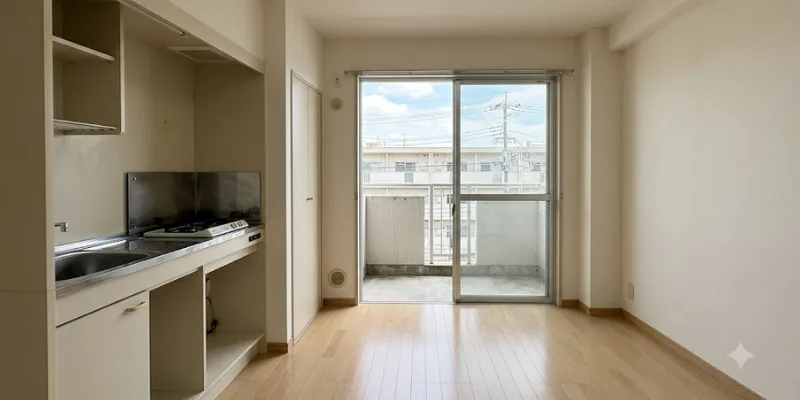
The trade-offs: UR buildings are older on average — much of the stock is from the 1970s–1990s. The architecture is functional rather than modern, and some buildings lack auto-lock or have older elevator systems. Renovated UR units exist and are genuinely comfortable; unrenovated units require more tolerance for building age.
How to apply for UR Housing: applications go directly through the UR Housing website or offices. Unlike private apartments, there is no agency involved. The application requires a residence card, proof of income (or parental income documentation for students), and bank statements. The income threshold is approximately 4× monthly rent in annual income — slightly higher than the private market standard of 3×. For foreign nationals without Japanese income, the equivalent overseas income with documentation is accepted.
UR Housing availability changes frequently. Contact Arealty for current UR availability in your target areas.
Option 2: Owner-Direct Rentals Without Guarantor
Some Tokyo landlords manage their own properties without a management company. Some — particularly older owners of inherited properties — waive the guarantor requirement in exchange for a higher deposit (2–3 months rather than 1–2).
The practical access challenge: owner-direct no-guarantor properties are not consistently listed on major portals and rarely appear with explicit “no guarantor” labelling. They surface through direct landlord relationships and local agency networks.
Who this works for: long-term foreign residents with established Japan presence or Japanese language ability. For recently arrived renters, this path is difficult to access systematically.
Option 3: Institutional or Building-Level Guarantee Schemes
Some buildings targeting international residents have institutional arrangements substituting the standard hoshō gaisha requirement. These include:
Corporate lease arrangements: a company rents the apartment and subleases to the employee. The company acts as the guarantor. Relevant for renters on corporate relocation packages.
Building-level institutional guarantors: some buildings have an exclusive arrangement with a single hoshō gaisha that covers all tenants in the building regardless of visa type or income documentation. The guarantee fee is often built into the monthly rent rather than charged separately.
Kolet and similar managed apartment brands: some apartment brands operating in Tokyo have their own internal guarantee systems that accept a wider range of tenant profiles, including Working Holiday visa holders and newly arrived foreign residents. These properties typically carry a slight rent premium (¥5,000–¥15,000/month above comparable market rate) in exchange for the streamlined acceptance.
No Guarantor Tokyo Apartments: What Foreigners Give Up
Pursuing a no-guarantor apartment in Tokyo involves accepting constraints:
Fewer options. UR Housing covers a specific portion of the market. Owner-direct properties are hard to find. Building-level schemes exist in a limited number of developments. The total inventory is significantly smaller than the full private rental market.
Older building stock. UR Housing — the most accessible no-guarantor option — skews older than the private market. If newer construction with auto-lock, IH cooktops, and separate bath are priorities, the no-guarantor category becomes even more limited.
Higher income threshold for UR. UR’s 4× annual income requirement (vs private market 3×) can be more difficult to meet for students and WH holders — the population most likely to need a no-guarantor option.
When No-Guarantor Makes Sense vs Standard Hoshō Gaisha
| Your situation | Better path |
| Work visa, stable income, standard application | Standard hoshō gaisha — widest inventory |
| Student visa, parental guarantee available | Standard hoshō gaisha with parental docs |
| Working Holiday, no tax document | WH-compatible hoshō gaisha + doc workarounds (see WH guide) |
| Any visa, want UR’s no-guarantor + no key money | UR Housing — if building age acceptable |
| Corporate relocation | Corporate lease arrangement |
| Any situation, income documentation very thin | UR Housing or share house bridge |
The Foreign Renter Reality: Most Applications Need a Guarantor
For most foreign renters in Tokyo, the standard hoshō gaisha path is broader, faster, and gives access to more inventory than no-guarantor options. The key is using a hoshō gaisha that accepts your visa type and income profile. That is where most rejections come from — not the requirement itself.
Work visa with provable income? Use a standard hoshō gaisha. Non-standard situation (WH visa, student without income)? A WH-compatible or student-compatible hoshō gaisha is the solution — not eliminating the guarantor requirement.
Contact Arealty to identify which hoshō gaisha accept your visa type and income profile before starting your Tokyo apartment search. Browse current foreigner-friendly listings on Arealty.
Further Reading
- No-deposit apartments in Tokyo — related but different category
- Working Holiday Japan: no tax document — guarantor workarounds
- Student visa Japan — how guarantor companies screen applications
- Flexible lease in Japan — all contract types for foreigners
- Renting in Japan as a foreigner — full step-by-step process
- Cheap apartments in Tokyo under ¥70,000 — outer ward options

Real estate advisor at Arealty Japan, specialising in helping foreign residents navigate the Tokyo and Osaka rental markets. Lucy has guided hundreds of international renters — from Working Holiday visa holders to corporate relocations — through Japan’s apartment application process. Her writing draws on firsthand experience with landlord screening, guarantor companies, and foreigner-friendly listings across all 23 Tokyo wards and major Kansai cities.