
The capsule hotel vs share house decision in Tokyo comes down primarily to length of stay — this comparison matters most: capsule hotels work well for under 2 weeks at ¥1,500–¥4,000/night, while share houses become more cost-effective and practical beyond that point at ¥45,000–¥80,000/month all-inclusive, according to pricing data from major capsule hotel chains and share house operators in 2026. For foreigners navigating Tokyo’s housing market during a transition period, understanding exactly where this crossover point sits — and what each option actually offers beyond price — helps avoid both overpaying and under-resourcing your temporary living situation.
This guide breaks down the capsule hotel vs share house comparison in Tokyo across cost, privacy, registration ability, and practical daily life considerations.
Capsule Hotel vs Share House in Tokyo: Quick Comparison
| Capsule hotel | Share house | |
|---|---|---|
| Cost | ¥1,500–¥4,000/night | ¥45,000–¥80,000/month |
| Minimum stay | 1 night | Typically 1 month |
| Privacy | Capsule/pod only | Private room |
| Kitchen access | No | Yes, shared |
| Address registration | Not possible | Usually possible |
| Storage | Locker only | Full room storage |
| Social environment | Minimal interaction | Built-in community |
| Booking speed | Instant | 1–3 days |
When a Capsule Hotel Makes Sense
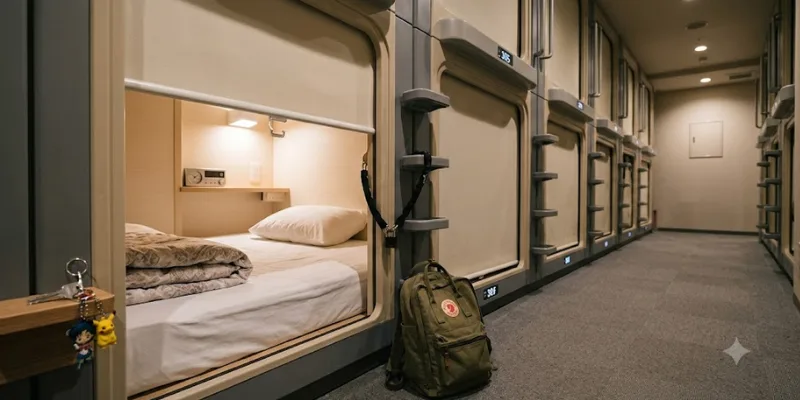
Capsule hotels are the right choice for very short stays where the lack of registration ability and storage doesn’t yet matter:
- First few nights after arrival — while you orient yourself before committing to longer-term accommodation
- Between apartments — a short gap while moving from one lease to another
- Business travel or short visits — under 2 weeks, where you’re not establishing residency
- Budget testing — trying out a neighborhood before committing to a longer stay nearby
Capsule hotels in areas like Shinjuku, Asakusa, and Akihabara offer easy booking with no application process, no guarantor, and no commitment beyond your stated nights. The trade-off is that you cannot register your address here, which becomes a real constraint if your stay extends much beyond 1–2 weeks — see our guide on sofa surfing and short-stay alternatives in Tokyo for the administrative reasons why this matters for foreign residents.
When a Share House Makes Sense
Share houses become the more practical and cost-effective option once your stay extends beyond roughly 10–14 days:
Cost crossover point. At ¥3,000/night, a capsule hotel costs ¥90,000 over 30 nights — more than most share house rooms, which include utilities and Wi-Fi in that monthly figure. The capsule hotel cost advantage only holds for very short stays.
Address registration. Most share houses allow you to register your address at the ward office, which capsule hotels cannot offer. This matters for opening a bank account, registering with an employer, or enrolling at a school.
Storage and stability. A share house room gives you a stable base to unpack, store belongings, and establish a routine — something that becomes increasingly valuable the longer your stay extends.
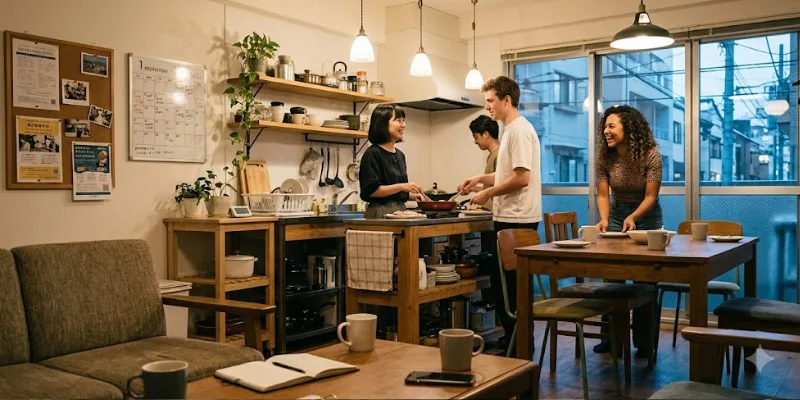
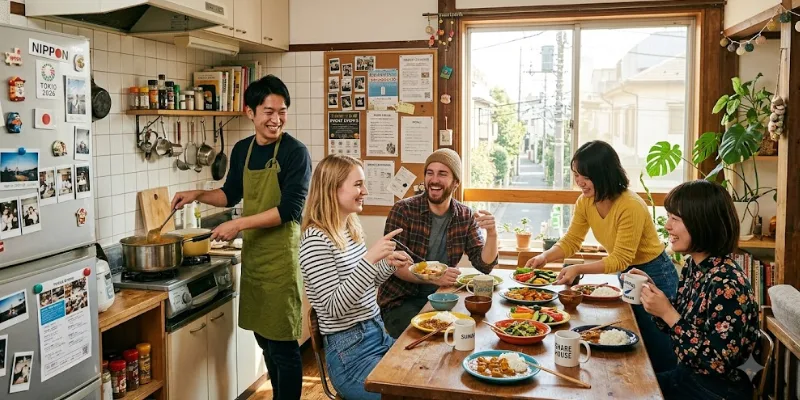
Community. Many share houses, particularly those marketed to foreigners, have a built-in social environment through shared kitchens and common areas — useful for newcomers building a social network in Tokyo.
For pricing and how to book a share house room, see our share house in Japan for foreigners guide.
External reference: Japan National Tourism Organization — Accommodation Types — official overview covering capsule hotels and other accommodation categories in Japan.
Capsule Hotel vs Share House in Tokyo: The Middle Ground Options
Between the capsule hotel vs share house comparison sits two other options worth knowing about:
Guest houses function similarly to share houses but with more hotel-style management — often slightly more expensive but with services like cleaning included. Good for those who want share-house pricing with less day-to-day self-management.
Monthly mansions offer full private apartments (not shared) on monthly contracts, at a higher price point (¥90,000–¥180,000/month) but with complete privacy and a private kitchen/bathroom. See our monthly mansion Tokyo guide for full pricing.
Practical Scenario Walkthrough
Scenario: You arrive in Tokyo with a job starting in 3 weeks and no apartment secured yet.
- Nights 1–3: Capsule hotel while you get oriented, open initial accounts, and start your apartment search (~¥9,000 total)
- Week 1–3: Move to a share house room while your permanent apartment application processes (~¥45,000–¥55,000 for 3 weeks at a monthly rate, prorated)
- Week 4 onward: Move into your permanent apartment once the lease, guarantor screening, and contract are complete
This staged approach avoids overpaying for capsule hotel nights beyond the first few days while giving you a stable, registerable address during the apartment search period.
Address Registration: The Deciding Factor for Longer Stays
If your stay in Tokyo will exceed roughly 2–3 weeks and you’re on a resident visa (not a short tourist stay), address registration becomes a practical necessity rather than a preference. Japan’s Basic Resident Registration Act requires foreign residents to register an address within 14 days of moving in. Since capsule hotels cannot serve as a registered address, anyone planning to stay more than 1–2 weeks should transition to a share house, guest house, or monthly mansion specifically to maintain compliant registration. See our guide on how to register your address in Japan for the full process.
FAQ: Capsule Hotel vs Share House in Toky
Can I stay in a capsule hotel for a month? Technically yes if you can keep finding availability, but it becomes expensive (often ¥60,000–¥120,000/month at nightly rates) and you still cannot register your address — making a share house the more practical choice well before the 1-month mark.
Are capsule hotels safe for solo female travelers? Most major capsule hotel chains maintain gender-separated floors or female-only sections with secure locker storage, and are generally considered safe and well-suited to solo travelers of any gender.
Do share houses require a guarantor? No — this is one of their main advantages over private apartments. Most share houses require only a passport and basic enrollment/employment confirmation.
What’s the average stay length at a share house? Many residents stay 3–12 months, though there’s no fixed maximum. Minimum stays are typically 1 month.
→ Browse short-stay and share house options in Tokyo
What Capsule Hotels and Share Houses Don’t Tell You Upfront
Capsule hotel hidden limitations. Many capsule hotels restrict luggage storage to a single locker, which becomes genuinely impractical if you’ve arrived with multiple suitcases for a relocation rather than a short trip. Confirm luggage storage capacity before booking if you’re using a capsule hotel as a bridge during a longer-term move, not just a tourist stay.
Share house common area etiquette. Share houses function on shared expectations around kitchen cleanliness, noise levels, and common area usage that aren’t always spelled out in the contract. Ask to see house rules (often posted in the kitchen or common area) before committing, and if possible, ask current residents about the actual day-to-day culture of the specific house — this varies meaningfully between properties even within the same operator’s portfolio.
Seasonal price fluctuation. Both capsule hotels and share houses see price increases during Japan’s peak travel and moving seasons (cherry blossom season in spring, New Year holidays, and the April/September moving seasons). Booking further in advance during these windows can meaningfully reduce cost compared to last-minute booking.
Cost Modeling: Capsule Hotel vs Share House Over Different Stay Lengths
| Stay length | Capsule hotel (avg ¥2,500/night) | Share house (¥55,000/month, prorated) |
|---|---|---|
| 3 nights | ¥7,500 | ¥5,500 (if available at this length) |
| 1 week | ¥17,500 | ¥12,800 |
| 2 weeks | ¥35,000 | ¥25,600 |
| 1 month | ¥75,000 | ¥55,000 |
| 3 months | ¥225,000 | ¥165,000 |
Even at the shorter end, share house pricing often comes out ahead once you account for prorated monthly rates — though very short share house bookings (under 1 week) are uncommon since most operators set a 1-month minimum. The capsule hotel’s real advantage is flexibility and zero-commitment booking, not necessarily lower total cost beyond the first few days.
Making the Switch From Capsule Hotel to Share House
If you start in a capsule hotel and need to transition to longer-term accommodation, the process is straightforward:
- Research share house options while still in the capsule hotel — most platforms allow remote browsing and inquiry
- Book a viewing or request photos/video if you can’t visit in person before checking out of the capsule hotel
- Submit basic documents — passport and enrollment/employment confirmation, typically processed within 1–3 days
- Pay deposit and first month to secure the room
- Move directly from capsule hotel to share house, minimizing any gap in accommodation
This transition typically takes 3–5 days from decision to move-in, making it realistic to plan a short capsule hotel stay specifically as a bridge while share house arrangements are finalized.
Internal Resources for Short-Stay Housing Decisions
- Short stay apartments in Tokyo under ¥50,000 — broader budget-conscious accommodation comparison
- Monthly mansion Tokyo: furnished rooms — the private-apartment alternative if budget allows
- Share house in Japan for foreigners guide — detailed operator comparison and booking process
- How to register your address in Japan — the registration process once you’ve settled into longer-term housing

Real estate advisor at Arealty Japan, specialising in helping foreign residents navigate the Tokyo and Osaka rental markets. Lucy has guided hundreds of international renters — from Working Holiday visa holders to corporate relocations — through Japan’s apartment application process. Her writing draws on firsthand experience with landlord screening, guarantor companies, and foreigner-friendly listings across all 23 Tokyo wards and major Kansai cities.