
Cheap houses for rent in Japan without deposit — specifically listings that waive both the security deposit (敷金, shikikin) and key money (礼金, reikin) — can save ¥100,000 to ¥300,000 on move-in costs compared to traditional apartment leases, representing one of the most significant levers for reducing the financial barrier to renting in Japan. For foreigners arriving with limited initial savings, finding cheap houses for rent in Japan without deposit is often the difference between being able to move into a private apartment immediately and having to bridge with a share house until funds accumulate.
This guide explains exactly how Japan’s deposit and key money system works, where to find no-deposit listings, and what to look for before signing.
Understanding the Deposit System: Shikikin vs Reikin
When searching for cheap houses for rent in Japan without deposit, it’s important to distinguish between the two main upfront cost categories:
敷金 (Shikikin) — Security deposit
- Refundable at move-out, minus legitimate restoration costs
- Typically 1–2 months’ rent
- Held by the landlord as insurance against damage or unpaid rent
- This is what “without deposit” usually refers to
礼金 (Reikin) — Key money / gratuity payment
- Non-refundable, paid directly to the landlord
- Typically 0–1 month’s rent
- A culturally embedded payment with origins in post-war Japan’s housing shortage
- Also often listed as “without” in zero-upfront-cost properties
When you search for cheap houses for rent in Japan without deposit, listings may be:
- 敷金なし (shikikin nashi) — no security deposit only
- 礼金なし (reikin nashi) — no key money only
- 敷礼なし (shikirei nashi) — neither deposit nor key money
- ゼロゼロ物件 (zero-zero bukken) — colloquial term for no deposit, no key money
The “zero-zero” listings offer the maximum upfront savings and are the most valuable finding for foreigners trying to minimise initial costs.
Where to Find Cheap Houses for Rent in Japan Without Deposit
1. Dedicated platform filters
Major listing platforms allow direct filtering for no-deposit listings:
- SUUMO: filter “敷金なし” under move-in conditions
- Homes.co.jp: similar deposit/key-money filters
- GaijinPot Apartments: “no deposit” filter (English interface)
- Arealty: foreigner-friendly no-deposit listings
2. Management company listings
Large professional property management companies (大手管理会社) have moved toward zero-deposit or zero-key-money contracts more quickly than individual private landlords, driven by competitive pressure and tenant preference. Filtering specifically for properties managed by companies (rather than individual owners) often yields a higher proportion of no-deposit options.
3. New construction listings
Newly completed apartment buildings often launch with zero key money to attract first tenants quickly, since the property has no established reputation. This makes new constructions a productive search category for cheap houses for rent in Japan without deposit.
4. Vacant-for-a-while properties
Properties that have been listed for more than 4–6 weeks without finding a tenant sometimes convert to zero-deposit or zero-key-money terms as an incentive. Asking your agent to flag recently price-adjusted listings is one way to surface these opportunities.
What Zero-Deposit Properties Actually Cost
Finding cheap houses for rent in Japan without deposit doesn’t mean the total upfront costs are zero — even shikikin/reikin-free listings still involve:
| Cost item | Even with no deposit | Typical amount |
| First month’s rent | Always required | ¥60,000–¥100,000 |
| Agency fee | Usually required | ¥60,000–¥110,000 |
| Guarantee company fee | Usually required | ¥30,000–¥60,000 |
| Fire insurance | Required | ¥15,000–¥20,000 |
| Total (no deposit/key money) | ¥165,000–¥290,000 |
Compare to a standard listing with 1 month deposit + 1 month key money for a ¥80,000/month apartment: total move-in of ¥375,000–¥530,000. The savings from cheap houses for rent in Japan without deposit are real and significant — typically ¥120,000–¥240,000 in direct savings.
Risks and Trade-offs with No-Deposit Apartments
Non-refundable move-in fees. Some zero-shikikin apartments substitute a non-refundable “administrative fee” (事務手数料 or 消毒費) — sometimes called a “cleaning fee” — in place of a deposit. This is effectively a non-refundable payment that replaces the refundable deposit. Compare the total move-in cost carefully, not just which items are labeled “zero.”
Guarantee company requirement. Zero-deposit properties almost always require a rental guarantee company (保証会社) — the guarantee company serves the landlord’s financial protection function that the deposit would otherwise provide. This adds a guarantee company fee that partially offsets the deposit savings.
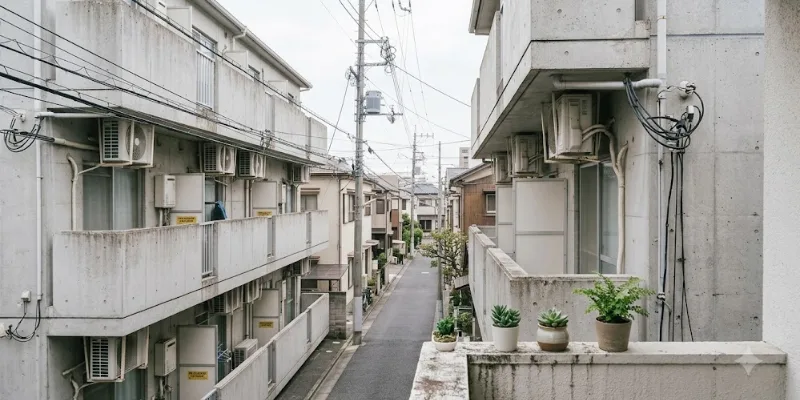
Older building stock. The distribution of no-deposit, no-key-money listings skews toward older buildings, which carry higher risks of dated infrastructure, weaker soundproofing, and less efficient insulation. Not universal — plenty of no-deposit properties are well-maintained — but worth checking building age and construction type carefully.
Higher rent premium. Some landlords raise the base monthly rent by ¥2,000–¥5,000 for zero-deposit listings to compensate for the removed deposit buffer, effectively spreading the cost differently rather than eliminating it. Calculate the 2-year total cost to compare fairly.
No-Deposit Apartments by Location: Tokyo Price Context
Using Hato Mark Site data (Zentakuren, 2026), here are the wards where 1R no-deposit listings tend to be most concentrated, alongside average 1R prices for reference:
| Ward | Avg. 1R rent | No-deposit availability | Notes |
| Itabashi-ku | ¥61,600 | Good | Many older managed buildings |
| Nerima-ku | ¥61,300 | Good | Suburban stock, often zero-reikin |
| Katsushika-ku | ¥61,200 | Moderate | Some stock, smaller market |
| Suginami-ku | ¥67,900 | Good | Mix of ages, competitive management |
| Adachi-ku | ¥74,700 | Good | Active market, many management company listings |
| Edogawa-ku | ¥65,100 | Moderate | Good value, some no-deposit options |
Source: Hato Mark Site rental statistics (Zentakuren), 2026.
No-Deposit Apartments Outside Tokyo
The search for cheap houses for rent in Japan without deposit extends well beyond Tokyo, with several major cities offering substantial no-deposit inventory:
Osaka: No-deposit listings are proportionally more common in Osaka than in Tokyo, reflecting the city’s more tenant-competitive market. See our cheap apartments in Osaka under ¥70,000 guide.
Fukuoka: One of Japan’s most affordable major cities for rental generally, with many no-deposit listings in its central wards.
Nagoya: Strong management company market with good no-deposit availability in the central-adjacent residential wards.
What to Check Before Signing a No-Deposit Apartment
Confirm what “no deposit” actually means. Read the contract carefully for substitute fees (administrative fees, cleaning fees) that function like a non-refundable deposit under a different name.
Verify restoration responsibilities in the contract. The absence of a security deposit doesn’t change your legal restoration obligations — it just means you pay restoration costs directly at move-out rather than having them deducted from a held deposit. Some landlords use this to charge more aggressively at move-out. See our restoration costs Japan guide.
Check the guarantee company fee. This is usually the main cost that substitutes for the deposit. GTN and Roommate are established options — see our guarantee company fee structure Japan guide.
FAQ: Cheap Houses for Rent in Japan Without Deposit
Is “no deposit” the same as “no key money”? No — these are separate items. “No deposit” (敷金なし) means no refundable security deposit. “No key money” (礼金なし) means no non-refundable gratuity payment. You can have one without the other, or both.
Are no-deposit apartments legal in Japan? Yes — there is no legal requirement for a security deposit in Japanese residential leases. Zero-deposit contracts are fully legal and increasingly common.
Will the landlord be stricter at move-out with no deposit? Potentially — without a held deposit, landlords may pursue move-out restoration costs more actively. Document the unit condition thoroughly at move-in (photos and written check-in report) to protect yourself.
Are no-deposit apartments harder to get approved for? Generally no — the guarantee company substitutes for the financial protection function of the deposit, so the screening process is similar to standard applications.
External reference: Ministry of Land, Infrastructure, Transport and Tourism — Rental Housing Guidelines — official government guidance on rental housing practices including deposit conventions.
→ Browse no-deposit foreigner-friendly apartments in Tokyo
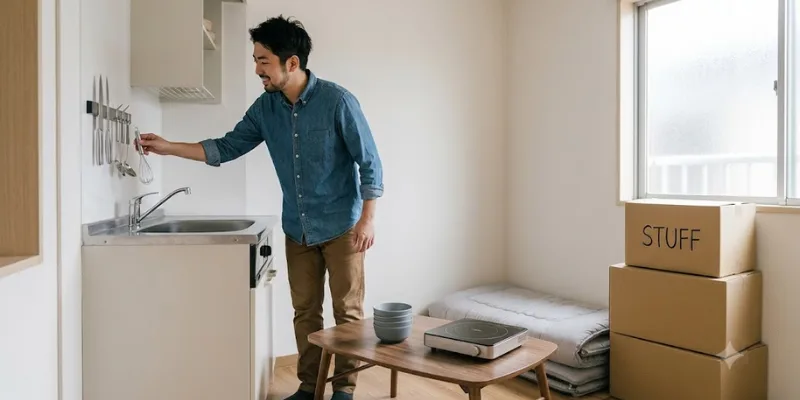
The ゼロゼロ物件 (Zero-Zero Apartment) Phenomenon in Japan
The term ゼロゼロ物件 (zero-zero bukken) — colloquially describing cheap houses for rent in Japan without deposit or key money — has an interesting history in the Japanese rental market. These listings surged in prominence after the 2008 financial crisis, as both landlords (wanting to fill vacancies quickly) and tenants (facing reduced savings) converged on reducing upfront friction. The category has since become mainstream, particularly in urban rental markets where competition among landlords is high.
However, ゼロゼロ物件 attracted some criticism in Japan for occasionally being associated with:
- High-pressure sales tactics by certain unlicensed or marginally-regulated housing operators who target financially vulnerable renters
- Substitute fees that functionally recreate the eliminated costs under different names
- Older, less maintained building stock that landlords are willing to offer on more flexible terms due to difficulty filling otherwise
None of these concerns apply to listings offered by licensed real estate agencies operating through standard channels. They’re more relevant to the informal market — something to be aware of if a listing seems to come through unconventional channels rather than through a standard licensed agent.
Seasonal Patterns in No-Deposit Availability
The availability and terms of cheap houses for rent in Japan without deposit shifts seasonally:
March–April (peak moving season): No-deposit listings are less common relative to total inventory during this period, since landlords can fill units quickly with standard contracts. If you must move during spring, factor in that your no-deposit filter will return fewer results than at other times of year.
June–August: The summer lull in Tokyo’s rental market (between the March-April peak and the September-October student/corporate move season) is one of the best windows to find no-deposit listings, as landlords who couldn’t fill units at spring-peak terms adjust their offerings.
October–November: Another good window, after the September secondary peak subsides. Similar to summer but slightly shorter.
Beyond Tokyo: No-Deposit Apartments Across Japan’s Major Cities
For foreigners considering destinations outside Tokyo, no-deposit availability and norms vary:
Osaka: Zero-deposit (敷金なし) listings are proportionally more common than in Tokyo, reflecting Osaka’s slightly more price-competitive landlord market. Particularly good availability in central wards (Chuo, Namba area).
Fukuoka: Strong no-deposit availability across the city, supported by a large student population creating demand for low-upfront-cost housing. See our Fukuoka apartments for rent for foreigners guide.
Kyoto: No-deposit listings are less common in Kyoto’s tighter rental market near university areas, where landlord leverage is higher due to consistent demand. More availability in the outer residential wards.
Internal Resources for Budget-Conscious Renters
- Zero agency fee rental Japan guide — eliminating another major upfront cost category
- Tokyo no key money apartments foreigners guide — specifically key-money-free Tokyo listings
- Average cost of apartment in Tokyo by ward — ward-by-ward baseline pricing to compare against specific listings
- Apartment move-in cost Japan guide — complete breakdown of all move-in cost categories

Real estate advisor at Arealty Japan, specialising in helping foreign residents navigate the Tokyo and Osaka rental markets. Lucy has guided hundreds of international renters — from Working Holiday visa holders to corporate relocations — through Japan’s apartment application process. Her writing draws on firsthand experience with landlord screening, guarantor companies, and foreigner-friendly listings across all 23 Tokyo wards and major Kansai cities.