
If you are comparing rentals in Japan, an all-electric apartment bill can look intimidating at first. Many foreign renters see a higher electricity estimate and assume the apartment will always be more expensive than a standard unit.
The reality is more nuanced. In an all-electric apartment, cooking, hot water, and often heating are powered by electricity, so the monthly power bill usually looks higher. But that does not automatically mean the total household utility burden is worse, because there is usually no separate gas bill.
That distinction matters for couples and two-person households. When people search electricity bill japan apartment or wonder about gas vs electric apartment japan, they are often trying to answer a simple question: will this apartment still feel affordable after the first few months? The answer depends on season, room size, lifestyle rhythm, contract amperage, and how efficiently the apartment is used.
This guide explains how an all-electric apartment works, what a realistic two-person bill looks like, why winter costs spike, and how to control the total utility bill japan apartment without making daily life uncomfortable.
Is an all-electric apartment bill in Japan actually high?
At first glance, yes. For a two-person household, the average monthly electricity cost in an all-electric home is ¥13,406, compared with ¥9,183 in a standard home. That means the all-electric setup looks about ¥4,223 higher per month if you only compare the electricity bill.
| Housing type | Average monthly electricity bill |
| Standard home | ¥9,183 |
| All-electric home | ¥13,406 |
| Difference | ¥4,223 |
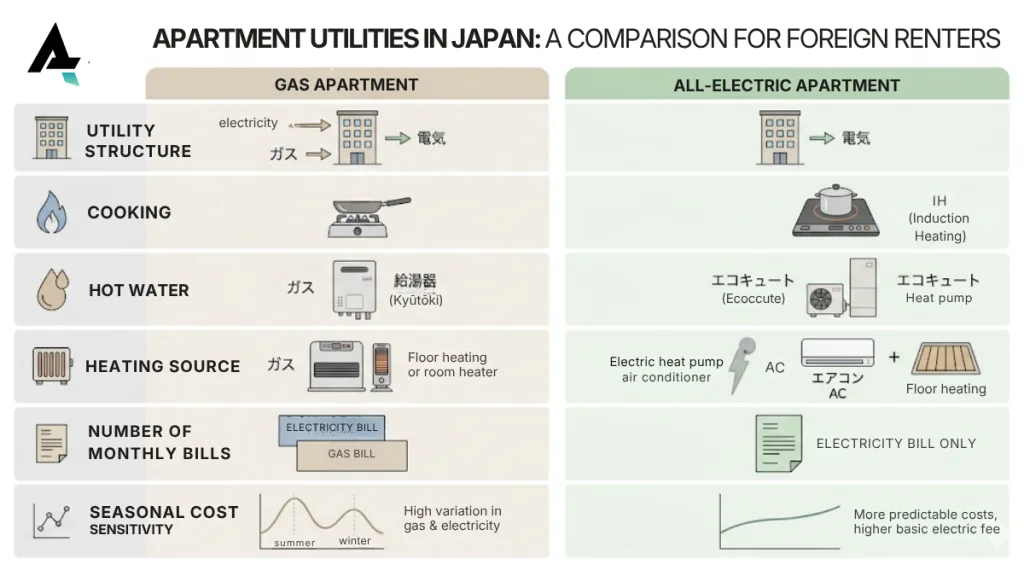
But this is where many renters misread the numbers. A standard apartment usually splits energy costs across electricity and gas, while an all-electric apartment combines most of that usage into one electricity bill. Cooking, hot water, and sometimes part or all of heating are all powered by electricity, so the monthly bill naturally looks heavier.
That is why the better comparison is not electricity alone, but the full utility structure. In a gas-equipped apartment, the electricity bill may look lower, but hot water, baths, showers, and cooking often sit on a separate gas bill. In an all-electric apartment, those same daily costs are simply billed differently.
For foreign renters, this distinction is important. A listing may look cheaper because the power bill appears lower, but the real monthly saving can be much smaller once gas is added back in. The smarter question is not which line item looks better on paper, but which setup makes more sense for your lifestyle, your cooking habits, and your total monthly housing budget.
Why winter is the most expensive season
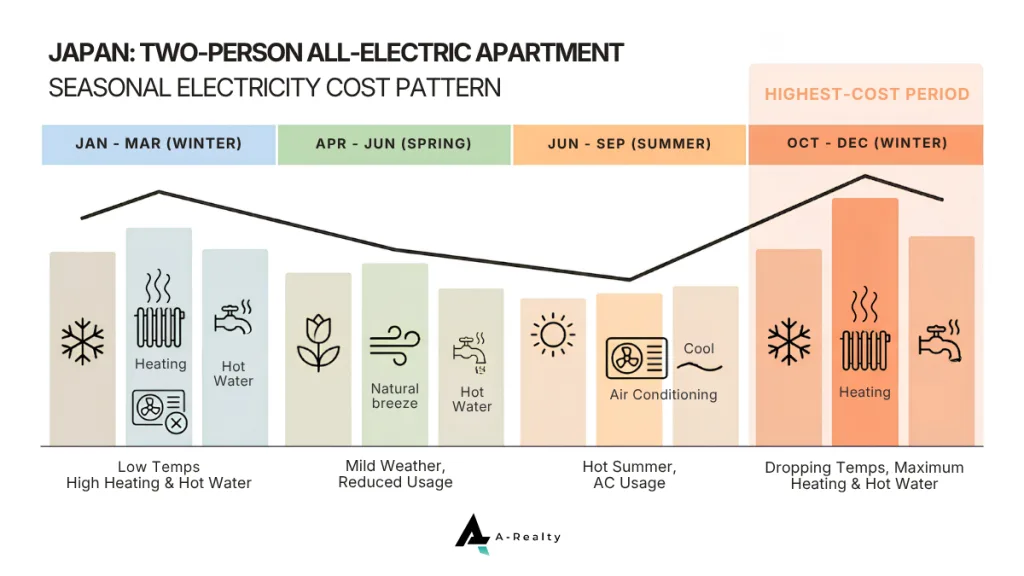
Seasonality has a major effect on an all-electric apartment bill. Winter is usually the most expensive period because two things rise at the same time: heating demand and hot water demand.
The average monthly electricity pattern by season looks like this:
| Period | Average monthly electricity bill |
| January to March | ¥13,265 |
| April to June | ¥11,125 |
| July to September | ¥11,984 |
| October to December | ¥11,657 |
Source: Statistics Bureau of Japan, Family Income and Expenditure Survey 2024 (Household Accounts).
Winter leads clearly. The reason is simple. In colder months, electric heating systems run longer, and households use more hot water for showers, baths, dishwashing, and laundry. In an all-electric apartment, that entire seasonal burden shows up in one place.
This is often the first shock for new renters. A couple may move in during spring or early autumn, feel comfortable with the monthly bill, then see a steep jump once the temperature drops. That does not necessarily mean the apartment is inefficient. It often means the household has reached the season where all-electric living becomes most demanding.
Based on properties we manage, a couple in a 1LDK where one person showers early in the morning and the other takes a bath late at night. In winter, that pattern increases hot water demand across a longer window, which pushes the bill higher even if neither person feels they are “wasting” energy.
How much electricity do two people usually need?
For many two-person households in Japan, 30A is considered a reasonable starting point. In many apartments, that is enough to support normal daily life.
But “enough” depends on what is running at the same time. In an all-electric unit, timing matters much more than many renters expect.
Here is a practical guide:
| Simultaneous use example | Estimated amperage |
| Lighting + TV + fridge + air conditioner | 15 to 20A |
| Lighting + fridge + microwave + air conditioner | 25 to 30A |
This matters because an all-electric apartment may also rely on high-consumption systems like electric water heaters or IH cooktops. If you run multiple heavy appliances at once, a 30A contract may feel tight.
That does not automatically mean you need to pay for a higher contract. It may simply mean you need to manage timing more carefully.
For example, if one person is microwaving food while the air conditioner, kettle, and multiple lights are already running, that short overlap may be enough to cause problems. In practice, the solution is often smarter coordination, not always a bigger contract.
Why two-person households often pay more than expected
An electric apartment cost japan estimate for two people is not just a doubled version of one-person living. Shared households create new patterns that often increase usage in less obvious ways.
Different schedules increase energy use
If one partner wakes early, showers, and leaves for work while the other stays home or returns late, the apartment stays active for more hours. Lighting, hot water, and climate control all stretch across a longer day.
Larger homes cost more to run
Many couples move into 1LDK, 2DK, or 2LDK layouts. More rooms often mean more lighting, more heating, and more separate appliance use. A second room used for remote work can quietly raise the utility bill all year.
Separate routines create overlap
A couple may not think they use much energy, but if they use the microwave separately, heat different rooms, or run entertainment systems in different spaces, small overlaps start adding up.
A realistic example is a two-person household in a 2LDK where one person works from home in the second room while the other uses the living area in the evening. Even when both are careful, the apartment may still consume more electricity than a smaller one-room or 1K setup simply because more space is being actively maintained.
How to lower an all-electric apartment bill without sacrificing comfort
The good news is that an all-electric apartment bill can often be reduced without making life feel inconvenient. The biggest savings usually come from habits, not from extreme restrictions.
Use appliances more strategically
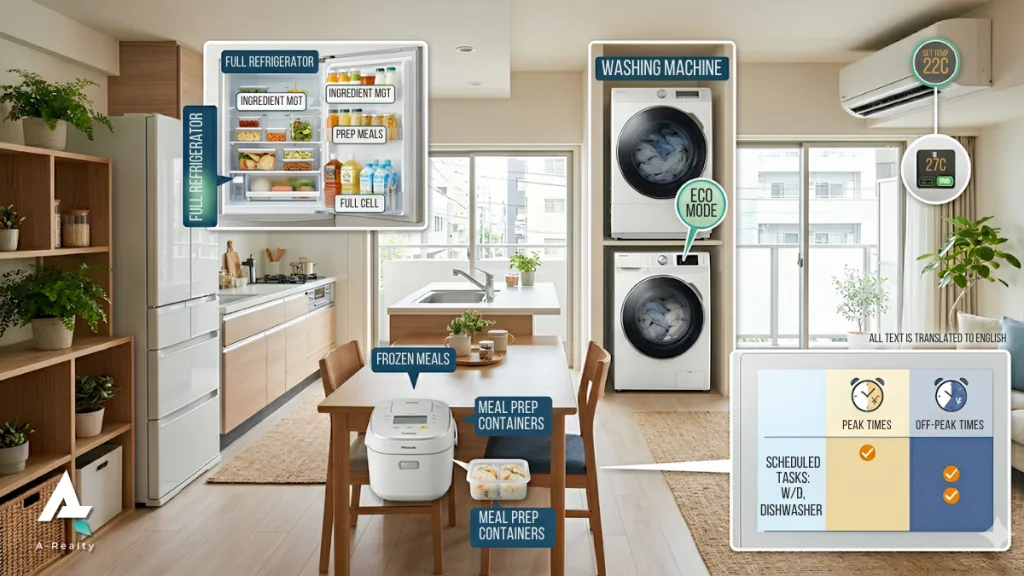
A few simple changes can make a real difference:
| Appliance | Better usage habit |
| Fridge | Keep contents organized so the door stays open for less time |
| Rice cooker | Freeze extra rice instead of leaving it on warm for hours |
| Washing machine | Run fuller loads instead of frequent small loads |
These habits are especially effective because they repeat every day. Small waste multiplied over a month becomes a real bill increase.
Coordinate timing as a couple
Two-person households save more when they coordinate energy-heavy activities. Doing laundry in fuller loads, timing cooking more efficiently, and avoiding simultaneous heating in multiple rooms can reduce unnecessary peaks.
Avoid empty-room energy use
If you have a second room, avoid leaving the air conditioner, heater, or lights running when that room is not being used. In larger apartments, this alone can meaningfully improve the utility bill japan apartment over time.
A practical example is a couple who used to keep rice warm all evening, run partial laundry loads, and heat both the bedroom and living room. Adjusting those three habits can cut visible waste without changing the overall comfort of the home.
Best settings and tariff choices that help
Not every saving comes from behavior. Some of the easiest gains come from settings and plans.
Use energy-saving modes
Many appliances already include eco or energy-saving settings:
- TVs can auto-adjust brightness
- fridges can be adjusted by season
- air conditioners can control airflow more efficiently
These changes are easy because they usually require almost no daily effort after setup.
Review your night-time electricity plan
Review your electricity plan, equipment type, and contract amperage together
In Japan, オール電化 means the home runs daily life without gas. Cooking is usually done with IH, hot water is often supplied by EcoCute or an electric water heater, and some homes also rely on electric heating. That is why the all-electric apartment bill often looks higher on the electricity side: more of your total utility cost is concentrated into one bill instead of being split between electricity and gas.
It also helps to understand the equipment itself. IH stands for induction heating. It heats cookware without a gas flame, which makes the kitchen cleaner and easier to maintain, but it also means cooking costs sit fully inside the electricity bill. EcoCute is a heat-pump water heater that uses outside air to warm stored water more efficiently than a standard electric heater. In many all-electric homes, EcoCute works best when hot water is heated during cheaper off-peak hours.
For many two-person households, 30A can still work as a starting point, but all-electric living makes appliance overlap more important. If you run the microwave, air conditioner, IH stove, kettle, and other heavy appliances at the same time, 40A may feel more realistic, especially in winter or in larger 1LDK and 2LDK layouts. In practice, 30A is often enough for careful daily use, while 40A gives more buffer for couples with staggered routines.
This is also where your electricity tariff becomes important. In the TEPCO area, the main all-electric time-of-use option is Smart Life. These plans are designed for homes that shift more power use into cheaper overnight hours, especially homes using systems like EcoCute that heat water at night.
That means an all-electric apartment only delivers its full cost advantage when the equipment, tariff, and household routine match each other. If the apartment has EcoCute but your lifestyle does not shift enough energy use into the cheaper overnight window, the savings will not show up as clearly on the bill. The smartest check is not only “Is this apartment all-electric?” but also “How does this apartment heat water, when does it use power, and does the contract plan actually reward that pattern?”
Is an all-electric apartment worth it?
For many couples, yes. But not for the reason they first think.
The benefit of an all-electric apartment is not that the monthly electricity bill looks low. It is that the home can feel simple, efficient, and easy to manage. There is no separate gas account to track, and daily life can feel streamlined, especially in newer buildings.
All-electric apartments often make sense for:
- couples who want a simpler utility setup
- renters in newer buildings with efficient equipment
- households that can take advantage of night-time plans
- people who prefer IH cooking and electric systems
A gas-equipped apartment may still be the better choice for renters who strongly prefer separate utility structures, older but cheaper stock, or a setup where electricity spikes feel easier to avoid.
The right answer depends on routine. If your home life is coordinated, your apartment is reasonably efficient, and your tariff matches your equipment, an all-electric unit can be a very practical choice.
How Arealty helps renters compare utility costs more clearly
Arealty helps foreign renters compare more than rent. That matters because the true cost of a home in Japan is rarely visible from the listing price alone.
An apartment with a lower monthly rent may come with a heavier seasonal utility burden. A slightly higher-rent apartment may actually feel easier to afford if the layout is efficient and the utility setup fits your lifestyle better.
Arealty helps renters compare apartment type, room size, building age, and expected utility behavior together. That makes it easier to judge whether an all-electric unit is actually a good fit or just a listing that looks simple at first glance.
Need help comparing rent, apartment type, and utility cost in Japan? Arealty helps foreign renters evaluate the real monthly cost of an apartment before signing, including whether an all-electric unit makes sense for your lifestyle.
Final checklist before choosing an all-electric apartment in Japan
Before you sign, check these five things:
- Do you understand the difference between a high electricity bill and a high total utility bill?
- Can your budget handle winter spikes?
- Is the apartment size likely to increase heating and lighting use?
- Is the contract amperage realistic for your routine?
- Does the tariff plan match the all-electric setup?
An all-electric apartment bill in Japan can be higher, but that does not automatically mean it is the wrong choice. The better question is whether the full utility structure fits your actual daily life. When it does, an all-electric apartment can be comfortable, efficient, and surprisingly manageable over time.

As a real estate professional with 10 years of living and working in Japan, I write from the intersection of property expertise and lived experience. My perspective is rooted not only in an understanding of the Japanese rental market, but also in the nuances of building a life here as a foreigner, where practical decisions often carry personal meaning.
I see a home as more than a place to stay. It is part of how we move through the city, shape our routines, and create a sense of ease in everyday life. That is why my writing goes beyond surface-level advice, offering guidance that is informed, considered, and attuned to both lifestyle and reality. My goal is to make renting in Japan feel less overwhelming, more intentional, and ultimately more human.