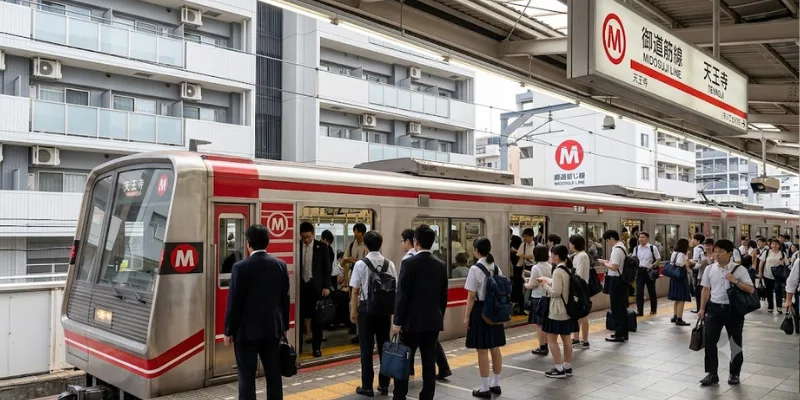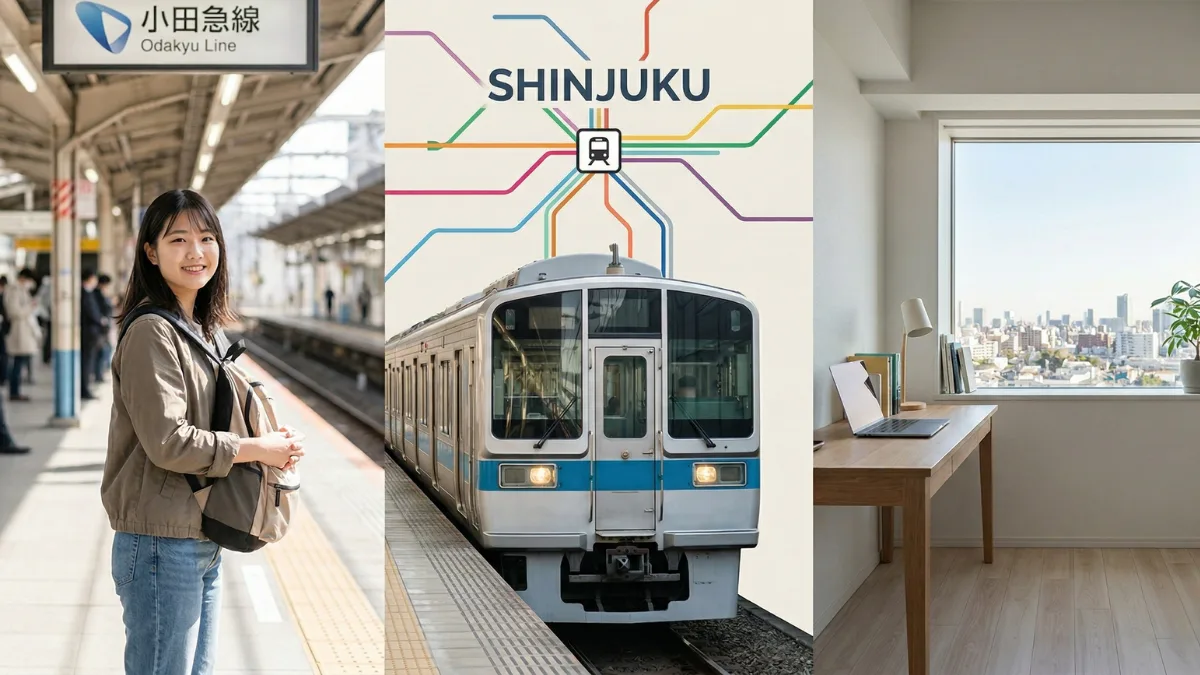

Students get the fastest, most reliable commute to Shinjuku by living directly on the JR Chuo, Odakyu, or Keio lines — no-transfer stations like Nakano, Sasazuka, or Kyodo cut travel time while keeping rent 15–30% below units within 5 minutes of Shinjuku Station itself.
Navigating the real estate market in a foreign country is a significant milestone for international scholars moving to Japan. Shinjuku Station stands as the primary transportation hub of Tokyo, facilitating the commute of over 3.5 million passengers daily across 11 different railway lines. Securing direct train access to Shinjuku for students is a strategic decision that balances academic commitments with the vibrant lifestyle of Japan’s capital. This guide provides professional insights into finding the ideal apartments in Japan, focusing on connectivity, budgeting, and the logistical advantages of living along major Shinjuku-bound arteries.
Direct Lines to Shinjuku — Quick Facts
| Fact | Detail |
|---|---|
| Daily passengers through Shinjuku Station | 3.5+ million across 11 railway lines |
| JR Chuo Line stops | Nakano, Koenji — 1–2 stops, no transfer |
| Odakyu Line stops | Kyodo, Seijo-gakuen-mae — quieter, more residential |
| Keio Line stops | Sasazuka (5 min), Meidaimae (dual access to Shibuya) |
| Rent, 0–5 min walk from station | ¥90,000+ (1K) |
| Rent, 5–10 min walk | ¥75,000–¥85,000 (1K) |
| Rent, 15+ min walk | Under ¥70,000 (1K) |
| Typical move-in cost | ¥400,000+ (3–5x monthly rent) |
The Advantage of Direct Train Access to Shinjuku for Students
Choosing a residence with a “no-transfer” connection to Shinjuku simplifies daily life and reduces the physical exhaustion associated with long-distance travel. Direct access means a student can board a train near their home and disembark at Shinjuku Station without changing lines, which is a critical factor for maintaining a consistent study schedule.
Efficiency in Academic and Professional Life
Direct routes provide predictable travel times, allowing students to manage their seminars and part-time jobs with precision. When students reside in apartments in Tokyo Japan located on lines like the Chuo or Yamanote, they gain back hours of personal time every week. This efficiency is paramount if the student’s university or language school is located within the Shinjuku, Yoyogi, or Takadanobaba areas.
Cost-Effectiveness of Commuter Passes
The Japanese railway system offers deep discounts for students through the Teikiken or commuter pass. This pass allows for unlimited travel between a student’s home station and their school station. If a student chooses an apartment for rent Japan on a direct line, the cost of the pass is often lower than routes requiring multiple transfers across different railway companies.
Enhanced Safety and Convenience
Direct lines often run late into the night, providing a safer environment for students who may be returning from evening library sessions or social gatherings. Notable examples of direct lines to Shinjuku include:
- The JR Chuo Line: Known for its rapid service from western Tokyo suburbs like Mitaka, Nakano, and Kichijoji.
- The Odakyu Line: Offering affordable housing options in residential areas such as Setagaya, Machida, and Tama.
- The Keio Line: Connecting students to quieter neighborhoods like Chofu, Fuchu, and Hashimoto while maintaining a fast transit time.
Understanding the Market for Apartments in Japan
The landscape for apartments in Japan is diverse, ranging from traditional wooden structures to modern high-rise “mansions.” For an international student, understanding these distinctions is necessary to make an informed financial commitment.
Types of Housing for International Students
International students typically choose between three main types of housing, each offering different levels of privacy and price points:
- Gaijin Houses (Share Houses): Fully furnished rooms with shared kitchens and bathrooms, ideal for those seeking an immediate community.
- Standard Apartments (Apāto): Usually two-story wooden or light-steel buildings that are more affordable but may have less soundproofing.
- Mansions: Concrete buildings with three or more floors, offering better insulation and security features like auto-locks and video intercoms.
Essential Rental Terminology
When searching for a japan tokyo apartment rent, students will encounter specific codes describing the layout. A “1K” refers to one room with a separate kitchen, while a “1R” (One Room) means the kitchen is located within the main living area. Understanding these terms ensures that the student selects a layout that fits their lifestyle if they require a dedicated space for intensive studying.
Navigating the Costs of Japan Tokyo Apartment Rent
Budgeting for a japan tokyo apartment rent involves more than just the monthly payment. Initial costs in Japan can be substantial, often requiring a sum equivalent to three to five months of rent upfront.
Common Upfront Fees
Students must prepare for several one-time payments when signing a lease:
- Shikikin (Security Deposit): Usually one month’s rent, used for repairs after move-out.
- Reikin (Key Money): A non-refundable “gratuity” paid to the landlord, though many modern apartments now waive this fee.
- Hoshonin-ryo (Guarantor Company Fee): Since most students do not have a Japanese relative to act as a guarantor, they pay a company to provide this legal assurance.
Monthly Utilities and Management Fees
In addition to the base rent, tenants are responsible for the Kanrihi (Management Fee), which covers the maintenance of common areas like hallways and trash collection points. Utilities such as electricity, water, and gas are typically billed separately. Students can save significantly if they find apartments in Tokyo Japan that include high-speed internet in the monthly rent, as separate contracts can be expensive.
Best Neighborhoods with Direct Train Access to Shinjuku
Finding the right balance between rent prices and proximity to Shinjuku is the core of a successful housing search. Several neighborhoods offer excellent value for apartments in Japan while maintaining a direct connection to the world’s busiest station.
The Chuo Line: Nakano and Koenji
Nakano is just one stop away from Shinjuku via the JR Chuo Limited Express. It is a haven for students due to its vibrant “Nakano Sun Mall” shopping arcade and affordable dining options. Koenji, the next station over, is famous for its thrift stores and live music venues, offering a unique cultural experience for international residents. These areas provide a dense concentration of apartments for rent Japan specifically designed for single occupants.
The Odakyu Line: Kyodo and Seijo-gakuen-mae
The Odakyu Line is highly recommended for students looking for a quieter, more residential atmosphere. Neighborhoods like Kyodo offer a suburban feel with plenty of supermarkets and parks. These areas provide high-quality apartments in Tokyo Japan that are often newer and more spacious than those found in the immediate city center. Commuting from here is seamless if you utilize the “Express” trains that bypass smaller stations.
The Keio Line: Sasazuka and Meidaimae
Sasazuka is a hidden gem located only five minutes from Shinjuku. It features a local shopping street (shotengai) where groceries are significantly cheaper than in central Tokyo. Meidaimae is a major transfer point but also a residential hub, providing direct access to both Shinjuku and Shibuya. This dual-access makes it one of the most sought-after locations for students who attend classes in different parts of the city.
ARealty: Your Professional Partner in Tokyo Housing
Finding a home in a foreign language can be a daunting task, especially when trying to ensure direct train access to Shinjuku for students. ARealty specializes in bridging the gap between international residents and the Japanese real estate market.
At ARealty, we understand that students need more than just a roof over their heads; they need a location that fosters success. Our team provides comprehensive support, ensuring that you understand every clause of your contract. We maintain an extensive portfolio of apartments in Tokyo Japan that are specifically selected for their proximity to major transit lines and student-friendly amenities.
Premier ARealty Apartment Examples Near Shinjuku
Below are specific examples of high-quality residences managed or offered through ARealty in prime locations with direct or near-direct access to Shinjuku:
- Residia Shinjuku East III:
- Location: Situated in Shinjuku-ku, Tokyo.
- Access: A 6-minute walk to Shinjukusanchoume Station, serving the Tokyo Metro Marunouchi, Fukutoshin, and Toei Shinjuku lines.
- Details: A 1K unit (20.43 $m^2$) located on the 9th floor of an 11-story reinforced concrete building.
- Cost: Total monthly fee is approximately 166,000 JPY.
- Residia Shinjuku East II:
- Location: Prime central Shinjuku area.
- Access: 6-minute walk to Shinjukusanchoume Station.
- Features: Includes auto-locks, air conditioning, and a washlet toilet.
- Cost: Total monthly fee is approximately 164,650 JPY with an initial estimated cost of 391,650 JPY.
- Well Square Shin-Nakano II – 101:
- Location: Nakano, Nakano-ku, Tokyo.
- Access: 6-minute walk to Shinnakano Station (Marunouchi Line) and 8-minute walk to Nakano Station (JR Chuo Line).
- Space: A larger 1DK layout (30.99 $m^2$) in a modern building constructed in 2026.
- Cost: Total monthly fee of 168,000 JPY.
Ready to see what’s available? Browse current Shinjuku apartment listings filtered by station distance, or contact ARealty to curate a shortlist based on your specific budget and university location.
Detailed Financial Planning for Students in Tokyo
To maintain a healthy financial status, students must account for the high cost of living in the capital. While direct train access to Shinjuku for students saves on transit time, it often comes with a premium on rent.
Average Rent Prices by Station Distance
Rent generally decreases as the walking distance from the station increases. For example:
- 0-5 minutes walk: Rent may exceed 90,000 JPY for a 1K apartment.
- 5-10 minutes walk: Rent typically ranges between 75,000 and 85,000 JPY.
- 15+ minutes walk: High-quality apartments in Japan can be found for under 70,000 JPY.
Managing Initial Move-in Expenses
If a student finds a japan tokyo apartment rent listed at 80,000 JPY, the initial move-in cost might look like this:
- First Month Rent: 80,000 JPY.
- Security Deposit (Shikikin): 80,000 JPY.
- Key Money (Reikin): 80,000 JPY.
- Agency Fee: 88,000 JPY (including tax).
- Fire Insurance: 20,000 JPY (for 2 years).
- Guarantor Fee: 40,000 JPY to 80,000 JPY.
Totaling these figures often results in an upfront payment of 400,000 JPY or more. Students should look for “Zero-Zero” properties (No Deposit, No Key Money) to lower this barrier.
Legal Rights and Contractual Obligations
The Japanese rental system is governed by strict laws that protect both the landlord and the tenant. When signing a lease for an apartment for rent Japan, it is vital to understand the “Standard Term” vs. “Fixed Term” lease.
Standard Term Lease (Futsu Chintai)
This is the most common contract. It typically lasts two years and is automatically renewable. The landlord cannot refuse a renewal without “just cause,” providing significant security for the student. If the student wishes to renew, they usually pay a Koushinryo (renewal fee) equivalent to one month’s rent.
Fixed Term Lease (Teiki Chintai)
This contract has a strict end date and does not automatically renew. If a student chooses this for their apartments in Tokyo Japan, they must move out at the end of the term unless both parties agree to sign a completely new contract. These are often cheaper but offer less long-term stability.
Cleaning Fees and Restoration
Upon moving out, tenants are responsible for returning the room to its original state, minus “normal wear and tear.” Most contracts specify a mandatory professional cleaning fee. To avoid disputes, students should take photos of every corner of the apartment upon move-in if they find any pre-existing damage.
These lease structures are governed under Japan’s Act on Land and Building Leases — for the full legal text, the Japan Ministry of Land, Infrastructure, Transport and Tourism publishes official guidance for tenants and landlords.
Essential Considerations for International Tenants
Living in apartments in Japan requires an adjustment to local customs and regulations. Adhering to these rules ensures a harmonious relationship with neighbors and the landlord.
Garbage Disposal Rules
Japan has strict waste separation categories. Residents must separate trash into:
- Burnable waste: Such as food scraps, paper, and small rubber items.
- Non-burnable waste: Including glass, light bulbs, and small electronics.
- Recyclables: Specifically PET bottles, aluminum cans, and cardboard.
Failure to follow these rules can lead to complaints from the neighborhood association or the refusal of garbage collection services.
Noise Etiquette
Many apartments for rent Japan are built in close proximity to one another. It is expected that residents keep noise levels to a minimum, especially between 10:00 PM and 7:00 AM. Examples of noise to avoid during these hours include:
- Using high-suction vacuum cleaners.
- Operating laundry machines.
- Speaking loudly on balconies or near open windows.
Internet Connectivity
Not all apartments in Japan come with pre-installed internet. If the building is “Fiber Optic Ready” (Hikari Kyotsu), the student still needs to contract with a Provider (ISP) and a Line Operator. If the building has “Free Wi-Fi,” it may be shared among all tenants, which can lead to slow speeds during peak study hours.
Frequently Asked Questions
The JR Chuo Line offers the fastest connection from western Tokyo via its rapid/limited express services, with Nakano just one stop from Shinjuku.
For students with tight class schedules or late-night commutes, yes — but 5–10 minute walks on a direct line (like Sasazuka on the Keio Line) often offer nearly the same convenience for ¥10,000–¥15,000 less per month.
Nakano and Koenji on the Chuo Line, and Sasazuka on the Keio Line, are the strongest combinations of short commute time and student-friendly rent.
Yes, and it’s usually cheaper than a pass covering multiple transfers — most universities and language schools offer discounted student Teikiken rates.
A Standard Term (Futsu Chintai) lease auto-renews and gives tenants strong protection; a Fixed Term (Teiki Chintai) lease ends on a set date with no automatic renewal, but is often cheaper.
They exist, especially further from the station or on less central lines, and can meaningfully lower the roughly ¥400,000 typical move-in cost.
Conclusion
Securing direct train access to Shinjuku for students is more than a matter of convenience; it is a foundational step toward a successful life in Japan. By eliminating the stress of complex transfers and reducing daily transit time, students can dedicate more energy to their studies, cultural exploration, and personal well-being. Whether you prioritize the modern amenities of mansions or the community feel of a shared apartment for rent Japan, your choice of location along major arteries like the Chuo, Odakyu, or Keio lines will define your Tokyo experience.
The Japanese rental market for apartments in Japan is structured around long-term stability and mutual respect. Understanding the financial nuances and social etiquette ensures a harmonious stay. As you prepare to transition into your new home, remember that the most successful international residents are those who research thoroughly and seek professional guidance to navigate the local real estate landscape.

Real estate advisor at Arealty Japan, specialising in helping foreign residents navigate the Tokyo and Osaka rental markets. Lucy has guided hundreds of international renters — from Working Holiday visa holders to corporate relocations — through Japan’s apartment application process. Her writing draws on firsthand experience with landlord screening, guarantor companies, and foreigner-friendly listings across all 23 Tokyo wards and major Kansai cities.