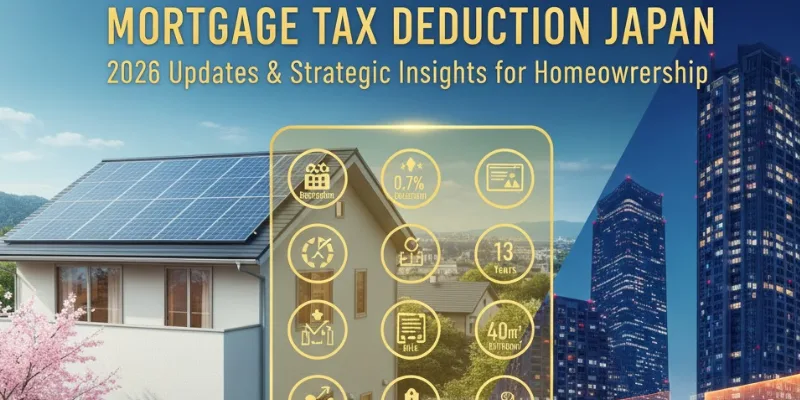

Transitioning from renting apartments in Japan to homeownership is a pivotal financial move for international residents. With the arrival of 2026, the Japanese government has introduced significant updates to the Mortgage Tax Deduction Japan (Jutaku-loan Kojo). These changes are designed to support a wider range of residents—from those paying high Japan Tokyo apartment rent to families seeking more permanent roots.
In an era of rising construction costs and record-high prices for apartments in Tokyo Japan, understanding these tax credits is no longer optional; it is the key to financial sustainability.
What is the Mortgage Tax Deduction Japan?
The Mortgage Tax Deduction Japan is a government-sponsored tax credit that allows homeowners to deduct a portion of their outstanding mortgage balance directly from their annual taxes. Unlike a standard deduction that reduces taxable income, this is a tax credit, meaning it provides a yen-for-yen reduction in the actual tax you owe.
As of the 2026 tax reform, the system has been officially extended through 2030. Eligible residents can deduct 0.7% of their year-end loan balance from their income tax for up to 13 years. If your income tax liability is lower than the credit amount, the surplus is deducted from your municipal inhabitant tax, capped at 97,500 yen per year.
Primary Benefits for Residents:
- Direct Tax Refunds: Most homeowners receive a substantial cash refund every spring after filing their taxes.
- Interest Offset: Given that many variable mortgage rates in Japan remain near 0.3%–0.5%, the 0.7% tax credit often exceeds the interest paid, effectively creating “interest-free” or “profit-generating” loans.
- Equity Growth: The funds saved through tax credits can be reinvested into the property or used to pay down the principal faster.
Crucial 2026 Updates: What Has Changed?
The 2026 updates represent a major shift in policy, focusing on flexibility for small households and revitalizing the second-hand market. If you have been living in apartments in Japan and waiting for the right moment to buy, these changes may accelerate your timeline.
Extension for Second-Hand Homes
One of the most significant 2026 updates is the expansion of the deduction period for used properties. Previously limited to 10 years, second-hand homes that meet modern energy-efficiency or “Long-life Quality” standards now qualify for the full 13-year deduction period. This makes older apartments in Tokyo Japan significantly more attractive from an investment perspective.
Relaxation of Floor Area Requirements
The 2026 reform has permanently extended the relaxed floor area requirement. While the standard remains 50 $m^2$, residents with an annual income of 10 million yen or less can now claim the deduction for properties as small as 40 m^2. This is a vital change for professionals currently paying high Japan Tokyo apartment rent for central 1LDK units who wish to purchase a similar-sized home.
Increased Borrowing Limits for Families
To combat rising housing prices, the 2026 policy maintains higher borrowing limits for households with children or “young couple” households (where at least one spouse is under 40). For these groups, the eligible loan limit for a “Long-life Quality” home remains at 50 million yen, compared to the 45 million yen cap for standard households.
Exclusion of Disaster-Risk Zones
In a new safety-focused regulation, new constructions located in designated “High-Risk Disaster Zones” (areas prone to landslides or severe flooding) are no longer eligible for the tax deduction. This encourages buyers to prioritize safety and long-term land value when moving out of rental apartments in Japan.
Eligibility Criteria for Foreign Residents
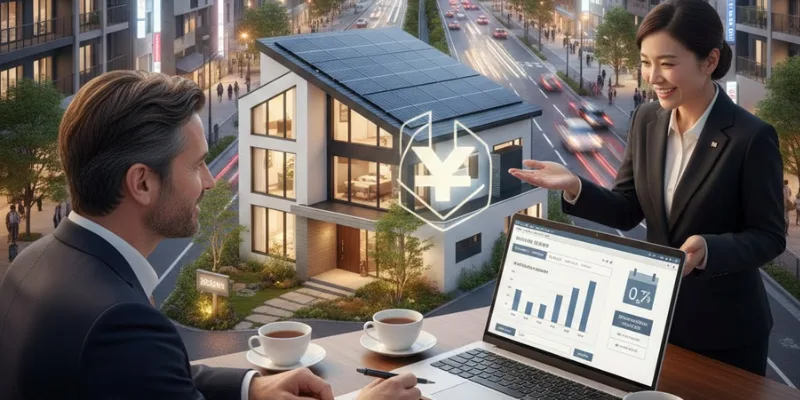
The Mortgage Tax Deduction Japan is available to foreign citizens, provided they are residents for tax purposes and meet the following criteria:
- Residency: You must move into the property within six months of purchase and remain a resident there.
- Income Limit: Your total annual income must be 20 million yen or less (lowered to 10 million yen for homes between 40 $m^2$ and 50 $m^2$).
- Loan Term: The mortgage must be from a Japanese bank or financial institution with a term of at least 10 years.
- Environmental Performance: Since 2024, new homes must meet at least “Energy Conservation Standards” to qualify. Non-compliant “Other Housing” no longer receives the deduction.
Concrete Examples of Qualifying Properties:
- ZEH (Net Zero Energy House): A modern apartment that generates its own energy, qualifying for a 35 million yen loan limit.
- Renovated Pre-owned Condo: A 1990s unit in central Tokyo that has been retrofitted with high-efficiency insulation and double-paned windows.
- Compact Urban Home: A 42 $m^2$ apartment near a major station, purchased by a resident earning 8 million yen annually.
Comparing Renting vs. Buying in the 2026 Market
The cost of apartments in Tokyo Japan hit record highs in early 2026, driven by rising material costs and a weak yen. However, the Japan Tokyo apartment rent market has also seen upward pressure, with many landlords raising rents during renewals.
The Financial Transition
Consider a resident paying 220,000 yen for an apartment for rent Japan. Over 13 years, they will pay roughly 34 million yen in rent.
By purchasing a 45 million yen “Long-life Quality” home:
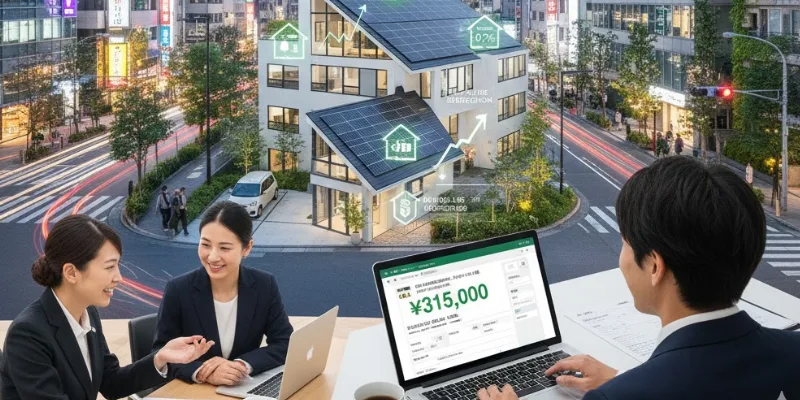
- They receive up to 315,000 yen in annual tax refunds.
- Over 13 years, the total tax savings can exceed 4 million yen.
- The resident essentially “earns back” a significant portion of their property tax and insurance costs through government incentives.
ARealty: Your Professional Real Estate Partner
Navigating the 2026 real estate landscape requires more than just a search engine; it requires a specialized partner who understands the intersection of immigration, finance, and tax law. ARealty is a premier real estate firm dedicated to helping international residents navigate the transition from renting apartments in Japan to becoming successful homeowners.
At ARealty, we provide bilingual support to ensure you understand every clause of your contract. We specifically screen properties for “Disaster-Risk Zone” status and energy-efficiency certifications, ensuring your home is both safe and eligible for the maximum Mortgage Tax Deduction Japan. Whether you are looking for a luxury residence or a compact urban unit to escape the rising Japan Tokyo apartment rent, ARealty is your bridge to a secure future.
Are you ready to stop paying rent and start building equity? Contact ARealty today for a personalized tax simulation and a curated list of properties that qualify for the 2026 deduction rules.
How to Apply: A Step-by-Step Guide
The application process is a critical part of securing your 0.7% credit. Missing a deadline can result in the loss of thousands of dollars in refunds.
Year One: The Final Tax Return (Kakutei Shinkoku)
In the first year after you move in, you must file a tax return at your local tax office (Zeimusho) between February 16 and March 15.
- Documents Needed: Loan balance certificate from your bank, the property’s sales contract, a certified copy of the Real Estate Register, and certificates proving the home’s energy-efficiency rating.
- Special 2026 Note: You may also need to provide a “Hazard Map” confirmation to prove the property is not in a restricted disaster zone.
Year Two Onwards: Year-End Adjustment
For salaried employees, the process is automated from the second year. Your employer will handle the deduction during the “Year-End Tax Adjustment” (Nenmatsu Chousei). You simply submit the loan balance certificate from your bank and the “Deduction Certificate” (sent to you by the tax office after your first successful filing) to your company’s HR department.
Strategic Considerations for Used Properties
With the 2026 extension of the deduction period to 13 years for certain used homes, many residents are looking at pre-owned apartments in Tokyo Japan. This is a smart way to find central locations without the 25%–40% price premium of new-build units.
Key Factors for Used Home Buyers:
- Seismic Standards: Ensure the building was constructed after 1982 or has a seismic certificate.
- Renovation Loans: If you take a loan for both the purchase and the renovation, the renovation costs may also be eligible for the 0.7% deduction, provided the work exceeds 1 million yen.
- Borrowing Limits: Standard used homes are capped at a 20 million yen loan limit, while “Energy Efficient” used homes can reach 30 million yen (or 45 million for families in 2026).
Common Pitfalls for Foreign Residents
Even with professional help, you must be aware of certain “tax traps” that could disqualify you from the Mortgage Tax Deduction Japan.
- The Primary Residence Rule: You must live in the property. If you move out and rent it to someone else while you move back into an apartment for rent Japan, your eligibility stops immediately.
- The Refinancing Trap: If you refinance your loan to a term shorter than 10 years, you will lose the remaining years of your tax credit.
- The Income Barrier: If your career takes off and your annual income exceeds 20 million yen in a specific year, you cannot claim the deduction for that year.
Conclusion
The Mortgage Tax Deduction Japan remains the most powerful financial tool for residents to combat rising living costs. By moving from the cycle of apartments in Japan and paying ever-increasing Japan Tokyo apartment rent to owning a sustainable, energy-efficient home, you are making an investment in your stability and wealth.
The 2026 reforms have made it easier for small households to enter the market and have significantly increased the value of second-hand properties. As the market for apartments in Tokyo Japan continues to evolve, staying informed and partnering with experts like ARealty will ensure you maximize every available yen of government support.

Real estate advisor at Arealty Japan, specialising in helping foreign residents navigate the Tokyo and Osaka rental markets. Lucy has guided hundreds of international renters — from Working Holiday visa holders to corporate relocations — through Japan’s apartment application process. Her writing draws on firsthand experience with landlord screening, guarantor companies, and foreigner-friendly listings across all 23 Tokyo wards and major Kansai cities.