
Quick answer
Moving from Tokyo to Osaka costs about ¥80,000 to ¥100,000 for a single person using a full-service mover outside peak season. A single-person container plan can cut that to around ¥30,000. A couple pays about ¥180,000, and the same moves cost roughly 1.5 to 1.7 times more in March and April.
The road trip is about 400 km, so most movers deliver the next day or within two days. You can travel ahead by Shinkansen in about 2.5 hours for ¥14,720. Before you pack, check your appliances: Tokyo runs on 50Hz electricity and Osaka on 60Hz, and some washing machines and microwaves will not work after the move.
At Arealty, we help clients relocate between our Tokyo and Osaka listings every month. This guide covers what the move costs, which paperwork to file in each city, and how to time everything so you are never without a home or hot water.
| Key fact | Detail (2026) |
|---|---|
| Distance by road | About 400 km |
| Mover delivery time | Next day to 2 days |
| Single, full-service mover | ¥79,600 to ¥99,300 (May to February) |
| Single, container plan | From about ¥29,700 |
| Couple, full-service mover | About ¥177,000 normal season, ¥283,000 in March and April |
| Shinkansen, Tokyo to Shin-Osaka | ¥14,720 reserved seat, about 2.5 hours |
| Electricity frequency | Tokyo 50Hz, Osaka 60Hz |
| Address paperwork | Moving-out notice in Tokyo, moving-in notice in Osaka within 14 days |
| Typical Osaka 1K rent | About ¥58,000 to ¥75,500 per month |
How much does moving from Tokyo to Osaka cost?
The cost depends on three things: how much you own, when you move, and which service you choose. The table below shows average prices paid by people who booked a Tokyo to Osaka move through Hikkoshi Samurai, one of Japan’s largest moving comparison sites.
| Household | Normal season (May to February) | Peak season (March and April) |
|---|---|---|
| Single, few items | ¥79,561 | ¥110,540 |
| Single, many items | ¥99,287 | ¥126,802 |
| Single, container plan (studio) | ¥29,700 | Limited availability |
| Couple | ¥177,188 | ¥282,750 |
| 1LDK (by layout) | ¥108,673 | ¥173,877 |
| 2LDK (by layout) | ¥199,393 | ¥341,944 |
| 3LDK (by layout) | ¥257,615 | ¥447,418 |
Source: Hikkoshi Samurai, Tokyo to Osaka moving costs. Figures are averages from user surveys, so your quote may differ.
Option 1: Full-service mover
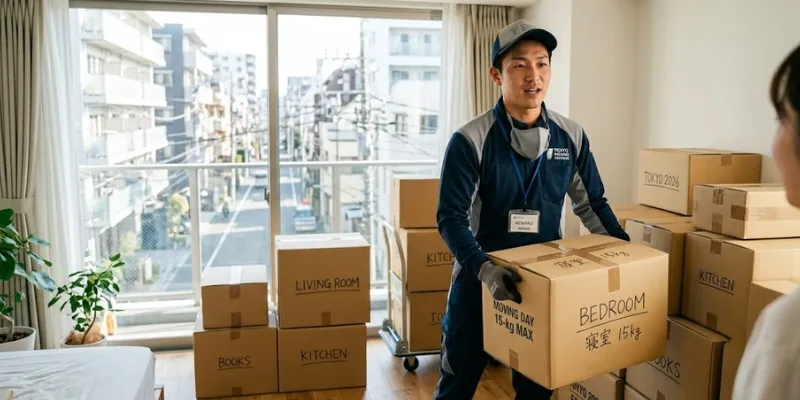
A full-service mover packs, loads, drives, and unloads. This is the easiest option for families and anyone with large furniture. Expect next-day delivery in most cases, or two days during busy periods. If you want English support, compare the companies in our guide to moving companies with English support in Tokyo. Nippon Express, Sakai, and Yamato all cover the Tokyo to Osaka route nationwide.
Option 2: Single-person container plan
Yamato, Nippon Express, and Sakai offer small-load plans where your belongings go into a fixed-size cage, usually around 1 m wide and 1.75 m tall. Prices start near ¥30,000, which makes this the cheapest option for students and minimalists. The trade-offs are real: large furniture will not fit, you pack everything yourself, and delivery can take three to five days with no time slot.
Option 3: Do it yourself
Renting a van for 24 hours costs around ¥9,500 to ¥12,800, before fuel and expressway tolls. On a 400 km trip, tolls and fuel add a significant amount, and you need to return the vehicle in Osaka or drive back. DIY makes sense only if you have a driving license valid in Japan, very few belongings, and friends to help.
Is it cheaper to sell everything and rebuy in Osaka?
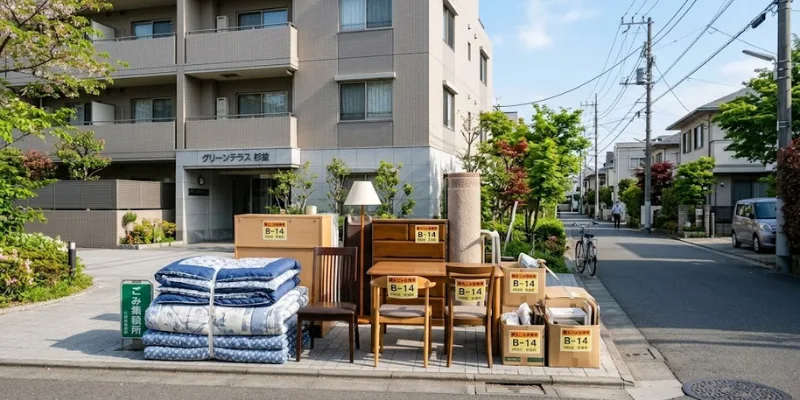
Sometimes. If a mover quotes you ¥200,000 for a full one-room move, selling cheap furniture and rebuying basics in Osaka can save money. But disposal fees, rebuying costs, and the time involved often cancel out the savings. A good middle path is to ship boxes and valuable items with a container plan, and sell only bulky, low-value furniture. If you throw items away, book Tokyo’s sodai gomi (oversized garbage) collection two to three weeks ahead.
How to lower your moving cost
- Avoid March and April. Peak prices run 1.5 to 1.7 times higher, and slots sell out.
- Move on a weekday. Weekend moves cost more because demand is higher.
- Choose a flexible time slot. Free-time plans, where the mover picks the start time, are cheaper.
- Get at least three quotes. Japanese moving prices are negotiable, and quotes for the same move can differ by tens of thousands of yen.
- Ask your employer. If you are transferring for work, your company may cover the move.
What paperwork do you need when moving from Tokyo to Osaka?
Because you are changing city, you file paperwork in both places. Most of it is free, but deadlines matter.
| Task | Where | When |
|---|---|---|
| Moving-out notice (tenshutsu todoke) | Your Tokyo ward office, or online with a My Number Card | Up to 14 days before you move |
| Moving-in notice (tennyu todoke) | Your new Osaka ward office | Within 14 days of moving in |
| Residence card address update | Osaka ward office, done with the moving-in notice | Same visit |
| National Health Insurance | Cancel in Tokyo, enroll in Osaka | Same time as address notices |
| Japan Post mail forwarding | Online or any post office | 1 to 2 weeks before |
| Driver’s license address | Osaka police station or license center | After moving in |
| Bank, employer, phone, credit cards | Online or in person | After your new address is registered |
Bring your residence card, passport, the moving-out certificate from Tokyo (if you filed on paper), and My Number Card if you have one. Our address registration guide explains each form in detail.
If you have a car, you also need a parking certificate in Osaka and a vehicle registration change. Start these early, because they require a confirmed parking space.
Will your appliances work in Osaka? The 50Hz and 60Hz problem
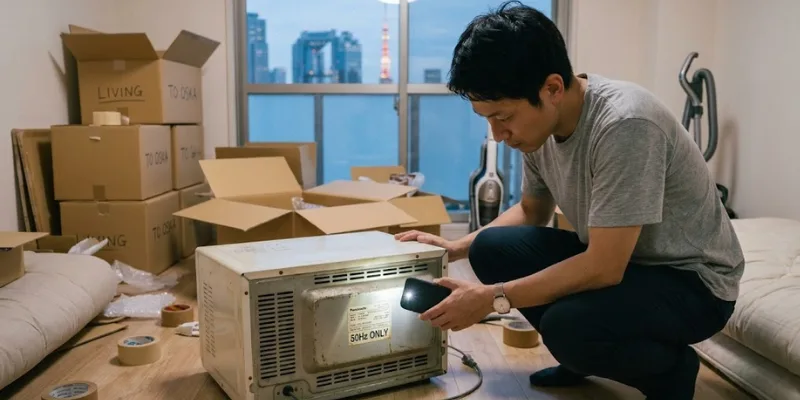
This is the mistake that catches most people moving from Tokyo to Osaka. Eastern Japan, including Tokyo, runs on 50Hz electricity. Western Japan, including Osaka, Kyoto, and Kobe, runs on 60Hz. Voltage is the same (100V), but frequency is not.
| Appliance type | Works after moving? |
|---|---|
| TV, PC, vacuum, air conditioner, toaster, LED lights | Yes, works anywhere |
| Fridge, fan, air purifier, humidifier | Works, but performance may change unless inverter-type |
| Older washing machines, older microwaves, fluorescent light fittings | May not work without parts replacement |
Check the label on the side or back of each appliance, or the spec page in the manual. A label reading 50/60Hz, often called hertz-free, works in both cities. A label reading 50Hz only needs adjustment or replacement before it will work properly in Osaka, as Sharp explains for washing machines. If an old 50Hz-only washer or microwave needs new parts, replacing it is often cheaper than moving it.
How do you set up utilities in Osaka?
Cancel your Tokyo services and start new ones in Osaka about one to two weeks before your move.
- Electricity: Kansai Electric Power is the default supplier, but you can choose another retailer. Apply online and switch on the breaker when you arrive.
- Gas: Osaka Gas serves most of the city. Gas requires a technician visit to open the line, so book a time slot on move-in day or the day after.
- Water: Apply to the Osaka City Waterworks Bureau or your local water authority. Water is often already running.
- Internet: Fiber installation can take two to six weeks. Order as soon as your lease is signed.
For step-by-step instructions, see our guide to setting up utilities in a Japanese apartment.
How are Osaka leases different from Tokyo?
Most rules are the same, but one Kansai clause surprises people moving from Tokyo to Osaka: shikibiki. Under shikibiki, a fixed amount of your deposit is kept by the landlord when you move out, even if the apartment is spotless. Always ask for the deducted amount in writing before you sign.
Osaka is also much cheaper. A 1K studio costs about ¥58,000 to ¥75,500 per month in most Osaka City wards, compared with well over ¥100,000 for a typical single unit in Tokyo’s 23 wards. Many Osaka listings now offer zero key money. Our Osaka apartment for rent guide breaks down rent by ward and the full move-in cost.
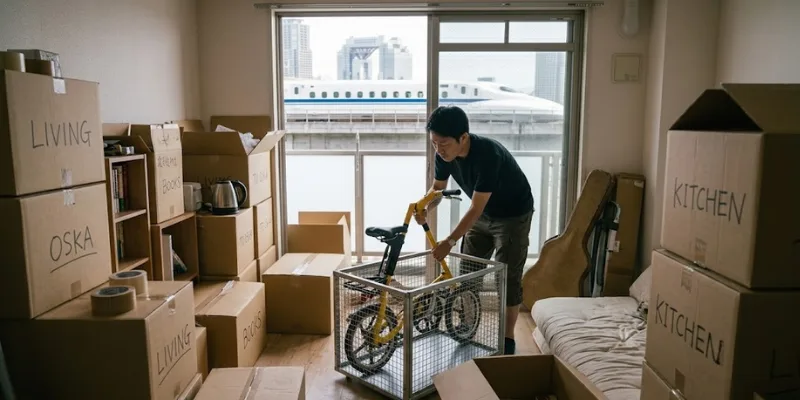
Moving from Tokyo to Osaka: week-by-week timeline
Plan on six to eight weeks from deciding to move until your first night in Osaka. Use this as a working plan.
8 to 6 weeks before
- Give notice on your Tokyo apartment. Most leases require one to two months.
- Start searching for your Osaka apartment and request viewings, online if you cannot travel.
- Check every appliance label for 50Hz or 50/60Hz.
6 to 4 weeks before
- Sign your Osaka lease and confirm the key handover date.
- Get three moving quotes and book your mover.
- Order internet for the new apartment.
- List items to sell, give away, or throw away.
4 to 2 weeks before
- Book oversized garbage collection in Tokyo.
- Book your Shinkansen ticket if traveling on a busy day.
- Arrange electricity, water, and the Osaka Gas opening visit.
- File your moving-out notice at your Tokyo ward office.
- Set up Japan Post mail forwarding.
Moving week
- Pack an overnight bag with documents, residence card, chargers, and two days of clothes.
- Attend the Tokyo move-out inspection and photograph the empty apartment. Our move-out inspection guide explains how to protect your deposit.
- Travel by Shinkansen and receive your belongings in Osaka.
- Meet the gas technician.
Within 14 days of arriving
- File your moving-in notice at your Osaka ward office.
- Enroll in National Health Insurance if applicable.
- Update your address with your bank, employer, and phone provider.
Where should you live after moving from Tokyo to Osaka?
Choose by train line first, then by ward. Osaka’s Midosuji Line links Shin-Osaka, Umeda, Namba, and Tennoji, so living near it keeps most of the city within 20 minutes.
- Umeda and Kita: best for office workers in central Osaka. See our Osaka Kita apartments guide.
- Shin-Osaka: ideal if you still travel to Tokyo for work, since every Shinkansen stops here. Read living in Shin-Osaka.
- Esaka: a quieter, family-friendly option on the Midosuji Line, just north of the city. Read living in Esaka.
- Namba and Tennoji: best for nightlife, shopping, and Kansai Airport access.
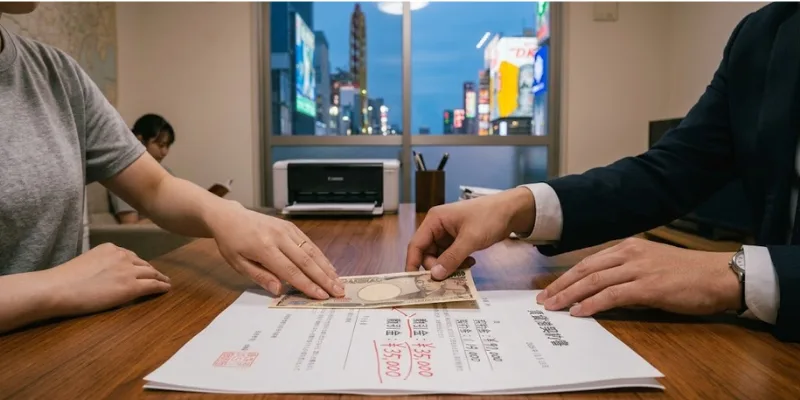
FAQ
A single person typically pays ¥80,000 to ¥100,000 with a full-service mover outside March and April, or about ¥30,000 with a container plan. A couple pays around ¥177,000 in normal season.
The drive is about 400 km. Most movers load on day one and deliver on day one or day two.
The Nozomi Shinkansen costs ¥14,720 for a reserved seat and takes about 2.5 hours from Tokyo Station to Shin-Osaka. Budget flights can be cheaper, but once you add airport transfers, the Shinkansen is usually faster door to door.
Only if its label says 50/60Hz. A 50Hz-only machine needs parts replaced or adjustment before it works properly on Osaka’s 60Hz power.
Yes. File a moving-out notice in Tokyo, then a moving-in notice at your Osaka ward office within 14 days of arriving.
Yes. Rent for a single unit in Osaka City is roughly half the Tokyo 23-ward average, and many listings offer zero key money.
Find your Osaka apartment before you move
The hardest part of moving from Tokyo to Osaka is finding a home from 400 km away. Arealty’s English-speaking team handles viewings, applications, and guarantor setup for Osaka apartments, so you can sign your lease before you leave Tokyo.
Sources
- Hikkoshi Samurai: Tokyo to Osaka moving costs (updated April 2025)
- Sharp: Checking power frequency when moving
- Arealty: Osaka apartment for rent 2026
- Japantrain: Tokyo to Osaka Shinkansen 2026 fares

Real estate advisor at Arealty Japan, specialising in helping foreign residents navigate the Tokyo and Osaka rental markets. Lucy has guided hundreds of international renters — from Working Holiday visa holders to corporate relocations — through Japan’s apartment application process. Her writing draws on firsthand experience with landlord screening, guarantor companies, and foreigner-friendly listings across all 23 Tokyo wards and major Kansai cities.