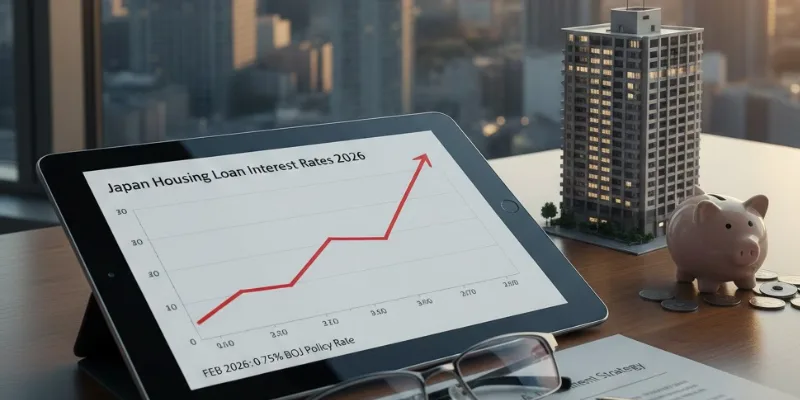

Japan mortgage interest rates in 2026 have moved decisively higher after the Bank of Japan’s June 2026 hike. Variable-rate loans now start in the high-0.9%–1.1% range for well-qualified borrowers, while 10-year fixed rates have climbed above 3.2% at the megabanks.
Quick Rate Snapshot — August 2026
| Loan Type | Current Rate | vs. July 2026 |
|---|---|---|
| Variable (megabank median, best execution) | 1.0% – 1.2% | Held flat (0 change) |
| 10-Year Fixed, preferred rate (MUFG) | 3.59% | +0.24pp |
| 10-Year Fixed, preferred rate (SMBC) | 3.65% | +0.15pp |
| 10-Year Fixed, preferred rate (Mizuho) | 3.35% | +0.15pp |
| Flat 35 (JHF, most common, LTV ≤90%) | 3.290% | Up again — 13th straight monthly record |
Sources: Bank of Japan monetary policy decisions (June 16, 2026); MUFG, SMBC rate sheets (announced May 29, 2026, effective June 2026 new borrowers). Confirm current-month figures directly with each bank before publishing — rates reprice monthly.
Last updated: August 2026 · Reviewed by the Arealty Tokyo licensing team
What Changed: BoJ December 2025 Rate Hike Explained
On December 19, 2025, the Bank of Japan raised its policy rate by 0.25 percentage points — from 0.50% to 0.75%. It was the BoJ’s third hike of the cycle that began in March 2024, when negative interest rates officially ended.
Update — July 30–31, 2026: The BoJ held at 1.00%. The Policy Board voted 8-1 to keep the rate unchanged, with board member Hajime Takata dissenting in favor of a hike to 1.25%. In its quarterly Outlook Report, the BoJ flagged that core inflation is likely to run “clearly above” 2% in the second half of the fiscal year (September 2026–March 2027), citing wage pass-through, rising oil prices, and yen weakness. The next policy decision is due at the September 17–18, 2026 meeting; market-implied pricing puts the odds of a further 25bp hike at roughly a coin flip.
What this means for borrowers: megabank variable rates held flat in the August revision (announced July 31) — the first month without a variable-rate increase since the June hike fully passed through. Fixed rates, by contrast, kept climbing: all five major banks raised their 10-year fixed preferred rates again in August (+0.15 to +0.27 percentage points), and Flat 35 hit its 13th consecutive monthly record high at 3.290%. The gap between variable and Flat 35 is now roughly 2.2 percentage points — the widest it’s been this cycle.
For mortgage borrowers, the hike matters in three concrete ways:
- The Short-Term Prime Rate moved up. Most Japanese banks tie variable mortgages to the Short-Term Prime Rate (短期プライムレート). When the BoJ raises its policy rate, megabanks pass through roughly 0.15–0.20% to variable mortgage rates within 1–2 quarters.
- The 10-year JGB yield jumped. Fixed-rate mortgages track the 10-year Japanese Government Bond. Yields climbed from around 1.40% in November 2025 to 1.85% by April 2026 — and 10-year fixed mortgages followed.
- Megabank “best execution” discounts shrank. Throughout the zero-rate era, banks offered aggressive promotional discounts (often 1.6–1.8% off the displayed rate) to win new business. Those discounts are now narrowing as banks rebuild margin.
Why it matters for you: A ¥40 million mortgage that cost ¥102,000/month at 0.40% in early 2025 now costs roughly ¥112,000/month at 0.65% — about ¥120,000 more per year, or ¥4.2 million over a 35-year term.
A concrete example from the August revision: Mizuho confirms that borrowers who lock in a variable rate of 1.025% or better by September 30, 2026 will see their applied rate rise to 1.275% starting with the January 2027 repayment statement — reflecting the bank’s August 3, 2026 short-term prime rate revision.
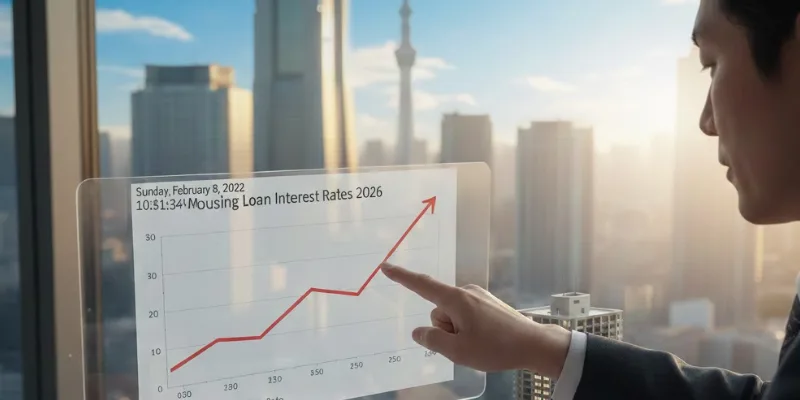
Rising interest rate trends in Japan 2026
Variable vs. Fixed Rates: 2026 Comparison Table
The choice between variable and fixed is the single biggest financial decision you’ll make on a Japanese mortgage. Here’s the 2026 comparison.
| Loan Type | August 2026 Rate | Tied To | Best For | Risk |
|---|---|---|---|---|
| Variable (Floating) | 1.0% – 1.2% | Short-Term Prime Rate | Borrowers with cash reserves; planning early payoff | Payments rise if BoJ hikes again in September |
| 10-Year Fixed (megabank preferred) | 3.35% – 3.65% | 10-Year JGB yield | Mid-term stability; switches to variable after year 10 | Lose protection at year 11 |
| Flat 35 (Full Fixed) | 3.29% (most common) | JHF bond pricing | Long-term residents wanting zero rate risk | Highest current rate; 13 straight months of increases |
Variable rates: still the popular choice, but riskier than they were
Variable rates remain dominant in Japan — about three-quarters of new mortgages still use them (see next section for the data). The pitch is simple: lowest initial payment, lowest total interest if rates stay low.
But the calculation has shifted. With the BoJ in active hiking mode and inflation persistently above 2%, the historical case for “variable always wins” no longer holds automatically. Run a stress test at 2.0% before signing — if you can’t afford the payment at that rate, choose fixed.
Fixed rates: insurance you might actually need
A 10-Year Fixed mortgage protects you against rate hikes for the first decade, then converts to variable. Flat 35 (the JHF-backed product) locks in a single rate for the full 35-year term — the most expensive option upfront, but the only one that fully eliminates rate risk.
Flat 35 is especially attractive in 2026 for two reasons:
- It’s available to foreign residents without permanent residency, on softer income criteria than megabanks
- Recent JHF promotional adjustments have narrowed the gap between Flat 35 and 10-year Fixed to under 0.30%
For a deeper look at how foreign visa status affects your loan options, see our guide to how visa status affects home loans in Japan.
What Percentage of Japanese Borrowers Use Variable Rates?
According to the Japan Housing Finance Agency (JHF) borrower survey for the second half of 2025 (most recent data, published February 2026):
| Loan Type | Share of New Mortgages |
| Variable rate | 75.8% |
| Fixed-period (3, 5, 10-year) | 17.4% |
| Flat 35 (full fixed) | 6.8% |
Variable’s dominance has held steady through three BoJ hikes — but the trend within fixed-period borrowers has shifted notably toward longer lock-in terms. In 2022, most fixed-period borrowers chose 3- or 5-year products. By late 2025, the 10-year option had become the most common, suggesting borrowers expect rates to keep climbing.
The takeaway: Even as the variable share holds, the people choosing fixed are choosing longer fixed. That’s a market signal worth paying attention to.
Data source: JHF Mortgage User Survey, H2 2025 release.
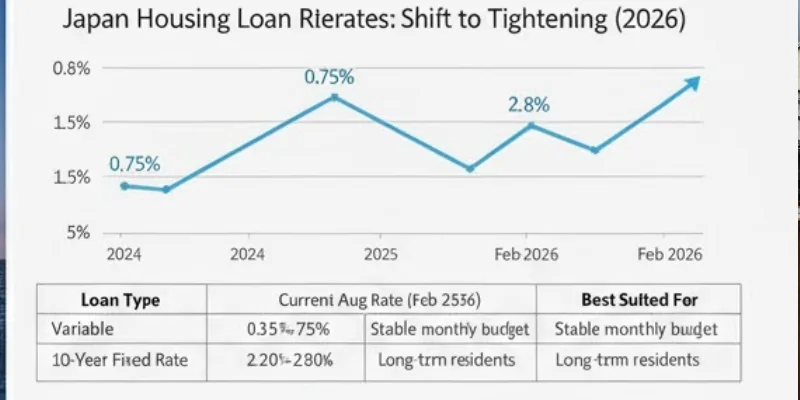
Smart strategies for buying property in Japan.
Flat 35 Monthly Rate History (Jan–Apr 2026)
Flat 35 is the JHF-backed full-term fixed mortgage available through over 300 partner lenders. Its rate is set monthly. Here’s the 2026 trajectory for the most common product (loan-to-value ≤ 90%, 21–35 year term):
| Month | Most Common Rate |
|---|---|
| April 2026 | 2.40% |
| May 2026 | ~2.6%* |
| June 2026 | ~2.9%* |
| July 2026 | ~3.1%* |
| August 2026 | 3.290% |
The “Lowest Rate” column reflects the most competitive lender for that month; the “Most Common Rate” is the modal offer across the lender network; the “Highest Rate” represents lenders with smaller funding bases.
Source: Japan Housing Finance Agency monthly rate publication.
For most foreign borrowers, expect to land near the “Most Common Rate” column — competitive lenders typically reserve their lowest tier for borrowers with PR status and 20%+ down payment.
If You Already Have a Variable-Rate Loan: The 5-Year & 125% Rules
If you signed a variable-rate mortgage before December 2025, two protective clauses cushion the impact of BoJ hikes — but they don’t make the cost go away.
The 5-Year Rule (5年ルール)
Your monthly repayment amount is fixed for five years, even if the underlying interest rate rises during that period. What changes is the split between principal and interest — more of each payment goes to interest, less to principal.
This means: in the short term, your bank statement looks unchanged. In the long term, you’re paying down principal more slowly, so the loan ends up costing more total.
The 125% Rule (125%ルール)
When your 5-year period resets and a new monthly payment is calculated, the new payment cannot exceed 125% of the previous payment. So even if rates spike dramatically, your monthly bill can’t more than double in a 5-year window.
The catch: if the calculated payment would have exceeded 125%, the unpaid interest doesn’t disappear — it accrues as a balloon owed at the end of the loan term. For most borrowers this is unlikely to materialize at current BoJ pace, but it’s a real risk if rates climb above 2.5%.
When does my rate adjustment kick in?
Most Japanese banks use a “Standard Date” (基準日) system to recalculate variable rates twice a year — typically April 1st and October 1st. The new rate then applies starting with the next billing cycle. For most borrowers affected by the December 2025 BoJ hike, the rate adjustment shows up in the July 2026 statement.
Foreigner Eligibility: How to Qualify in 2026
Foreign residents face stricter loan criteria than Japanese citizens, but a Japanese mortgage is absolutely achievable — and the rate you’ll pay is usually within 0.10–0.15% of the citizen rate, not double or triple. Here’s the realistic 2026 picture by visa status.
Permanent Resident (永住権) — Tier 1 access
PR holders qualify for the same products and discounted rates as Japanese citizens at every megabank. Down payment requirements drop to 10–20%, and loan-to-income ratios stretch to 7–8× annual salary. If you’re seriously considering a Japan property purchase, getting PR first is the single biggest financial lever available.
Spouse Visa (日本人の配偶者) — Tier 1 access
Spouse visa holders are treated nearly identically to PR for loan purposes at most major banks. The Japanese spouse may need to co-sign, depending on the bank.
Working Visa (技術・人文知識・国際業務) — Tier 2 access
Working visa holders can borrow at megabanks, but expect:
- Down payment of 20–30% (vs. 10–20% for PR)
- Loan-to-income capped at 5–6× salary (vs. 7–8×)
- Minimum 3 years tenure in Japan, often 5 years
- Annual income above ¥5M for most lenders (¥7M+ to access best rates)
If you’re not yet eligible at a megabank, Flat 35 is your best alternative — it accepts working visa holders with shorter Japan history and softer income tests.
Other Visas (Student, Working Holiday, Designated Activities)
Conventional mortgage access is limited. Cash purchase or partner-financed purchase are the practical paths. See our guide to buying property in Japan without permanent residency for the full set of options.
For a broader view of how visa type affects your eligibility, see how visa status affects home loan approval in Japan and the specific case for Americans buying real estate in Japan.
Should You Refinance Now?
If you took out your mortgage in 2018–2022 at a fixed rate above 1.5%, refinancing to a variable rate — even at today’s elevated 0.55–0.75% — likely still saves money over the remaining term. But the calculation is more nuanced than it was a year ago.
Refinancing math: the rough rule of thumb
Refinancing is generally worthwhile when all three of these are true:
- Your current rate is at least 1.0% higher than the new rate you’d qualify for
- Your remaining loan balance is at least ¥10 million
- You have at least 10 years remaining on the term
Refinancing costs in Japan typically run ¥300,000–¥800,000 (registration tax, mortgage registration fee, agency commission, new property valuation). You’ll usually break even within 2–4 years if all three conditions are met.
When NOT to refinance
- You’re already on a variable rate below 0.50% — the new rate may be higher
- You have under 7 years remaining (transaction costs eat the savings)
- You’re planning to sell within 3 years
- Your visa status has changed since the original loan and approval is uncertain
For property tax planning that affects your overall ownership cost, see our guide to annual property tax in Japan for homebuyers and the 2026 mortgage tax deduction updates — the deduction can offset roughly ¥200,000–¥350,000 per year for most foreign buyers.
Rate Outlook: What to Watch in H2 2026
The BoJ held at 1.00% at its July 30–31 meeting, as widely expected, but the dissenting vote for a hike to 1.25% and the “clearly above 2%” inflation language in the Outlook Report both point toward further tightening. The next decision — September 17–18, 2026 — is close to a coin-flip in market pricing. Three factors will decide which way it breaks:
That said, three factors could shift the trajectory:
1. Spring Wage Negotiations (Shuntō) results
The 2026 Shuntō produced average wage gains of 5.3% at major firms — the third consecutive year above 5%. If this holds through 2027, the BoJ has political room to keep tightening. If wage growth softens, the BoJ likely pauses.
2. Global recession risk
Slowdowns in the US or China would pressure the BoJ to pause hikes to protect Japan’s export economy. Watch the September 2026 BoJ meeting closely — if global growth signals are weak, expect a pause through year-end.
3. JGB market stability
If 10-year JGB yields breach 2.50%, expect emergency BoJ bond-buying intervention. This would effectively cap fixed mortgage rates around 3.0% even if short-rate hikes continue.
Property prices vs. rates
Despite higher rates, property prices in central Tokyo have stayed buoyant — driven by limited land supply, rising construction costs, and continued foreign demand. A meaningful price correction would require both rates above 1.5% and a significant economic slowdown. For ward-by-ward apartment price data, see our guide to the average cost of a home in Japan.
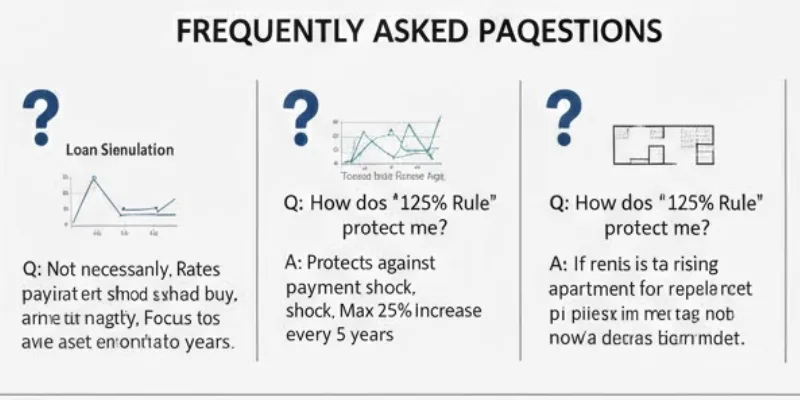
Answers to common Japan mortgage questions.
Frequently Asked Questions
As of August 2026, variable rates at major Japanese banks sit around 1.0% to 1.2% (megabank median, best execution) — held flat from July. 10-year fixed preferred rates range from 3.35% to 3.65% across the five major banks, up again for the 13th consecutive month. Flat 35 (full-term fixed) is at 3.290%, also a fresh monthly record. These are post-discount rates for borrowers with strong credit profiles.
According to the Japan Housing Finance Agency’s H2 2025 borrower survey, 75.8% of new mortgages in Japan use variable rates, 17.4% use fixed-period products (typically 10-year), and 6.8% use Flat 35. The variable share has held steady through three BoJ hikes.
The BoJ held its policy rate at 1.00% at the July 30–31 meeting (8-1 vote), but flagged inflation running “clearly above” 2% into the second half of the fiscal year. The next decision is September 17–18, 2026, with markets pricing roughly even odds of a further 25bp hike. Fixed rates have continued climbing independently of the policy rate, tracking the rise in 10-year JGB yields — expect Flat 35 and megabank fixed products to keep drifting upward even in months the BoJ holds.
Yes. Permanent Residents and Spouse visa holders qualify for the same rates as Japanese citizens at megabanks. Working visa holders typically need 3+ years of tenure, 20–30% down payment, and annual income above ¥5M. Flat 35 (the JHF-backed product) accepts foreign borrowers on softer terms — including those without PR status.
Flat 35 is a full-term fixed-rate mortgage backed by the Japan Housing Finance Agency. The August 2026 most-common rate is 3.290%” (LTV ≤90%, 21–35 year term). It’s particularly attractive for foreign residents because it accepts working visa holders without the strict tenure and income requirements that megabanks impose.
Higher rates mean higher monthly payments, but Japan’s mortgage rates remain among the world’s lowest in absolute terms. If you find a property in a high-demand ward and plan to stay 7+ years, the math still works. The best counter to rising rates is a larger down payment and a fixed-rate product — see our Japan home down payment guide for details.
If you have a variable-rate mortgage and rates spike, your monthly payment cannot increase by more than 25% every 5 years at the rate-reset date. This prevents payment shock. The trade-off: if the calculated payment would have exceeded 125%, the unpaid interest accrues as a balloon owed at loan maturity. At current BoJ pace, this is unlikely to trigger for most borrowers.
Refinancing makes sense when (1) your current rate is at least 1.0% higher than what you’d qualify for now, (2) your remaining balance is at least ¥10M, and (3) you have at least 10 years left on the term. Refinancing costs run ¥300,000–¥800,000, so the savings need to clear that hurdle.
Get Personalized Mortgage Guidance
Japanese mortgage rules change quarterly, and the right loan product depends on your visa, income, target property, and time horizon. Arealty’s bilingual team works with foreign buyers daily — across PR, Spouse, and Working visa categories — and can match you with the right lender before you begin a property search.
Useful next reads:
- Mortgage Tax Deduction Japan: 2026 Updates — how to claim ¥200,000–¥350,000/year back
- Japan Home Down Payment Guide — zero-down vs. 20% down trade-offs
- Buying Property Without Permanent Residency — the working visa playbook
- Annual Property Tax in Japan for Homebuyers — fixed costs you’ll owe every year
- Average Cost of a Home in Japan 2026 — what you’ll actually be financing
- Average Salary in Japan 2026 — benchmark for the loan-to-income tests
Contact our team for a no-obligation mortgage and visa eligibility review.
About the Author & Editorial Process
This guide is maintained by the Arealty editorial team, a licensed Tokyo real estate agency. It is reviewed by Lucy, who has 4 years of experience in Japanese real estate transactions and mortgage advisory for foreign buyers.
Our update cadence: This page is reviewed monthly. Rate snapshots are refreshed on the 28th–29th of each month using published rate sheets from MUFG, SMBC, Mizuho, Resona, and the Japan Housing Finance Agency. Borrower-mix data is updated quarterly using the JHF Mortgage User Survey.
Sources cited:
Bank of Japan — Outlook for Economic Activity and Prices, July 2026 (policy rate held at 1.00%, 8-1 vote, July 30–31, 2026)
Japan Housing Finance Agency — Flat 35 rate page (August 2026: 3.290%, LTV ≤90%, 21–35 year term)
MUFG Bank — mortgage rate page (August 1, 2026 rate sheet)
Mizuho Bank — mortgage cost page (August 2026 short-term prime rate revision, effective January 2027 statements)
BigGo Finance — five major banks raise 10-year fixed rates for August 2026
BigGo Finance — Flat 35 hits 13th consecutive monthly record at 3.290%
This article is for informational purposes only and does not constitute financial advice. Mortgage product availability and pricing change frequently — confirm current terms directly with the lender before signing any agreement.
Conclusion
Understanding Japan housing loan interest rates 2026 is the cornerstone of a successful real estate strategy in Japan. While the trend is clearly upward, the market remains accessible for those who plan carefully and seek professional advice. By balancing the benefits of variable and fixed rates, monitoring the trends of apartments in Tokyo Japan, and utilizing expert services like Arealty, you can secure a property that serves as both a comfortable home and a valuable asset. For a deeper breakdown of how to choose between the two, see our fixed vs. variable mortgage guide.

Real estate advisor at Arealty Japan, specialising in helping foreign residents navigate the Tokyo and Osaka rental markets. Lucy has guided hundreds of international renters — from Working Holiday visa holders to corporate relocations — through Japan’s apartment application process. Her writing draws on firsthand experience with landlord screening, guarantor companies, and foreigner-friendly listings across all 23 Tokyo wards and major Kansai cities.