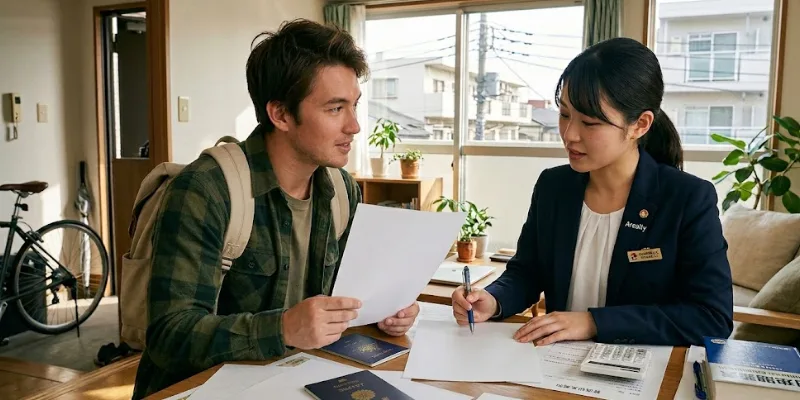

Disclosure: This guide is written by Arealty’s team of licensed real estate advisors (宅地建物取引士) who work daily with international renters across Japan. The advice below reflects real application outcomes and lease negotiation experience — not general theory.
One of the most common mistakes foreign residents make when renting in Japan is choosing the wrong lease type for their visa situation. Signing a standard 2-year lease when your visa expires in eight months creates real legal and financial risk. Choosing a short-term option when a 2-year lease would have been approved means paying significantly more per month for the same space.
The right answer depends on three things: your visa type, your length-of-stay plan, and your income documentation. This guide covers all three.
The Two Main Lease Types in Japan
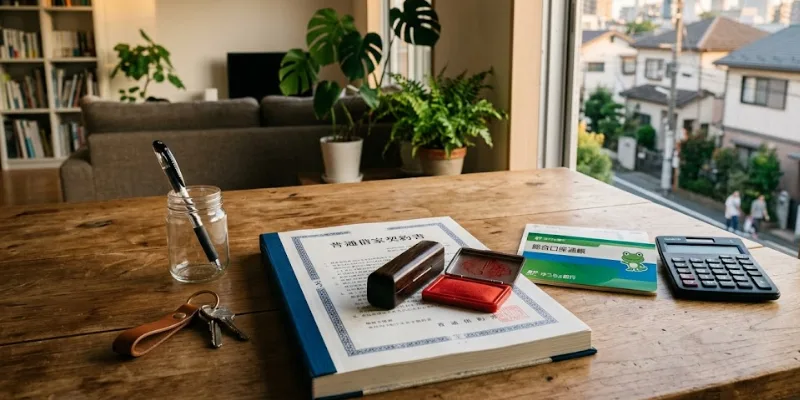
Standard 2-year Lease (普通借家契約, Futsū Shakuya Keiyaku)
The default residential lease in Japan. Key terms:
- Duration: 2 years, renewable
- Renewal: Automatic unless either party gives notice (typically 3–6 months before expiry)
- Tenant protection: Strong — landlords cannot terminate without “justifiable reason” under the Borrowing and Lending of Land and Buildings Act
- Renewal fee (更新料, kōshin-ryō): Typically 1 month’s rent, paid every 2 years
- Rent negotiation: Possible at renewal, but uncommon in practice
This is the lease type most Japanese renters sign. It gives tenants strong legal protection and rent stability, but commits you to 2 years — with early termination penalties if you leave before the end of the term.
Fixed-term Lease (定期借家契約, Teiki Shakuya Keiyaku)
A structured alternative where the lease ends on a specific date with no automatic renewal. Key terms:
- Duration: Can be set to any length — 6 months, 1 year, 18 months, 2 years, or more
- Renewal: Not automatic — lease ends on the agreed date. Re-contracting requires mutual agreement
- Tenant protection: Lower — landlord can decline to re-contract without justification
- Rent: Sometimes slightly higher than equivalent standard leases to compensate for the term certainty provided to the landlord
- Early termination: Generally permitted with 1 month’s notice if the unit is over 200sqm or if the tenant has specific qualifying circumstances
Fixed-term leases are more common in foreigner-targeted buildings, corporate housing, and newly developed properties. For international residents whose stay duration is uncertain, they are often the practical solution — but they require careful attention to end dates.
Which Lease Fits Which Visa?
This is where most guides fall short. The visa-to-lease match is not a theoretical framework — it is a practical decision with real financial consequences.
Working Holiday Visa (ワーキングホリデービザ)
Visa duration: 1 year (extendable in some cases for Australian and Canadian nationals) Recommended lease: Fixed-term, 1 year — or share house for the first 2–3 months
The core problem with a standard 2-year lease on a Working Holiday visa is the duration mismatch. Most landlords will notice that your visa expires before the lease ends and reject the application outright — not because of discrimination, but because an expiring visa creates legal ambiguity around the continued tenancy.
Fixed-term leases set to 1 year resolve this. Landlords who rent to Working Holiday holders understand the visa structure, and a 1-year fixed-term lease aligns the contract duration with the visa timeline.
If you plan to extend your Working Holiday visa, providing evidence of extension eligibility at the time of application significantly improves approval rates. For a full breakdown of how the application process works for Working Holiday holders specifically, see our Working Holiday visa Japan apartment guide.
Student Visa (留学ビザ)
Visa duration: Typically 1–2 years, renewable while enrolled Recommended lease: Fixed-term matching course length, or standard 2-year if degree program is 2+ years
Student visa holders have a clearer path to longer leases than Working Holiday holders because enrollment documentation provides a predictable stay duration. A 2-year language school program or 4-year university degree supports a standard 2-year lease application more convincingly than a 1-year Working Holiday visa.
The practical obstacle for students is income documentation — most landlords require 36× monthly rent in annual income, and many students do not meet this threshold from part-time work alone. A parental guarantee letter or proof of scholarship funding is sometimes accepted as a substitute.
For a detailed checklist of what student renters need to prepare, see our student housing Japan guide.
Specified Skilled Worker Visa (特定技能ビザ) / Engineering Visa / Other Work Visas
Visa duration: 1–5 years depending on category, renewable Recommended lease: Standard 2-year lease
For most work visa holders with documented employment, the standard 2-year lease is both appropriate and achievable. Your employer’s documentation — employment contract, certificate of employment — provides the income and stability evidence landlords require.
The main consideration: if your visa has less than 12 months remaining, some landlords will ask for confirmation of renewal intent before approving a 2-year application. Bringing a letter from your employer confirming your continued employment through the intended lease period addresses this.
Spouse Visa / Dependent Visa
Visa duration: Tied to spouse’s visa; typically renewed in parallel Recommended lease: Standard 2-year lease
Spouse visa holders are generally treated similarly to work visa holders for rental purposes, provided the primary visa holder (spouse) has stable documented employment. The main landlord concern is whether income documentation is sufficient — the 1/36 annual income rule applies to household income.
Permanent Residency (永住権) / Long-term Resident
Recommended lease: Standard 2-year lease, with full negotiating position
Permanent residents face the fewest obstacles in the Japanese rental market. Visa expiry is not a concern, income documentation requirements are the same as for Japanese applicants, and a wider range of guarantor companies will approve applications. Standard 2-year leases are appropriate in all cases.
The Cost Difference: Short-term vs Standard Lease
This is the practical trade-off that most guides do not quantify. Short-term and fixed-term leases typically cost more than equivalent standard leases for the same unit.
| Factor | Standard 2-year lease | Fixed-term / Short-term |
| Monthly rent | Base rate | 5–15% premium typical |
| Key money | 0–2 months | Often lower or waived |
| Renewal fee | 1 month every 2 years | None (no automatic renewal) |
| Early termination penalty | 1–2 months’ rent | 1 month’s notice (varies) |
| Availability | Wide — most apartments | More limited inventory |
| Landlord negotiability | Standard | Sometimes more flexible |
For a ¥100,000/month apartment, a 10% short-term premium means ¥10,000 extra per month — ¥120,000 over a year. Over a 2-year period, that compounds to ¥240,000 — meaningful against the initial cost savings from lower key money. Run the full calculation before assuming short-term is cheaper.
Early Termination: What It Actually Costs
If you sign a standard 2-year lease and need to leave early — visa change, job relocation, family situation — early termination typically costs:
- Notice period: 1–2 months (varies by contract)
- Early termination fee: Usually 1–2 months’ rent, specified in the lease
- Restoration costs: Deducted from your security deposit based on condition
On a ¥120,000/month apartment, early termination with 2 months’ notice and a 1-month penalty fee costs ¥240,000–¥360,000 in non-recovered costs, before restoration deductions.
This is why choosing the right lease type at the start matters more than many renters realize. For a full breakdown of what landlords can and cannot charge when you move out, see our restoration costs guide.
Monthly Mansion and Share Houses: The Third Option
For residents whose stay is genuinely short or uncertain — 1–6 months — neither a standard lease nor a fixed-term lease may be the right fit. Two alternatives worth considering:
Monthly mansion (マンスリーマンション): Fully furnished short-term rental, typically 1–6 months, with no guarantor requirement and minimal application process. Monthly cost is significantly higher than equivalent long-term rental (often 1.5–2× the per-month rate), but initial costs are near zero. Practical for professionals on temporary assignment or those waiting for a longer-term application to clear.
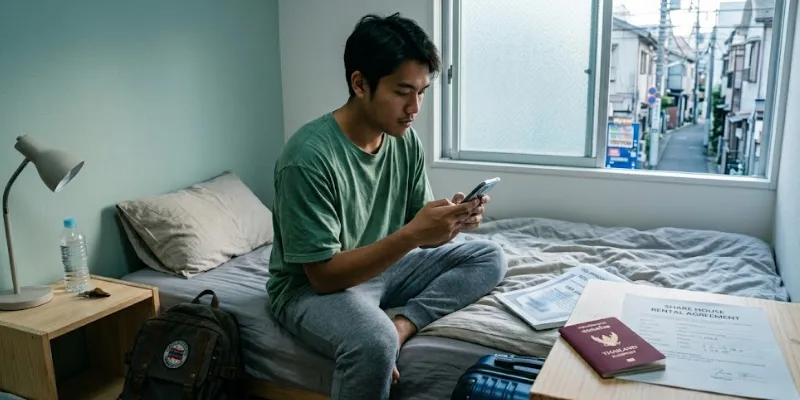
Share house: Lower barrier to entry than private apartments, flexible contract terms (typically 1–3 months minimum), and built-in community infrastructure useful for those new to Japan. Many share house operators accept Working Holiday and student visas without the income documentation requirements of standard leases. For a full comparison of share houses and private apartments, see our share house Japan guide.
Decision Framework: Which Lease Type Is Right for You?
Work through these four questions:
1. How long is your current visa valid?
- Less than 12 months → fixed-term lease matching visa duration, or share house
- 12–24 months → fixed-term matching visa length, or standard 2-year if renewal is expected
- 24+ months or permanent residency → standard 2-year lease
2. Are you likely to extend your stay?
- Certain to extend → standard 2-year lease, provide extension documentation
- Uncertain → fixed-term for flexibility; avoid standard 2-year early termination costs
- Leaving on a fixed date → fixed-term lease matching your departure date exactly
3. Can you document sufficient income?
- Yes (36× monthly rent in annual income) → standard 2-year lease accessible
- Partial documentation → fixed-term or share house; some operators have lighter requirements
- No income documentation yet → share house, then transition to private apartment after 2–3 months of payslips
4. How important is rent minimization vs. flexibility?
- Minimizing monthly cost → standard 2-year if visa allows (lower per-month rate)
- Maximizing flexibility → fixed-term or share house (higher per-month cost, lower commitment)
What to Check in the Lease Before Signing
Regardless of which lease type you choose, these clauses require careful attention:
Early termination clause (中途解約条項): How much notice is required? Is there a penalty fee? This is the most important clause for anyone whose stay duration is uncertain.
Restoration scope (原状回復): What condition must the apartment be returned in? Japanese law protects tenants from unfair restoration charges, but the contract wording matters. See our restoration costs guide for what is legally your responsibility versus the landlord’s.
Renewal terms: For standard leases, what is the renewal fee? When must renewal or non-renewal notice be given?
Guarantor company requirements: Which guarantor companies does the landlord accept? This affects your application process significantly, particularly for non-standard visa types.
All lease documents in Japan are in Japanese. Working with a bilingual agent before signing — not after — is strongly recommended for international renters. See our list of top real estate agencies in Tokyo for foreigners for agencies with documented experience handling international tenant applications.
Frequently Asked Questions
Can I sign a 2-year lease on a 1-year Working Holiday visa?
Legally yes — lease duration and visa duration do not have to match. But in practice, many landlords and guarantor companies will reject applications where the visa expires before the lease ends. Fixed-term leases set to 1 year, or landlords who specifically accept Working Holiday applications, are the practical solution.
What happens if my visa isn’t renewed and I’m still in a lease?
Your tenancy does not automatically terminate if your visa expires — you remain legally bound by the lease contract. However, an expired visa creates complications for guarantor companies and may trigger a landlord’s termination notice on specific grounds. The safest approach is to notify your landlord and agent early if your visa renewal is delayed, and to have your documentation in order.
Is a fixed-term lease always more expensive than a standard one?
Not always — but typically yes, by 5–15% on monthly rent. The trade-off is flexibility and lower risk of early termination penalties. Run the full cost calculation including key money, renewal fees, and potential early termination costs before deciding.
Can I negotiate the lease type with a landlord?
Yes, in some cases. Buildings that market specifically to foreign residents are more accustomed to fixed-term requests. Standard Japanese landlords are less flexible, particularly in high-demand areas. Your agency’s relationship with the landlord makes a significant difference to what is negotiable.
Do share houses use standard or fixed-term leases?
Most share house operators use their own licence agreements rather than standard residential lease forms. These are typically month-to-month with a minimum stay requirement (1–3 months common), which provides more flexibility than either standard or fixed-term residential leases.
Further Reading
- Working Holiday visa Japan — apartment rental guide
- Student room sharing in Japan
- Share house Japan — complete guide
- Renting in Japan as a foreigner — step by step
- Restoration costs when moving out in Japan
- Top real estate agencies in Tokyo for foreigners
- Tokyo apartment rent trends 2026
Browse foreigner-friendly apartments with flexible lease options: arealty.mom/rent/tokyo
References
- Ministry of Land, Infrastructure, Transport and Tourism. Shakuya Shakka Hō (Borrowing and Lending of Land and Buildings Act), amended 2000.
- Immigration Services Agency of Japan. Status of Residence — Working Holiday.
- Ministry of Land, Infrastructure, Transport and Tourism. Teiki Shakuya Keiyaku Guidelines.

Real estate advisor at Arealty Japan, specialising in helping foreign residents navigate the Tokyo and Osaka rental markets. Lucy has guided hundreds of international renters — from Working Holiday visa holders to corporate relocations — through Japan’s apartment application process. Her writing draws on firsthand experience with landlord screening, guarantor companies, and foreigner-friendly listings across all 23 Tokyo wards and major Kansai cities.