
Most rental guides for students in Japan tell you what documents to prepare. Very few explain what actually happens after you submit those documents — what the landlord and guarantor company are looking at, which factors trigger rejection, and why two students with similar situations can have very different application outcomes.
This guide is about the screening process itself: what landlords and guarantor companies (保証会社, hoshō gaisha) actually assess when a student visa holder applies for an apartment in Japan. Understanding the logic behind the screening process changes how you prepare your application and significantly improves your approval rate.
If you want to start browsing options now, see foreigner-accepted apartments in Tokyo on Arealty. For the full application process overview, the step-by-step foreigner rental guide covers each stage from document gathering to contract signing.
Who Actually Screens Your Application
When you submit a rental application in Japan, two separate parties review it — and they are checking for different things.
The landlord (大家, ooya) or property management company is checking whether you are a tenant they want in their building: stable, communicative, and likely to stay for the lease term. Their criteria are informal and influenced by their prior experience with foreign tenants, the building’s tenant mix, and their personal risk tolerance.
The guarantor company (保証会社, hoshō gaisha) is checking whether you are a financial risk they are willing to underwrite. Their criteria are more structured — they are essentially running a credit-like assessment — and their decision is the one that most commonly blocks applications.
Understanding this distinction matters because the two reviews happen in sequence. The landlord or management company typically does a first review and passes the application to the guarantor company if they are willing to proceed. A landlord who is comfortable with foreign tenants can still see the application rejected at the guarantor company stage — which is where most student visa rejections actually occur.
What Landlords Check First
At the landlord stage, the primary concerns for a student visa applicant are:
1. Visa validity period vs. lease length A standard Japanese lease runs for two years. A student visa is typically issued for the duration of your school enrollment — often one to two years initially, renewable. Landlords check whether your current visa validity period covers at least the first year of the lease. If your visa shows only three months of remaining validity (which happens when students apply for housing before renewing), many landlords will not proceed regardless of other factors.
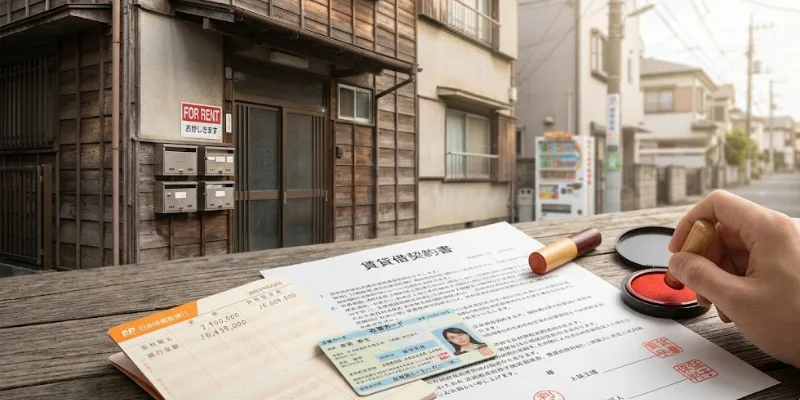
2. Proof of enrollment A formal enrollment certificate (在学証明書, zaigaku shōmeisho) from your school is the document that establishes your reason for being in Japan. Without it, a student visa application is missing its foundational document. Language schools issue these after enrollment is confirmed; universities typically issue them on request. If you are applying before your course begins — as many overseas students do — a certificate of acceptance (入学許可書) is the equivalent.
3. Communication ability Not explicitly on any checklist, but a real factor: landlords are evaluating whether they will be able to communicate with you about trash schedules, noise complaints, and maintenance requests. Working with a bilingual agency removes this concern entirely — the agency acts as the communication intermediary — which is one of the concrete reasons foreign students consistently have higher approval rates through bilingual agencies than when applying directly.

What Guarantor Companies Check — And Why This Is the Real Gate
The guarantor company’s job is to assess whether they will end up paying your rent if you default. Their review is structured around three factors:
Income-to-rent ratio. The standard threshold is monthly income ≥ 3x monthly rent. For a student paying ¥80,000/month rent, this means the guarantor company wants to see ¥240,000/month in demonstrated income somewhere in the application — either from the student’s own part-time employment, or from a parent’s or guarantor’s income documentation.
Visa type and duration. Not all guarantor companies accept student visas. Some only accept work visas or permanent residency. Of those that accept student visas, some have minimum remaining validity requirements. This is the variable most students are not aware of — the guarantor company used by the agency you work with determines whether your visa type clears the gate at all. Arealty works exclusively with guarantor companies that accept student visa holders; agencies using the wrong hoshō gaisha are a common source of student application failures.
Guarantor or co-signer income. When the student themselves does not have sufficient income, guarantor companies in Japan accept a parental income guarantee (親権者の収入証明). This is different from a personal Japanese guarantor — it is a document from a parent showing their income and a letter confirming they will cover rent in the event of non-payment. This pathway is available to most international students and is the standard workaround for the income threshold problem.
The Income Question: What to Do When You Have None
Most international students arrive in Japan without income. The three approaches that work, in order of reliability:
1. Parental income guarantee The most reliable pathway for students without Japanese income. Your parent provides: proof of income (payslip or tax return, officially translated into Japanese or with a Japanese translation statement), a signed guarantor letter (written in Japanese or with certified translation), and a copy of their ID. The income threshold the guarantor company looks for is typically ¥240,000–¥300,000/month (or equivalent annual income). Most guarantor companies that accept student visa holders provide a standard format for the parental guarantor document — ask your agency for this format.
2. Demonstrated savings Some guarantor companies accept proof of savings as a partial substitute for income, particularly if the savings represent 12–24 months of rent. A bank statement showing ¥1,000,000–¥2,000,000 in stable savings is viewed differently from an empty account. This is most relevant for students funded by scholarships or family transfers.
3. School guarantee programs Some Japanese language schools and universities have agreements with specific hoshō gaisha — or provide their own institutional guarantee — that simplifies the application for enrolled students. Ask your school’s housing office whether they have any such arrangement before beginning an independent apartment search.
Visa Validity and Lease Length: The Mismatch Problem
This is the most frequently misunderstood aspect of student rental applications in Japan.
A 2-year lease signed on a student visa that expires in 11 months does not mean the lease ends when the visa expires. In Japan, a residential lease continues regardless of visa status — visa expiry does not terminate the lease. The lease renews independently.
What landlords and guarantor companies are actually checking is whether you are likely to remain in Japan past the initial visa period — which is a proxy for whether you will complete the lease. An enrollment certificate showing a two-year course, or a certificate showing you are in the first year of a multi-year program, substantially addresses this concern. A document showing you are in the final three months of a one-year language course while applying for a two-year apartment is the situation that creates problems.
The practical approach: apply for a lease that begins at the start of your enrollment, not partway through. If you are already mid-course, consider a fixed-term lease (定期借家契約) for the remainder of your enrollment period, then re-apply for a standard lease when you renew your student visa and enrollment. For a full comparison of fixed-term and standard leases, see short-term vs 2-year lease in Japan.
The Documents That Change Your Approval Rate
Based on actual application outcomes, these are the documents that most reliably improve screening results for student visa holders:
| Document | Why it helps | Where to get it |
| Enrollment certificate (在学証明書) | Establishes reason for visa and expected stay duration | Your school — request on enrollment |
| Parental income proof + guarantor letter | Solves the income threshold problem | Parent provides; agency provides standard format |
| Bank statement showing 6–12 months of rent | Demonstrates financial stability beyond current income | Your home-country or Japanese bank |
| Certificate of acceptance (入学許可書) | Used when applying before course begins | Issued by school on admission |
| School address and contact in Japan | Landlords view school as stable, reachable contact | School enrollment materials |
Documents that are often over-relied on but less impactful: passport alone (confirms identity but not income or stability), scholarship award letters without accompanying bank statements (declares income but does not prove it is received), and English-only documents without Japanese translation.
Why Applications Get Rejected Even With Good Documents
The most common reasons for student application rejection that are not document-related:
Wrong guarantor company for your visa type. An agency that submits a student visa application to a hoshō gaisha that requires work visa or PR is a predictable rejection. This is the agency’s error, not yours — but the outcome is the same. Ask explicitly which guarantor companies your agency uses and whether they accept student visas.
Applying too close to visa expiry. Even with a renewal in process, a residence card showing 30-day validity triggers automatic rejection at most guarantor companies. Apply when you have at minimum 6 months of remaining validity showing on your card.
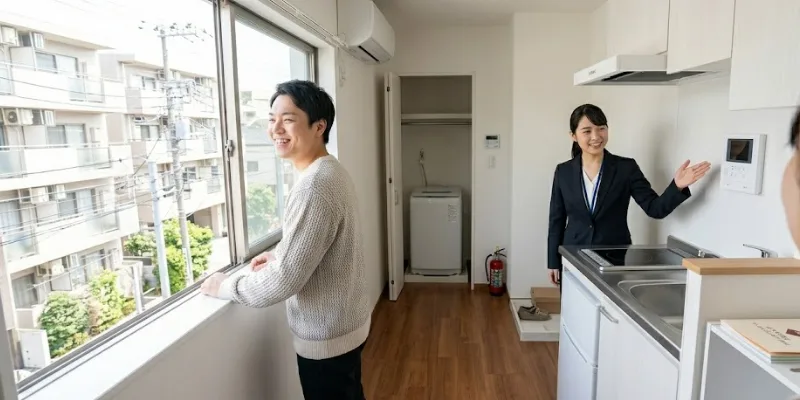
Applying without viewing. In Japan, an application submitted without a viewing is viewed with suspicion — it raises questions about whether the tenant is serious and will actually occupy the unit. If you are applying from overseas, request a video walk-through and note in your application that you have completed one. See how to rent before arriving in Japan for the full process.
Insufficient Japanese language support in the application. Some documents submitted in English only — without a Japanese cover summary or translation — create friction at the guarantor company review stage, particularly at hoshō gaisha that do not regularly handle foreign applications.
How to Build the Strongest Possible Student Application
The combination that consistently produces the highest approval rate for student visa holders:
- Use an agency that works with student-visa-accepted guarantor companies — this is the single highest-leverage factor
- Lead with the enrollment certificate and parental income documentation — do not wait for the agency to ask; provide both proactively
- Apply with at minimum 6 months’ visa validity showing on your residence card
- View the unit — in person if possible, by video if overseas
- Consider fixed-term lease if your enrollment period is under 18 months — it reduces the landlord’s concern about term mismatch
Contact Arealty to discuss your specific enrollment timeline, visa status, and document situation before beginning your search — a 15-minute conversation at this stage saves significant time and rejected applications later.
Further Reading
- How to rent an apartment in Japan before you arrive — overseas student guide
- Short-term vs 2-year lease in Japan — which fits your student visa?
- ISI Language School July intake — housing timeline and checklist
- Student housing in Japan — general guide
- Why apartment listing photos in Japan can mislead overseas renters
- Renting in Japan as a foreigner — full process guide
- Average apartment rent in Tokyo — 2026 ward data

Real estate advisor at Arealty Japan, specialising in helping foreign residents navigate the Tokyo and Osaka rental markets. Lucy has guided hundreds of international renters — from Working Holiday visa holders to corporate relocations — through Japan’s apartment application process. Her writing draws on firsthand experience with landlord screening, guarantor companies, and foreigner-friendly listings across all 23 Tokyo wards and major Kansai cities.