
The total cost of buying a home in Japan runs well beyond the listing price. One-time closing costs typically add 6–13% of the purchase price on top of what you pay the seller. Ongoing ownership carries its own recurring bill too. Property tax applies to every owner, and condominiums add monthly management fees plus a repair reserve fund. This guide breaks down every stage. We cover what you pay at contract signing, what you pay at closing, and what you’ll keep paying every year afterward.
For context on purchase prices themselves, see our guide to Japan’s average house price. If you’re comparing new construction against an older unit, our new build vs resale apartment guide covers that decision in detail. For official tax rate schedules, see the National Tax Agency of Japan’s English guidance.
Costs at contract signing
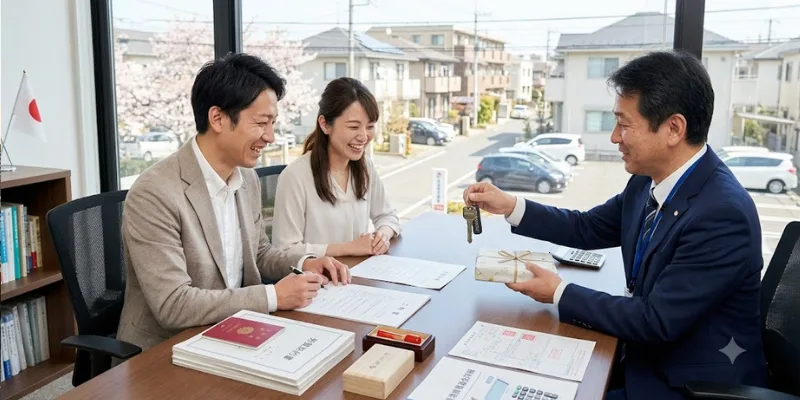
When you sign the purchase agreement (売買契約書), expect two immediate costs. First comes a deposit, typically 5–10% of the purchase price, paid to the seller as a show of commitment. Second comes stamp duty on the contract itself — a government tax that varies by contract value, currently reduced through March 2027. Properties in the ¥10–50 million range typically require ¥10,000 in stamps. Properties from ¥50–100 million require ¥30,000.
One-time closing costs: the full breakdown
By settlement, total one-time purchase costs typically reach 6–13% of the purchase price. That figure splits across several categories:
- Real estate agent fee: legally capped at 3% of the purchase price plus ¥60,000, plus consumption tax (10%). This is the single largest line item in most transactions.
- Registration and license tax: paid to transfer ownership into your name at the Legal Affairs Bureau. Current reduced rates run 1.5% for land and 0.1–0.3% for buildings, through March 2027, down from standard rates of 2%.
- Real estate acquisition tax: billed separately by the prefecture, typically 3–4 months after purchase. Budget for it even though it won’t appear on your settlement statement. The standard residential rate runs around 3% of assessed value, with deductions available for qualifying properties.
- Judicial scrivener fees: the licensed professional (司法書士, shihō shoshi) who handles registration typically charges several hundred thousand yen. Some calculate this as roughly 1.5% of the purchase price plus a base fee.
- Mortgage-related costs, if financing: expect a minimum of 2.2% of the loan amount for the handling fee, plus an additional 0.4% registration tax on the mortgage itself. Qualifying primary residences see this reduced to 0.1%.
- International transfer costs, for overseas buyers moving funds into Japan: this single line item alone can swing total costs by ¥1.2–1.6 million on a large purchase. That’s more than the scrivener and stamp duty combined — shop transfer providers carefully rather than defaulting to your home bank’s standard wire service.
On a ¥40 million apartment, that 6–13% range translates to roughly ¥2.4–5.2 million in costs beyond the purchase price itself.
Monthly costs after you own: management fee and repair reserve fund
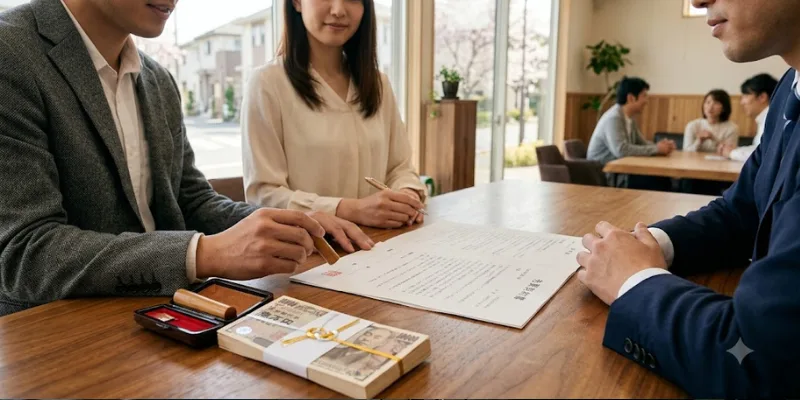
Condominium (mansion) purchases specifically carry two recurring monthly charges on top of any mortgage payment:
- Management fee (管理費, kanrihi): covers day-to-day building operations — cleaning, security, common-area utilities, and the management company’s administrative work.
- Repair reserve fund (修繕積立金, shuzenhi): a mandatory contribution toward the building’s major repair cycle — roof work, exterior repainting, plumbing replacement — typically scheduled every 12–15 years. This fund stays separate from the management fee. You cannot skip it or opt out.
Combined, these two fees commonly run ¥15,000–¥35,000/month for a standard 1–2 bedroom unit. Older buildings with underfunded reserves sometimes carry higher repair reserve contributions to catch up on deferred maintenance. Before buying resale, request the building’s repair reserve fund balance and history of past major works. A building that has consistently underfunded its reserve can mean a large special assessment bill in your future. That comes on top of the monthly fee you’re already paying.
Annual costs: property tax and city planning tax
Every property owner in Japan pays fixed asset tax (固定資産税, kotei shisanzei) annually, based on the property’s assessed value rather than its market price. Assessed value typically runs 50–70% of construction cost for buildings and roughly 70% of market price for land. The standard rate is 1.4% of assessed value. Properties in urbanization promotion areas also pay city planning tax (都市計画税), capped at 0.3% of assessed value. For a full breakdown of how these taxes get calculated and billed, see our guide to annual property tax in Japan for homebuyers.
Detached houses carry additional annual maintenance responsibilities that condominium owners share collectively through their management fee. Roof, exterior, and structural upkeep all fall on the individual homeowner rather than a building association.
A worked example: total cost on a ¥40 million Tokyo apartment
To make this concrete, here’s how the numbers stack up on a mid-range resale apartment:
- Purchase price: ¥40,000,000
- One-time closing costs (7–10% estimate): ¥2,800,000–4,000,000
- Monthly management fee + repair reserve: ¥20,000–30,000 (¥240,000–360,000/year)
- Annual fixed asset tax + city planning tax: roughly ¥150,000–250,000/year, depending on assessed value
In year one alone, total cost of ownership runs meaningfully above the ¥40 million purchase price. It lands closer to ¥43.2–44.6 million once closing costs and the first year of ongoing fees get included.
How mortgage financing changes the total cost picture
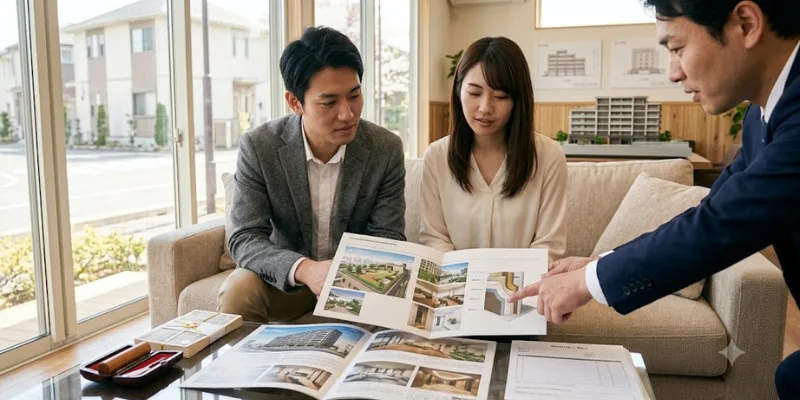
If you finance part of your purchase, the total cost of buying a home in Japan grows beyond the closing costs covered above — interest becomes a real factor too. Interest paid over the life of the loan adds a real, often substantial, sum on top of the principal. This figure varies enormously depending on your rate, loan term, and down payment size. Foreign buyers should also budget for the mortgage handling fee and registration tax noted earlier. These apply specifically to financed purchases and don’t show up at all for cash buyers.
On the positive side, Japan’s mortgage tax deduction program helps offset costs. It can reduce a meaningful portion of your annual tax bill for qualifying properties and buyers. This deduction changes periodically with national policy updates, so check current terms before finalizing your financing plan — see our guide to mortgage tax deduction in Japan for the latest details.
Costs specific to detached houses versus condominiums
Detached house owners skip the monthly management fee and repair reserve fund that condominium owners pay. There’s no shared building association managing common areas for a standalone house. This doesn’t mean detached houses cost less to maintain overall, though. Owners bear the full cost of roof repairs, exterior maintenance, and structural upkeep directly. That cost arrives unpredictably, rather than spreading across a mandatory monthly contribution. Over a multi-decade ownership period, many owners find the two approaches average out to a similar total cost, just distributed differently. Condominium owners pay steadily every month, while detached house owners pay in occasional larger lump sums when repairs become necessary.
Budgeting realistically: a checklist before you make an offer
Before committing to a purchase price, run through this checklist. It confirms your true total cost of buying a home in Japan:
- Confirm the exact closing cost percentage with your agent based on the specific property and financing method, rather than relying on the general 6–13% range alone
- Request the building’s repair reserve fund balance and major works history if buying a condominium
- Get a mortgage pre-qualification estimate early, so you know your actual borrowing capacity and associated fees before falling in love with a property outside your range
- Ask your agent or scrivener for a full itemized cost estimate in writing before signing the purchase agreement, not just a verbal percentage estimate
- Factor in the timing gap between closing costs (paid immediately) and acquisition tax (billed months later) so you don’t get caught short on cash flow
Why total cost matters more than purchase price alone
Two properties with identical listing prices can carry meaningfully different total costs of ownership. An older condominium with an underfunded repair reserve might look cheaper on paper than a newer building with healthy reserves. But the older building’s owners face a higher risk of a large special assessment bill down the line. Comparing properties on total cost of ownership, not just purchase price, gives a more accurate picture of what you’re actually signing up for. This matters especially for buyers planning to hold the property for a decade or more.
Frequently Asked Questions
One-time closing costs typically run 6–13% of the purchase price, covering agent fees, registration tax, acquisition tax, and scrivener fees. Ongoing costs add monthly management fees and repair reserve contributions for condominiums, plus annual property tax for any property type.
Yes, for condominium purchases. Both charges get set by the building’s management association and apply to every unit owner. Neither can be opted out of.
Typically 3–4 months after your purchase closes, billed separately by the prefecture. It doesn’t appear on your settlement statement, so budget for it in advance.
No. Japan applies the same cost structure to all buyers regardless of nationality. The one foreigner-specific cost is international money transfer. It can add a meaningful amount depending on the provider and transfer method used.
Plan for roughly ¥15,000–35,000/month in combined management fee and repair reserve fund, plus ¥150,000–250,000/year in property tax, depending on the unit’s assessed value and building age.
Not necessarily. Detached houses skip the monthly management fee and repair reserve fund. Owners bear the full, unpredictable cost of major repairs directly instead. Total ownership cost over the long run often ends up similar between the two, just distributed differently over time.
Arealty helps foreign buyers budget accurately for the full cost of ownership, not just the purchase price. Contact our team for a cost breakdown specific to a property you’re considering.

Real estate advisor at Arealty Japan, specialising in helping foreign residents navigate the Tokyo and Osaka rental markets. Lucy has guided hundreds of international renters — from Working Holiday visa holders to corporate relocations — through Japan’s apartment application process. Her writing draws on firsthand experience with landlord screening, guarantor companies, and foreigner-friendly listings across all 23 Tokyo wards and major Kansai cities.