Quick answer: A 1 bedroom apartment in Japan comes in four layouts: 1R, 1K, 1DK and 1LDK. In Tokyo’s 23 wards, a 1K or 1DK rents for ¥64,700 a month in Nerima up to ¥150,300 in Minato, and a 1LDK for ¥80,400 in Katsushika up to ¥383,000 in Minato. Rents are still rising: condos of 30㎡ or less in the 23 wards averaged a record ¥114,339 a month (fees included) in August 2026, about 10% higher than a year earlier.
| Layout | Typical size | Tokyo 23-ward average rent |
|---|---|---|
| 1R (one room, open kitchen) | 15–25㎡ | ¥59,800 to ¥138,500 |
| 1K (one room, separate kitchen) | 18–25㎡ | ¥64,700 to ¥150,300 (with 1DK) |
| 1DK (room + dining kitchen) | 25–35㎡ | Included with 1K |
| 1LDK (bedroom + living-dining-kitchen) | 35–45㎡ | ¥80,400 to ¥383,000 |
Ready to look? Browse 1K and 1DK apartments for one person or search all Tokyo rentals.

Japanese Apartment Layout Comparison
Tokyo 23 wards rent comparison table
The table shows average monthly rent in each ward by layout. Numbers in brackets are the listings within a 10-minute walk of a station, which tells you how much choice you’ll have.
| Ward | 1R | 1K / 1DK | 1LDK / 2K / 2DK |
|---|---|---|---|
| Chiyoda | ¥138,500 (15) | ¥144,800 (26) | ¥265,900 (19) |
| Chuo | ¥102,000 (29) | ¥128,500 (37) | ¥232,300 (50) |
| Minato | ¥133,300 (71) | ¥150,300 (107) | ¥383,000 (152) |
| Shinjuku | ¥80,050 (160) | ¥100,800 (226) | ¥182,200 (166) |
| Bunkyo | ¥78,100 (67) | ¥92,700 (104) | ¥133,700 (91) |
| Taito | ¥77,100 (54) | ¥87,900 (79) | ¥151,600 (86) |
| Sumida | ¥76,400 (33) | ¥83,200 (95) | ¥128,400 (91) |
| Koto | ¥72,800 (38) | ¥89,400 (105) | ¥134,900 (59) |
| Shinagawa | ¥89,100 (58) | ¥98,700 (183) | ¥163,500 (138) |
| Meguro | ¥81,600 (51) | ¥98,400 (66) | ¥181,900 (55) |
| Ota | ¥112,400 (92) | ¥79,900 (180) | ¥133,700 (165) |
| Setagaya | ¥77,400 (156) | ¥84,000 (289) | ¥143,500 (135) |
| Shibuya | ¥131,800 (88) | ¥111,500 (133) | ¥230,000 (88) |
| Nakano | ¥75,400 (110) | ¥89,400 (192) | ¥160,400 (113) |
| Suginami | ¥66,700 (119) | ¥71,800 (214) | ¥123,000 (101) |
| Toshima | ¥69,400 (139) | ¥83,800 (213) | ¥144,300 (141) |
| Kita | ¥71,900 (79) | ¥78,700 (192) | ¥119,900 (116) |
| Arakawa | ¥60,700 (28) | ¥70,800 (52) | ¥117,200 (27) |
| Itabashi | ¥60,000 (90) | ¥70,000 (209) | ¥114,400 (162) |
| Nerima | ¥59,800 (73) | ¥64,700 (175) | ¥110,010 (110) |
| Adachi | ¥84,100 (23) | ¥66,500 (73) | ¥93,400 (83) |
| Katsushika | ¥66,900 (16) | ¥65,800 (48) | ¥80,400 (52) |
| Edogawa | ¥61,100 (27) | ¥66,700 (88) | ¥115,900 (84) |
Source: Hato Mark Site rent statistics, compiled April 21, 2026. In Ota, Adachi and Shibuya the 1R average is higher than 1K because there are few 1R listings, so treat those cells with caution.
What the data shows:
- Cheapest 1LDK: Katsushika at ¥80,400, about a fifth of the Minato average.
- Best value for commuters: Suginami, Nerima and Itabashi keep 1K rent near ¥70,000 with trains into central Tokyo in about 30 minutes.
- Premium wards: Chiyoda, Minato and Shibuya cost roughly two to three times the outer wards for the same layout.
Budget-first? See our list of the cheapest Tokyo wards for renters or browse Tokyo apartments under ¥70,000 a month.
1 bedroom apartment rent outside Tokyo
Outside Tokyo, rent drops and space grows. These are typical asking rents for a 1LDK in each metro area.
| Region | Typical 1LDK rent | Typical size | Notes |
|---|---|---|---|
| Tokyo, central wards | ¥140,000–¥250,000+ | 35–42㎡ | Minato and Chiyoda run far higher |
| Tokyo, outer wards | ¥85,000–¥130,000 | 38–45㎡ | Setagaya, Nerima, Itabashi, Adachi |
| Yokohama / Kanagawa | ¥75,000–¥120,000 | 40–48㎡ | Tokyo commuter belt |
| Osaka | ¥65,000–¥100,000 | 42–50㎡ | See our guide to Osaka’s 24 wards |
| Nagoya | ¥55,000–¥90,000 | 45–55㎡ | Strong local job market |
| Fukuoka and Sapporo | ¥50,000–¥80,000 | 45–55㎡ | Most affordable major cities |
For the full monthly budget beyond rent, see our guides to the cost of living in Japan and utilities for one person in a 1K.
1R vs 1K vs 1DK vs 1LDK: which layout fits you?
What English speakers call a 1 bedroom apartment in Japan splits into four layouts. The number is the count of rooms, and the letters describe the kitchen area: K for kitchen, D for dining and L for living.
1R: the cheapest one-room option
A 1R (one room) puts the kitchen in the same room as your bed, with no door between them. It is usually 15–25㎡ and the cheapest layout in any ward. The trade-offs are cooking smells in your bedroom and less privacy when the front door opens.
Best for: students and anyone who rarely cooks and wants the lowest rent.
1K: the Tokyo standard for singles
A 1K has one main room plus a small kitchen behind a door or wall. It is typically 18–25㎡ and the most common rental layout in Tokyo. The door keeps cooking smells and the draft from the entrance out of your room.
Best for: single workers, students and anyone who puts location ahead of space.
1DK: room to eat and cook
A 1DK adds a dining area to the kitchen, usually 25–35㎡ in total. It fits a small table without taking over your bedroom.
Best for: people who cook often or sometimes work from home.
1LDK: the long-term choice
A 1LDK has a separate bedroom plus a combined living, dining and kitchen room. It is typically 35–45㎡ in Tokyo and 40–55㎡ in regional cities.
Best for: couples, full-time remote workers and anyone staying three years or more.
For floor plan examples, see our guides to Japanese apartment floor plans and the average apartment size for one person. Staying under six months? A furnished monthly mansion may suit you better than a standard lease.

How Income Affects Tokyo Housing
How to rent a 1 bedroom apartment in Japan as a foreigner
Renting as a non-Japanese resident means extra paperwork. Here is what you need and how to avoid the most common rejections.
Documents you’ll need
- Passport with your current landing permission
- Residence card (zairyū kādo), ideally with at least 6 months of validity left
- Proof of income: recent pay slips or an employment contract showing your salary
- Employer contact details for verification calls
- Japanese phone number and bank account, which most guarantor companies ask for
- Personal seal (hanko), preferred but often not required for foreigners
How to rent without a personal guarantor
Most landlords want a guarantor. You have three ways around it:
- Guarantor companies (yachin hoshō kaisha) replace a personal guarantor. The first-year fee is usually 50% to 100% of one month’s rent including fees, plus a yearly renewal fee, often around ¥10,000. Most foreigner-friendly listings on Arealty accept this by default.
- No-guarantor properties skip the requirement entirely. See our foreigner-friendly apartments guide and how to get a guarantor in Japan.
- Bilingual agencies handle the application for you. See our list of the top 5 real estate agencies in Tokyo for foreigners.
Turned down before? Our article on why foreigners get rejected for rentals explains how to fix your application.
Standard upfront costs
| Fee | Typical amount | What it’s for |
|---|---|---|
| Security deposit (shikikin) | 0–2 months’ rent | Refundable at move-out, minus repair costs |
| Key money (reikin) | 0–2 months’ rent | Non-refundable payment to the landlord |
| Agency fee | Up to 1 month’s rent + tax | The agent’s commission |
| Guarantor company fee | 50–100% of 1 month’s rent | Replaces a personal guarantor |
| Fire insurance | ¥15,000–¥25,000 | Required for most 2-year leases |
| Lock change | ¥15,000–¥30,000 | New key cylinder for you |
| First month’s rent | 1 month + fees | Often prorated for the move-in month |
Total: usually 4 to 6 months’ rent. Our move-in cost guide covers how to negotiate it down, and our guide to restoration costs explains what you pay when you leave. For shorter stays without these fees, see short-term rentals for expats and Tokyo short-term apartments.

Renting vs Buying in Japan
Real move-in cost example: a ¥60,000 1K
Here is the fee breakdown for a foreigner-friendly 1K listed by Arealty in western Tokyo (Maison Nishigikubo KM, near the JR Chūō Line).
| Item | Amount |
|---|---|
| Monthly rent | ¥60,000 |
| Common service fee | ¥7,000 |
| Other monthly fees | ¥4,050 |
| Total monthly cost | ¥71,050 |
| Security deposit (shikikin) | ¥0 |
| Key money (reikin) | ¥30,000 |
| Guarantor company fee | ¥35,000 |
| Agency fee + admin | ¥107,000 |
| First month’s rent and fees | ¥71,050 |
| Total move-in cost | ¥243,050 |
With no deposit, the move-in cost is about 4 months’ rent, the low end of the usual range. On a listing that asks for a 1-month deposit and 2 months’ key money, the same flat would cost around ¥393,000 to move into.
Listings with lower upfront costs:
- No-key-money apartments in Tokyo
- Tokyo apartments under ¥70,000 a month
- Tokyo rentals for one person
Earning around ¥200,000 a month? See how much rent you can afford on a 20万 salary.
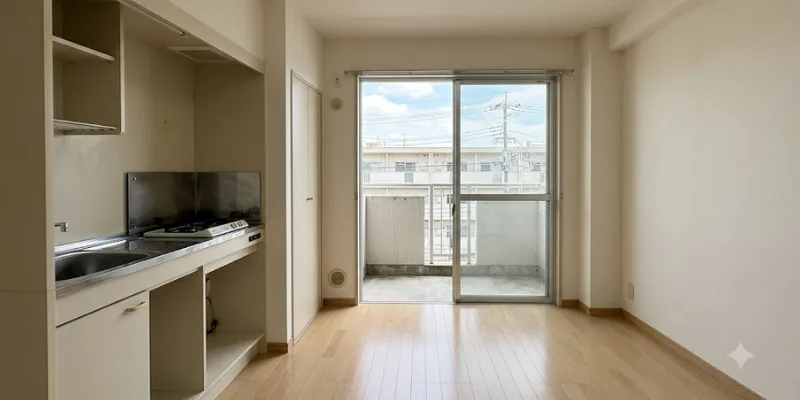
What’s inside a Tokyo 1K apartment?
Most 1K and 1LDK units are built for space efficiency. You can usually expect:
- Separate bath and toilet (called separate-type), one of the most searched features
- Compact kitchen with one or two gas or IH burners
- Air conditioner for heating and cooling
- Balcony for drying laundry
- Built-in closet (oshiire or closet)
- Auto-lock entrance and cameras in most buildings built after 2010
- Earthquake-resistant structure under current building standards
Newer buildings often add keyless entry, delivery boxes and double-glazed windows. Sensitive to noise? Read our guide to soundproof rental apartments. Short on space? Try multi-functional furniture for small apartments.
Rent vs buy: when owning a 1LDK makes sense
Most foreigners should rent first, but the numbers can change after about five years.
Keep renting if any of these apply:
- You plan to stay under 5 years
- You’re on a working visa, which makes loans harder to get
- Your annual income is under ¥6M
- You haven’t chosen a city yet
Buying can make sense if all of these apply:
- You have permanent residency or a spouse visa
- You plan to stay 7 years or more
- Your annual income is over ¥6M
- You have 10% to 20% of the price for a down payment
At August 2026 asking prices, a 40㎡ resale condo averages about ¥43M across Greater Tokyo and about ¥72M inside the 23 wards, based on Tokyo Kantei’s 70㎡ benchmarks. That puts a 10% to 20% down payment at roughly ¥4.3M to ¥14.5M. For full price data, see how much a house in Japan costs, plus our guides to Japan mortgage rates, mortgage tax deduction changes in 2026 and the average salary in Japan.
Need more space? See 2-bedroom apartments in Japan and 3-bedroom apartments in Japan.

Efficient Living in Japan’s Capital
Frequently asked questions
A 1K or 1DK averages ¥64,700 in Nerima up to ¥150,300 in Minato. A 1LDK ranges from ¥80,400 in Katsushika to ¥383,000 in Minato. Across the 23 wards, condos of 30㎡ or less averaged ¥114,339 including fees in August 2026.
A 1K is one main room plus a small kitchen separated by a door. It is usually 18–25㎡ and the most common layout for single people in Tokyo.
A 1R is a single room with the kitchen inside it and no door between them. It is usually 15–25㎡ and the cheapest layout, but cooking smells and noise from the entrance reach the whole room.
A 1K has a small separate kitchen (18–25㎡). A 1DK adds a dining area (25–35㎡). A 1LDK has a separate bedroom plus a living, dining and kitchen room (35–45㎡).
Yes. Most landlords accept a guarantor company instead of a personal guarantor. The first-year fee is usually 50% to 100% of one month’s rent, plus a yearly renewal fee.
Plan for 4 to 6 months’ rent upfront. For a ¥100,000 apartment, that is about ¥400,000 to ¥600,000. Zero-deposit listings can bring it closer to 4 months, as in the ¥243,050 example above.
Katsushika has the lowest average 1LDK rent at ¥80,400, followed by Adachi (¥93,400) and Nerima (¥110,010). For a 1K or 1DK, Nerima is cheapest at ¥64,700.
Find your 1 bedroom apartment in Tokyo
Arealty lists foreigner-friendly rentals across Tokyo, Yokohama and Osaka, with English support from viewing to contract.
- All Tokyo apartments for rent
- Tokyo rentals for one person
- Apartments under ¥70,000 a month
- No-key-money apartments
- 2K apartments in Tokyo
Not sure where to start? Contact our bilingual team and we’ll match you with 1 bedroom apartments that fit your visa, budget and move-in date.
Sources
Tokyo Kantei, market reports (resale condo prices, August 2026)
Hato Mark Site, Tokyo rent statistics (April 2026)
At Home, rent trends in major cities, August 2026 (September 28, 2026)
Nikkei, Tokyo 23-ward single-unit condo rent hits record in August (September 2026)

Real estate advisor at Arealty Japan, specialising in helping foreign residents navigate the Tokyo and Osaka rental markets. Lucy has guided hundreds of international renters — from Working Holiday visa holders to corporate relocations — through Japan’s apartment application process. Her writing draws on firsthand experience with landlord screening, guarantor companies, and foreigner-friendly listings across all 23 Tokyo wards and major Kansai cities.