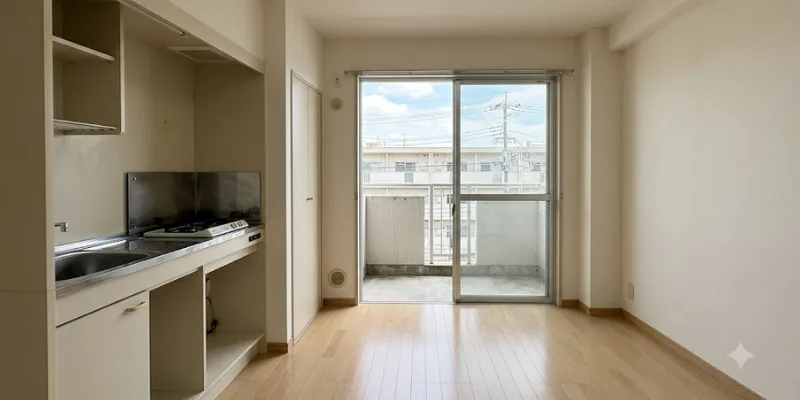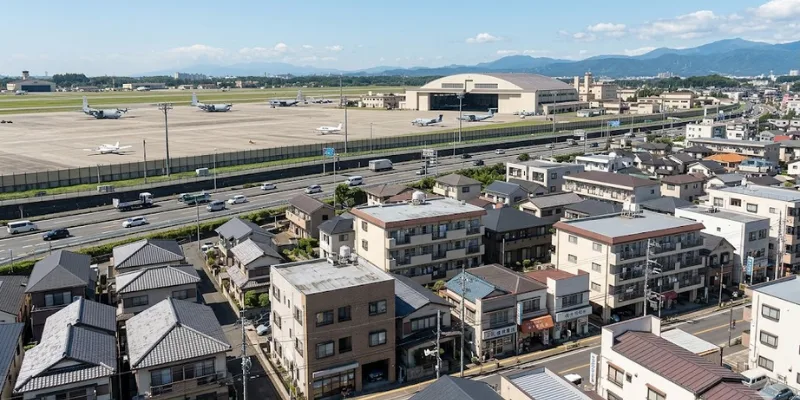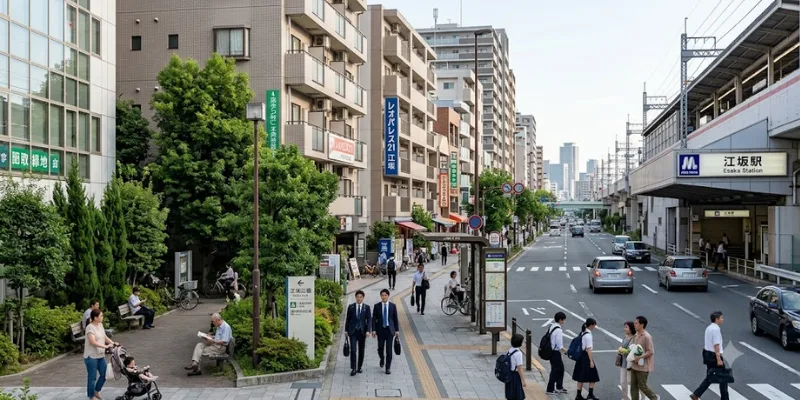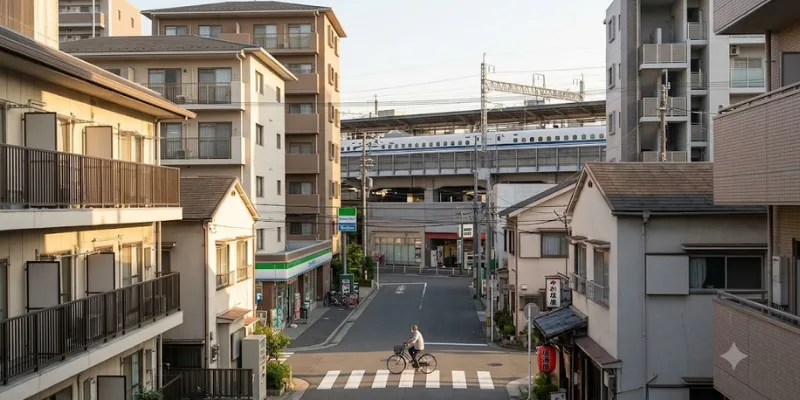

Guest house Japan options for foreigners typically cost between ¥45,000 and ¥70,000 per month for a private room on a long-stay basis, with no guarantor required and full furnishing included, according to 2026 pricing data from major operators including Sakura House and Oakhouse. For foreigners who want more stability than a short hotel stay but more flexibility and lower upfront cost than a standard private apartment lease, guest house Japan options have become one of the most practical long-stay accommodation categories — particularly for those in their first months in the country.
This guide covers how guest house Japan accommodation works for long stays, realistic pricing, what’s included, and how the application process compares to a standard apartment.
What Is a Guest House in Japan for Foreigners?
Guest house Japan for foreigners refers to a specific accommodation category distinct from the Western connotation of a small bed-and-breakfast. In Japan, guest houses are typically:
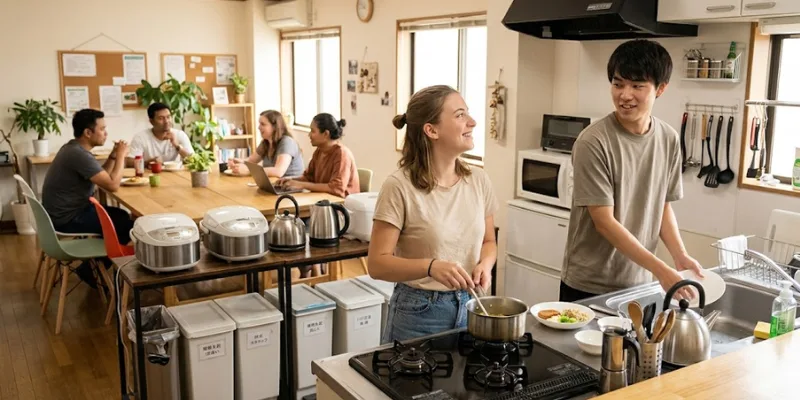
- Multi-room properties with private bedrooms and shared common facilities (kitchen, bathroom, lounge)
- Operated by property management companies rather than individual hosts
- Designed for stays ranging from 1 month to a year or more, not just short visits
- Fully furnished, including bedding, kitchenware, and often Wi-Fi
This makes Japanese guest houses functionally similar to share houses, with the main distinction often being operational style — guest houses tend toward more hotel-like management (cleaning services, more structured check-in/out), while share houses lean more toward a residential, self-managed community feel. In practice, the line between the two categories has blurred considerably, and many operators use the terms somewhat interchangeably.
Guest House Japan Pricing for Foreigners (2026)
| Room type | Typical monthly cost | Notes |
| Shared dormitory room (2–4 people) | ¥35,000–¥48,000 | Most affordable option |
| Private room, outer ward | ¥45,000–¥58,000 | Good value for solo privacy |
| Private room, central ward | ¥58,000–¥75,000 | Premium for location |
| Private room with en-suite bathroom | ¥70,000–¥95,000 | Less common, higher-end operators |
Source: Sakura House, Oakhouse, and Tokyo Share pricing data, 2026. Most quoted rates are all-inclusive of utilities and Wi-Fi.
What’s Typically Included in Guest House Japan Rentals
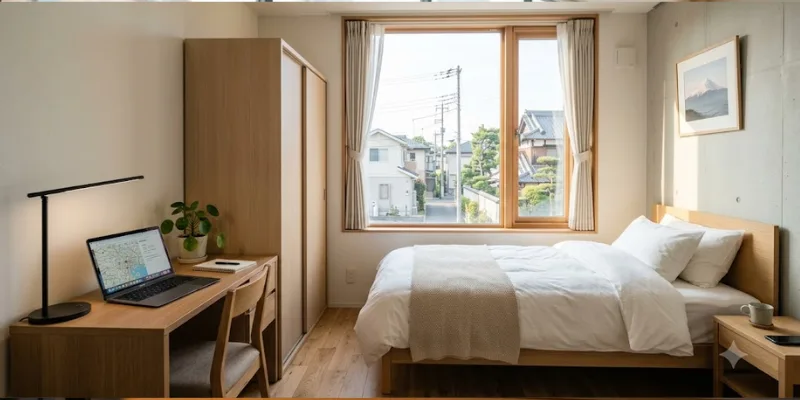
- Furniture — bed, desk, storage, basic furnishings in your private room
- Shared kitchen — fully equipped, available to all residents
- Utilities — electricity, gas, water bundled into the monthly rate
- Wi-Fi — included at most operators
- Common area cleaning — regularly scheduled cleaning of shared spaces
- Bedding — often included, though some operators charge a small separate linen fee
What’s typically NOT included: your private room’s day-to-day cleaning (your responsibility), and sometimes laundry (coin-operated machines on-site are standard).
Why Foreigners Choose Guest House Japan Accommodation for Long Stays
No guarantor required. This is the single biggest practical advantage over a standard private apartment — guest houses typically require only a passport and basic income/enrollment verification, skipping the guarantee company screening process entirely.
Fast move-in. Most guest house bookings can be confirmed within 1–3 days, compared to 2–3 weeks for a standard apartment lease.
Built-in community. Particularly relevant for newcomers to Japan, guest houses — especially those marketed toward foreign residents — offer a ready-made social environment through shared kitchens and common spaces, which can meaningfully ease the transition for those without an existing social network in the country.
Lower commitment. Most guest houses allow 1-month minimum stays with no long-term contract obligation, useful for those still deciding on their longer-term housing or location preferences.
Guest House Japan for Foreigners vs Other Long-Stay Options
| Guest house | Share house | Monthly mansion | Private apartment | |
| Cost/month | ¥45,000–¥75,000 | ¥45,000–¥80,000 | ¥90,000–¥180,000 | ¥58,000–¥130,000 |
| Privacy | Private room, shared common areas | Private room, shared common areas | Full private unit | Full private unit |
| Guarantor | No | No | No | Usually yes |
| Move-in speed | 1–3 days | 1–3 days | 1–5 days | 2–3 weeks |
| Best for | Newcomers wanting community | Similar to guest house | Privacy + flexibility | Long-term stability |
For comparison with the fully private alternative, see our monthly mansion Tokyo guide. For the share house option specifically, see our share house in Japan for foreigners guide.
External reference: Japan National Tourism Organization — Accommodation Types — official overview of accommodation categories available to foreign residents in Japan.
How to Apply for Guest House Japan Accommodation
The application process is significantly simpler than a standard private apartment:
- Browse available rooms through the operator’s website or booking platform
- Submit basic documents — passport copy and, if already in Japan, Residence Card
- Confirm enrollment or employment status — often just a brief written confirmation, not always requiring official documentation
- Pay deposit and first month’s rent — typically ¥10,000–¥30,000 deposit plus the first month
- Move in — often within days of booking confirmation
Compare this to the standard private apartment process, which requires guarantor screening, formal income documentation, and typically 2–3 weeks from application to move-in — see our rent Japan apartment from overseas before arrival guide for that fuller process.
Address Registration at a Guest House
Most established guest house operators allow residents to register their address at the local ward office, which matters significantly for opening a bank account, registering with an employer, and other administrative needs tied to your Residence Card. Always confirm this explicitly with the specific operator before booking, since policies can vary, and this is not a universal guarantee across every guest house property.
Best Areas for Guest House Japan Living in Tokyo
Shinjuku and Shibuya offer the most central guest house options, at a premium reflecting the location, with excellent train access throughout the city.
Nakano and Suginami provide a strong balance of affordability and reasonable commute time, popular among both Japanese and foreign long-term guest house residents.
Adachi-ku and Itabashi-ku offer the most budget-friendly guest house options in Tokyo, with the trade-off of longer commute times to central areas. See our Itabashi apartments for rent guide for more on this ward.
FAQ: Guest House Japan for Foreigners
How long can I stay at a guest house in Japan? There’s typically no maximum stay length — many residents stay 6 months to over a year. Minimum stays are usually 1 month.
Are guest houses safe for solo foreign travelers? Established operators with secure entry systems and a track record of foreign residents are generally considered safe and well-suited to solo newcomers, including women traveling or relocating alone.
Can I cook my own meals at a guest house? Yes — shared kitchens are standard, fully equipped with stove, refrigerator, and basic cookware, though you’ll typically need to bring or purchase your own dishes and utensils unless specified otherwise.
Is a guest house cheaper than a hotel for a 1-month stay? Significantly — a guest house at ¥50,000/month works out to roughly ¥1,650/night, far below even budget hotel rates for an equivalent month-long stay.
→ Browse guest house and short-stay accommodation options in Tokyo
Common Mistakes When Choosing a Guest House in Japan
Not confirming address registration ability upfront. As covered above, this varies by operator and matters significantly if your stay will exceed a couple of weeks — always confirm explicitly before booking rather than assuming.
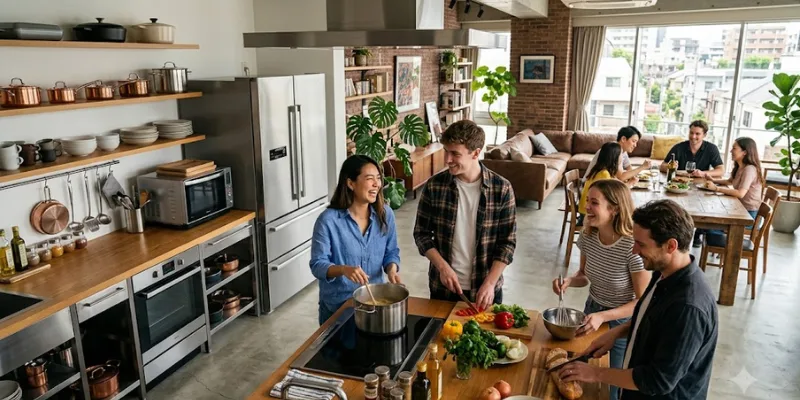
Underestimating shared kitchen logistics. Multiple residents sharing a single kitchen means coordinating around peak cooking times, particularly in larger guest houses. If you have a demanding cooking routine or specific dietary needs requiring dedicated prep time, ask about kitchen size and resident count before committing.
Overlooking the cleaning fee structure. Many guest houses charge a one-time cleaning fee at move-in or move-out, separate from the monthly rate. Confirm this upfront as part of your total cost calculation, not just the advertised monthly figure.
Not researching the specific house’s social dynamics. Guest houses vary considerably in their actual day-to-day social atmosphere — some have an active, communal culture with shared meals and events, while others function more like independent private rooms with minimal resident interaction. If the social aspect matters to your decision, ask the operator directly or, where possible, speak with current residents before booking.
Guest House Japan: A Practical First-Month Scenario
Consider a typical first month for a foreigner choosing guest house Japan accommodation as their entry point:
Days 1–3: Arrival and move-in, getting oriented to the shared kitchen, common areas, and immediate neighborhood.
Week 1: Opening a Japan Post Bank account and obtaining a Japanese mobile number, both of which the registered address from your guest house typically supports.
Weeks 2–4: Settling into a routine, potentially beginning a search for longer-term housing if the guest house was always intended as a transitional step, or deciding to extend the guest house stay if it’s meeting your needs well.
This staged approach — using a guest house as a stable, low-commitment base while you get oriented to Tokyo or Japan more broadly — is one of the most common and practical paths newcomers take, balancing speed of move-in against the stability needed to handle essential early administrative tasks.
When to Transition From Guest House to Private Apartment
Many guest house residents eventually transition to a private apartment once they have:
- Established income documentation — particularly relevant for those who arrived before securing employment
- A clearer sense of preferred neighborhood — having lived in Tokyo for a few months provides much better insight than research done before arrival
- A desire for more privacy and space — common after the initial adjustment period, particularly for those settling in long-term
If you’re approaching this transition, see our rent Japan apartment from overseas before arrival guide for the standard private apartment process, and our Japan rental guarantor system explained guide for what changes once you move beyond the no-guarantor world of guest houses and share houses.
Internal Resources for Long-Stay Housing Decisions
- Capsule hotel vs share house in Tokyo for long stays — comparing guest house alternatives at different stay lengths
- Short stay apartments in Tokyo under ¥50,000 — broader budget accommodation comparison
- Monthly mansion Tokyo: furnished rooms — the fully-private alternative if budget allows
- How to register your address in Japan — the registration process once settled into guest house accommodation
Guest House Japan for Foreigners: Demographic Trends
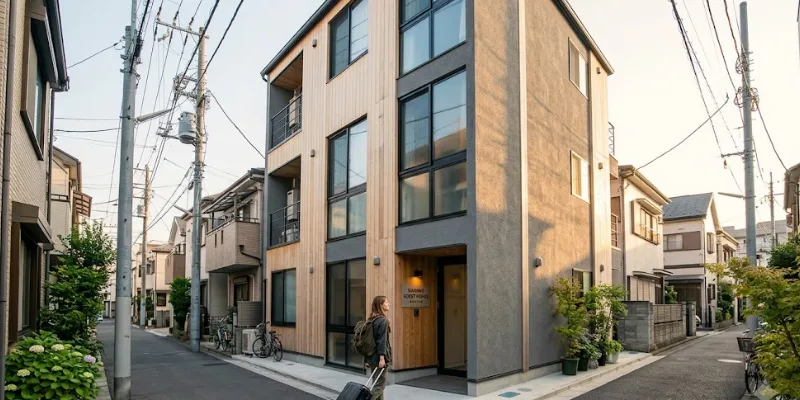
The guest house Japan market has evolved significantly over the past decade, shifting from a niche option primarily used by backpackers and very short-term visitors toward a more mainstream long-stay solution for a broader range of foreign residents. Several factors have driven this shift:
Growing remote work population. As more foreigners work remotely for companies outside Japan, guest houses offer a low-commitment way to “try out” living in Tokyo before committing to a longer-term arrangement, without sacrificing the community aspect that pure private apartments lack.
Rising awareness among employers. Some companies sponsoring foreign employees now actively recommend guest houses or share houses as a bridge solution during the often lengthy visa and apartment-hunting process, rather than leaving new hires to navigate this independently.
Improved operator professionalism. Major operators have invested significantly in property quality, online booking systems, and customer service over the past several years, narrowing the gap between guest house and private apartment living standards.
Tax and Visa Documentation Considerations
For most visa categories, living in a guest house creates no particular complications, provided your address is properly registered. However, a few specific situations are worth understanding:
Tax residency documentation. If you need to provide proof of residence for tax purposes — either in Japan or in your home country — a registered guest house address combined with your Residence Card typically satisfies this requirement, the same as a standard apartment lease would.
Visa renewal address consistency. Immigration authorities generally don’t distinguish between guest house, share house, or private apartment addresses when processing visa renewals, as long as the address is properly registered and consistent with your Residence Card.
Employer-sponsored visa documentation. Some employer-sponsored visa categories require a stated residential address as part of the sponsorship paperwork. A guest house address is generally acceptable here, though it’s worth confirming with your employer’s HR or immigration support team if you have any uncertainty about specific documentation requirements.
Guest House Japan: Regional Variation Beyond Tokyo
While this guide focuses primarily on Tokyo, guest house Japan accommodation exists throughout the country, with notable concentrations in:
Osaka — a large guest house market serving the city’s significant population of students, young professionals, and tourists transitioning to longer stays, generally priced 10–20% below equivalent Tokyo options.
Kyoto — a smaller but well-established market, often skewing toward a more traditional or culturally-themed guest house experience given the city’s character, with options near both Kyoto University and the central business district.
Fukuoka — a growing guest house scene reflecting the city’s increasing popularity among foreign residents and remote workers, generally the most affordable of Japan’s major guest house markets.
If your plans extend beyond Tokyo, researching guest house options in your specific target city follows the same fundamental principles covered in this guide — confirm address registration ability, compare all-inclusive pricing, and verify the specific operator’s track record with foreign residents.
Internal Resources for Newcomers to Japan
- Working holiday visa Japan apartment rent — visa-specific housing considerations relevant to many guest house residents
- Student room sharing in Japan — for students specifically considering shared accommodation options
- Japan rental deposit and key money explained — useful background once you transition from guest house to a standard lease
- Best places to live in Japan — broader location guidance for newcomers still deciding where in Japan to settle

Real estate advisor at Arealty Japan, specialising in helping foreign residents navigate the Tokyo and Osaka rental markets. Lucy has guided hundreds of international renters — from Working Holiday visa holders to corporate relocations — through Japan’s apartment application process. Her writing draws on firsthand experience with landlord screening, guarantor companies, and foreigner-friendly listings across all 23 Tokyo wards and major Kansai cities.