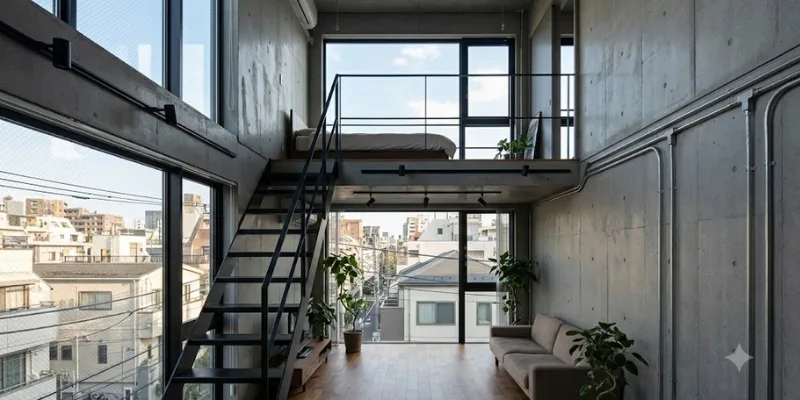

Tokyo loft apartments — units with double-height ceilings, mezzanine sleeping platforms, or industrial open-plan layouts — start from around ¥90,000 per month for a 1K-equivalent unit in outer central wards like Nakano or Suginami, and run to ¥200,000+ for architect-designed loft conversions in Shibuya or Meguro, based on current listings across major Tokyo rental platforms. For foreigners seeking something distinctly different from Japan’s standard compact apartment formats, a Tokyo loft apartment offers an aesthetic and spatial experience largely unavailable in the mainstream rental market.
This guide covers what “loft” actually means in Tokyo’s rental context, where these apartments concentrate, realistic pricing, and the specific points to check before signing a lease on one.
What “Loft” Means in Tokyo Rental Listings
Tokyo rental listings use “loft” (ロフト, rofuto) in two distinct ways that require careful interpretation:
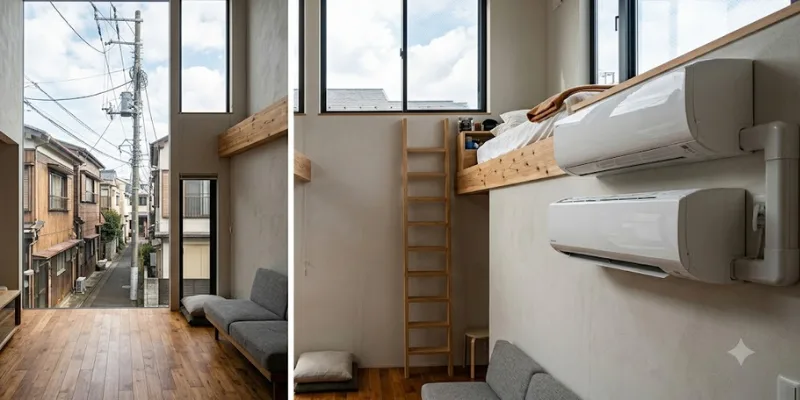
Standard ロフト (loft storage platform): The most common usage in Japanese rental listings — a small elevated sleeping or storage area accessible by ladder, built above the main room in a compact 1K or 1R apartment. This is not a double-height loft space; it’s essentially a built-in sleeping shelf. These appear at very affordable price points (¥50,000–¥75,000) but the headroom in the loft area is typically 100–120cm — usable for sleeping but not for standing. This is the common meaning in Japanese listings.
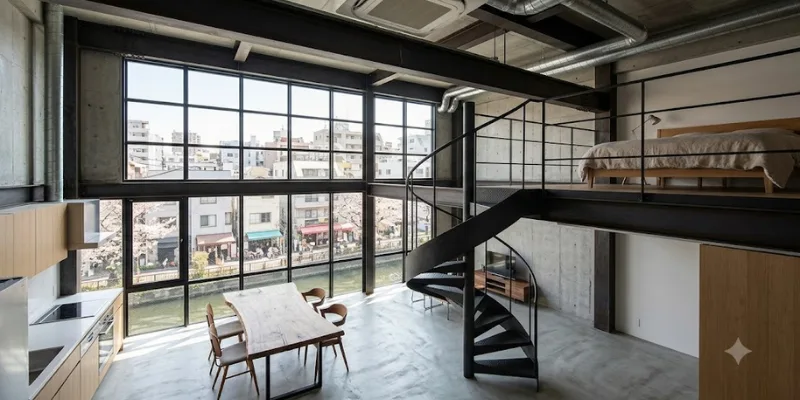
Open-plan / double-height loft: The Western sense of “loft” — genuine double-height space, often in converted commercial or industrial buildings, with high ceilings (2.7m+), sometimes exposed ductwork or beams, and an open plan layout. These are significantly rarer, more expensive, and concentrated in specific inner-Tokyo neighborhoods.
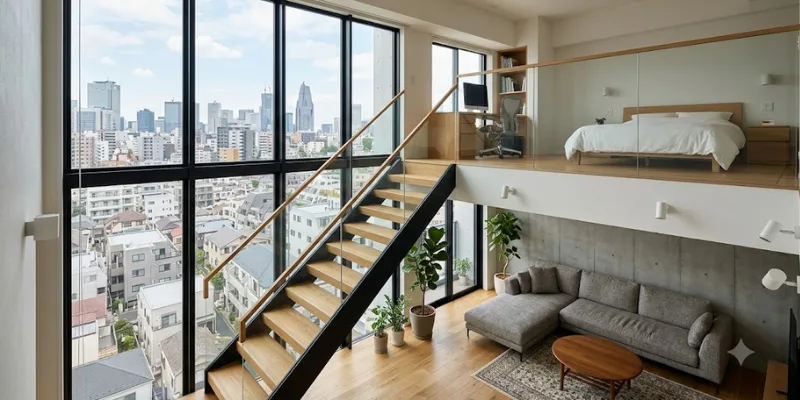
Mezzanine apartment (メゾネット, mezzanette): A two-floor apartment within a single unit, accessible by internal stairs rather than a ladder. This offers more genuine usable floor area than a platform loft.
When searching for a genuine Tokyo loft apartment in the open-plan sense, filter specifically for:
- 天井高 (tenjō-daka) — ceiling height specified at 2.7m or above
- デザイナーズ (designer’s apartment) — architect-designed units often have genuine loft character
- リノベーション (renovation) — converted older buildings often yield authentic loft spaces
Where to Find Genuine Tokyo Loft Apartments
Nakameguro and Daikanyama (Meguro-ku / Shibuya-ku border)
The most concentrated area for authentic Tokyo loft apartments, largely because the canal-side industrial and light-commercial buildings along the Meguro River have been progressively converted to residential use since the late 1990s. These conversions — often by boutique renovation companies — offer some of Tokyo’s most distinctive living spaces.
- Average 1K equivalent: ¥120,000–¥200,000/month (significant premium over standard)
- Character: Boutique café culture, canal views, design-conscious resident base
- See our Meguro apartments for rent guide
Shimokitazawa and Sangenjaya (Setagaya-ku)
Shimokitazawa’s vintage and subculture character has attracted a cluster of genuinely interesting rental buildings, including some loft conversions and purpose-built design apartments in the streets behind the main shopping areas.
- Average 1K equivalent: ¥90,000–¥140,000/month
- Character: Music and vintage fashion scene, younger demographic, more affordable than Meguro
- See our Setagaya City guide
Koenji and Asagaya (Suginami-ku)
Suginami-ku’s music and arts scene has created demand for unusual apartment types, and some older wooden buildings (古民家, kominka) and small commercial conversions offer loft-like spaces at comparatively affordable prices given the ward’s overall rent level.
- Average 1K equivalent: ¥85,000–¥120,000/month
- Character: Independent music, arts, vintage, most affordable of the loft-concentrated areas
- See our Suginami apartments for rent guide
Jiyugaoka and Okusawa (Meguro-ku / Setagaya-ku border)
Quieter and more family-oriented than Nakameguro, this area has a French-influenced café culture and some unusual residential buildings including renovated older detached homes with open-plan interior conversions.
- Average: ¥110,000–¥160,000/month for 1LDK equivalent
- Character: Upscale residential, quieter, popular with creative professionals and couples
Tokyo Loft Apartment Pricing (2026)
| Type | Ward | Avg. monthly rent | Notes |
| Platform loft 1R (ladder access) | Any ward | ¥50,000–¥80,000 | Most common, low headroom in loft area |
| Mezzanette 1LDK | Shinjuku, Shibuya | ¥120,000–¥180,000 | Two usable floors, internal stairs |
| Converted commercial loft | Meguro, Shibuya | ¥130,000–¥220,000 | Genuine double-height, rare |
| Designer loft 1K | Nakano, Suginami | ¥90,000–¥130,000 | Purpose-built design apartments |
Standard 1K prices in these wards for reference (Hato Mark Site, Zentakuren, 2026): Shibuya-ku ¥109,400, Meguro-ku ¥92,900, Nakano-ku ¥86,000, Suginami-ku ¥74,800.
The premium for a genuine open-plan Tokyo loft apartment over a standard 1K in the same ward runs approximately ¥20,000–¥60,000/month — reflecting the rarity of these units and their consistent demand from design-conscious renters.
Key Points to Check Before Signing a Tokyo Loft Apartment
Verify actual ceiling height in the main living area. Ask for the exact 天井高 (ceiling height) in centimetres before viewing. “Loft” in a Japanese listing doesn’t guarantee double-height living space — it may refer only to the sleeping platform.
Inspect the loft platform headroom if you plan to sleep there. For platform lofts accessible by ladder, stand under the platform and measure the headroom before deciding whether you can realistically use it as a bedroom versus storage only.
Check the heating and cooling efficiency. Double-height spaces are harder to heat in winter and cool in summer than standard-ceiling rooms. Ask about the air conditioning unit’s capacity relative to the actual volume of the space — undersized AC is a common complaint in loft apartments.
Ask about noise characteristics. Open-plan and industrial-conversion buildings often have different sound profiles than purpose-built residential apartments — higher ceilings can amplify sounds, and older converted buildings may have thinner walls between units.
Confirm building standards. For older or converted buildings, ask the construction year. Buildings pre-dating June 1981 don’t meet modern earthquake resistance standards (新耐震基準). This is particularly relevant for converted kominka or industrial spaces.
Tokyo Loft Apartments and Guarantee Company Applications
A Tokyo loft apartment at ¥130,000/month requires demonstrating ¥390,000/month household income under the standard 1/3 rule — significantly higher than a standard 1K apartment. For foreigners applying for higher-priced units, document preparation becomes more important:
- Prioritize providing both an employment contract and 6 months of payslips, not just one or the other
- If your income is paid in a foreign currency, include both original currency and JPY equivalent documentation
- Your guarantee company will assess the loft’s rent level against your income just as it would any apartment — the unusual layout doesn’t change the screening criteria
For more on income documentation, see our apartment financial proof Japan guide and our guarantor company fee structure guide.
Alternatives to Genuine Loft Apartments
If a genuine open-plan Tokyo loft apartment is beyond your budget or proving difficult to find, consider:
Renting a loft apartment Japan pitfalls guide — our dedicated guide on what to check and common disappointments: renting a loft apartment Japan pitfalls guide.
Spacious 1LDK in a standard building. Some newer 1LDK buildings offer 3m+ ceiling heights without the full loft aesthetic but with better energy efficiency and sound insulation. Search for 天井高 3000mm in listing filters.
Design apartments (デザイナーズマンション) in standard buildings often offer better aesthetic differentiation than typical apartments without the specific loft heating/cooling challenges.
FAQ: Tokyo Loft Apartments
Is “loft” in Japanese listings the same as in Western real estate? No — “ロフト” in Japanese rental listings almost always refers to a storage/sleeping platform, not a double-height open-plan space. Always check ceiling height specifications.
Are Tokyo loft apartments harder to heat in winter? Yes — double-height spaces require higher-capacity AC and heating than same-area standard rooms. Factor in potentially higher utility bills when comparing total monthly costs.
Can I find genuine loft-style apartments in outer wards? Occasionally, particularly in Suginami-ku (Koenji) and Nakano-ku, where older commercial buildings have been converted. These tend to be rare but exist at lower price points than the Meguro/Shibuya cluster.
Tokyo Metropolitan Government — Living in Tokyo (Housing) — official housing context for foreign residents.
→ Browse design and loft-style apartments in Tokyo
Tokyo Loft Apartments: Understanding the Renting a Loft Japan Pitfalls
Beyond the pricing and location considerations above, a Tokyo loft apartment comes with specific practical challenges that standard apartment guides don’t cover:
Summer heat concentration. Heat rises. In a double-height Tokyo loft apartment, the loft sleeping platform or mezzanine level can be 3–5°C warmer than the main floor during Tokyo’s hot, humid summer months (July–September). A standard wall-mounted AC unit positioned on the main floor may not effectively cool the upper level. Before signing, ask whether there is a second AC unit on the upper level, or whether the building’s specifications address this.
Winter heating efficiency. Conversely, heating a double-height space in winter is expensive and slow. The volume of air that needs to be heated is proportionally larger than in a standard-ceiling apartment. Concrete and steel-frame buildings retain heat better than wood-frame; ask about construction type when viewing.
Sound carry. In an open-plan Tokyo loft apartment, sound from the kitchen or living area carries freely to any sleeping area — there are no sound-insulating walls between zones. If you work shifts, have a partner with a different schedule, or are sensitive to background noise during sleep, this matters more than it does in a compartmentalized standard apartment.
Ladder access to sleeping platform. For budget Tokyo loft apartments with the platform-style loft, the ladder access becomes a real consideration for daily use — getting up to use the bathroom at night, carrying laundry up and down, and general mobility with injury or illness. Apartments with internal stairs (メゾネット style) avoid this.
Finding a Tokyo Loft Apartment: Search Strategy
Standard rental search platforms don’t have a single reliable “loft” filter that reliably surfaces genuine open-plan units. A more effective search approach:
Search terms to combine in Japanese-language platforms:
- 天井高 (ceiling height) + 2700mm or 3000mm — filters for double-height spaces
- デザイナーズ (designer) — surfaces architecture-designed units that more commonly feature loft elements
- リノベーション (renovation) — converted spaces often have loft character
- メゾネット (mezzanette) — two-level private units with internal stairs
Area + agency approach: For the Nakameguro/Daikanyama cluster specifically, smaller boutique agencies specializing in renovation and design properties in those specific neighborhoods often have off-market or early-listing access to the best Tokyo loft apartment options before they appear on aggregator platforms.
Direct inquiry to renovation companies: Several Tokyo renovation companies (リノベ不動産 operators) both develop and manage their own properties — contacting them directly sometimes yields first access to newly-completed loft conversions before they’re listed publicly.
Internal Resources for Design-Forward Tokyo Apartment Hunters
- Japan apartment viewing checklist — use the 20-point checklist with additional attention to the loft-specific checks above
- Best areas to live in Tokyo for foreigners — ward context for the areas where Tokyo loft apartments concentrate
- Shibuya apartments for rent guide — the premium-ward guide for the most design-concentrated area
- Internet setup and installation cost Japan — relevant for older converted buildings where fiber may not be pre-installed

Real estate advisor at Arealty Japan, specialising in helping foreign residents navigate the Tokyo and Osaka rental markets. Lucy has guided hundreds of international renters — from Working Holiday visa holders to corporate relocations — through Japan’s apartment application process. Her writing draws on firsthand experience with landlord screening, guarantor companies, and foreigner-friendly listings across all 23 Tokyo wards and major Kansai cities.