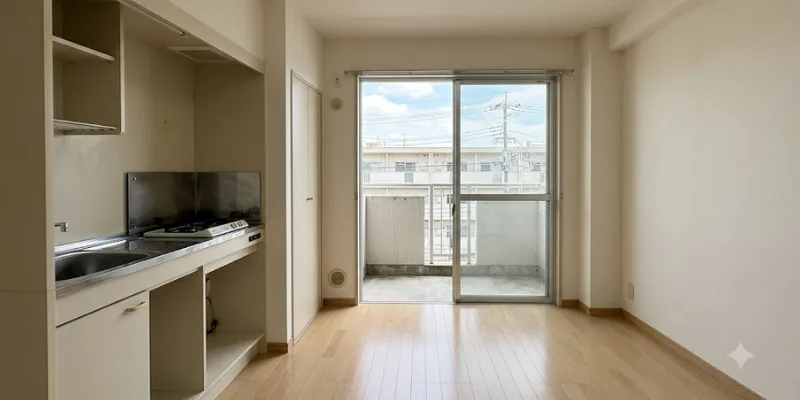

The best multi-functional furniture for a small Japanese apartment combines storage, transformation, and a low profile. Top picks for a 20–25m² 1K unit: a storage bed (¥35,000–¥80,000 at Nitori), a lift-top coffee table (¥18,000–¥35,000), a slim 30cm-deep sideboard (¥12,000–¥25,000), and a daybed sofa (¥45,000–¥120,000). Buy from Nitori, MUJI, or IKEA Japan — all three carry Japanese-spec sizes that fit narrow doorways and elevators.
This guide covers every essential furniture category for a Japanese 1K, 1DK, or 1LDK home — with specific brand picks, real 2026 prices, and the dimensional limits you’ll hit in a typical 18–35m² unit.
Last updated: April 29, 2026 · Reviewed by the Arealty Tokyo team
Storage Beds: The Single Most Important Purchase
In a 20m² studio, your bed occupies roughly 30% of the floor. A bed that only sleeps you is the most expensive square-meter mistake a small-apartment renter can make.
Three storage-bed configurations that work in Japanese rentals
1. Drawer base bed (¥30,000–¥55,000)
Four large drawers under the mattress, accessed from the side. Best for clothing, bedding, and seasonal items. Easiest to assemble in a small room because each drawer disassembles into a flat panel during move-in.
- Nitori “Friel” series — single ¥34,900, semi-double ¥44,900
- MUJI Walnut Storage Bed — single ¥45,000, semi-double ¥55,000
2. Gas-lift platform bed (¥55,000–¥120,000)
Hydraulic mechanism lifts the entire mattress platform, revealing a full-size storage box underneath. Holds 2–3 large suitcases plus a winter futon set. Best space-to-storage ratio of any bed type.
- IKEA MALM with storage — single ¥59,990
- Nitori Premium Lift-Up Bed — semi-double ¥79,900
3. Loft bed / high-sleeper (¥45,000–¥95,000)
Bed elevated to 1.4–1.7m, leaving floor space below for a desk, sofa, or wardrobe. Adds roughly 4–5m² of usable floor area to a 20m² studio. Best for solo renters under 175cm tall — taller users often hit ceiling clearance issues.
- Nitori Loft Bed Vega — ¥49,900
- IKEA STORÅ — ¥64,990
Dimensional warning
Standard Japanese single beds are 97cm × 195cm. A “queen” in Japan is 160cm × 195cm, narrower than a US queen. Western beds shipped from overseas often don’t fit standard Japanese bedrooms — measure the room and the doorway before buying.
For broader context on what fits in a typical Japanese apartment, see our guide to the average apartment size for one person in Japan and standard furniture dimensions for Japanese apartments.
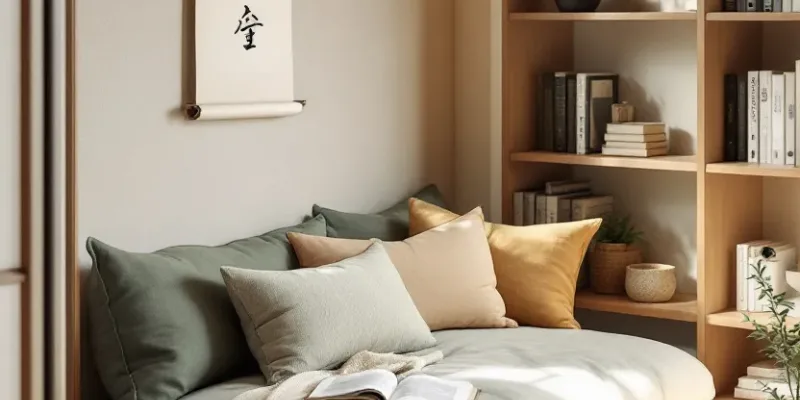
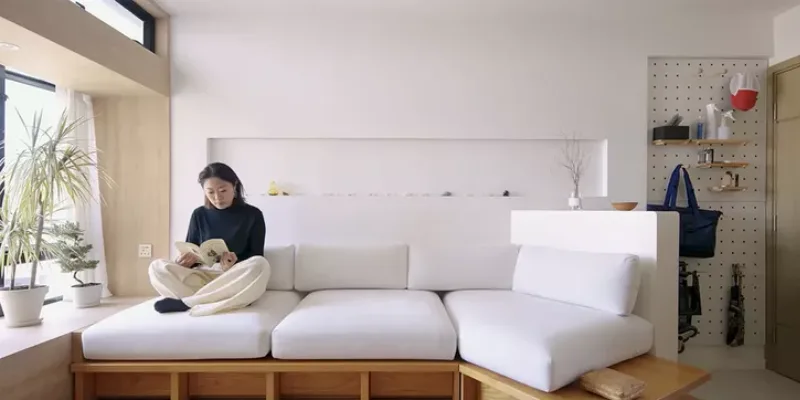
Modern multi-functional furniture in Japanese studio.
Best Sofas & Daybeds for Small Apartments in Japan
A full 3-seat sofa rarely fits a Japanese 1K. The dominant alternative is the daybed — a hybrid between a sofa, a chaise, and a single bed.
Best daybed options for small apartments in Japan
1. Compact convertible daybed (¥45,000–¥75,000)
Single-seat by day, single-bed by night. Backrest folds flat. Width typically 90–100cm. The most popular choice for solo apartments because it eliminates the need for a separate guest mattress.
- Nitori Niy Daybed — ¥49,900
- MUJI Wide Arm Sofa Bed — ¥69,000
2. Storage daybed (¥65,000–¥120,000)
Same convertible function plus a hidden storage compartment under the seat. Stores 4–6 stacked storage boxes. Best when closet space is limited.
- Nitori Storage Daybed Saric — ¥84,900
3. Modular sectional daybed (¥85,000–¥160,000)
Two-piece L-shape that breaks down into separate units when you move. Each piece fits through a 75cm doorway. Best for renters who plan to move within 2–3 years.
- IKEA VIMLE 2-piece — ¥99,990
Best cheap sectional sofas for apartments in Japan
If you have a 1LDK with a defined living area, a small sectional becomes viable. Look for sectionals under 220cm total length to fit standard Japanese living rooms.
- Nitori Roese 2-seat Sectional — ¥79,900 (180cm total)
- IKEA EKTORP 2.5-seat — ¥89,990 (215cm total)
- MUJI Wide Arm Sofa with chaise — ¥120,000 (210cm total)
For bigger floor plans, see our 2LDK apartment guide for layout context.
Multi-Functional Tables: Coffee, Dining & Work Surface in One
In a studio, one table typically serves three roles: coffee table for relaxing, dining surface for meals, and laptop desk for work. The right design transitions between all three without compromise.
Top dining table options for small apartments in Japan
1. Lift-top coffee table (¥18,000–¥38,000)
Mechanical top rises 25–35cm and slides forward, becoming a laptop-height surface. Returns to coffee-table height in seconds. Includes hidden compartment beneath for chargers, remotes, and notebooks. The single most useful piece in a 1K apartment.
- Nitori Lift-Up Center Table — ¥22,990 (90cm × 50cm)
- IKEA TROTTEN Sit/Stand — ¥34,990
2. Drop-leaf wall table (¥9,000–¥18,000)
Mounts to the wall (with tension-pole support if drilling isn’t allowed). Folds completely flat against the wall when not in use, projecting only 5cm. Pulls out to a 60cm × 80cm dining-for-2 surface. Best for studios under 22m².
- Nitori Wall-Mount Drop-Leaf — ¥12,900
- IKEA NORBERG — ¥9,990
3. Extendable dining console (¥35,000–¥75,000)
A 30cm-deep console table behind the sofa that extends to a 90–120cm dining table. Compresses again after meals. Best for 1LDK units where the kitchen and living are separate.
- MUJI Oak Extendable — ¥55,000
4. Kotatsu (¥15,000–¥45,000)
A heated low table with a quilted cover. Functions as a coffee table in summer, a heated work-from-home desk in winter, and a social gathering spot year-round. Power consumption is low (300–500W).
- Nitori Kotatsu with Reversible Top — ¥19,900
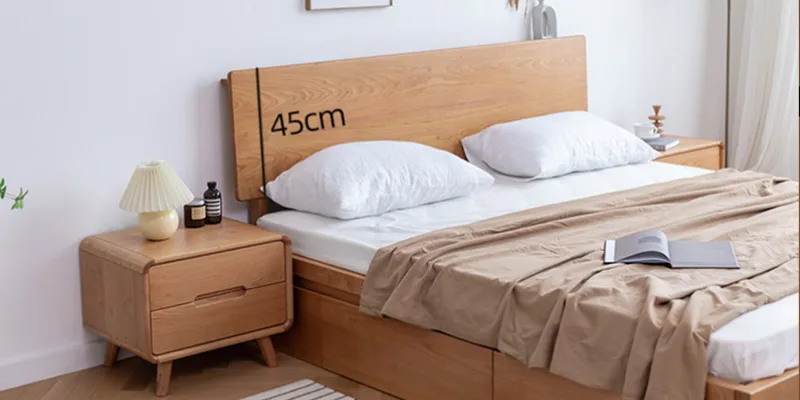
Compact bed with integrated storage drawers.
Best Dining Chairs for Small Apartments in Japan
In small apartments, dining chairs need to do double duty: comfortable enough for a 90-minute video call, light enough to lift over a coffee table, and stackable when not in use.
Three styles that work in Japanese rentals
1. Stackable wooden chairs (¥4,000–¥12,000 each)
Lightweight, stackable 4-deep, fits under standard tables. The default for small Japanese dining.
- Nitori Stacking Wood Chair — ¥4,990
- MUJI Beech Stacking Chair — ¥7,990
2. Folding chairs with cushions (¥6,000–¥15,000 each)
Folds completely flat for storage in a 5cm gap behind a sofa or against a wall. Good for hosting guests in a unit that normally needs only one or two chairs.
- IKEA TERJE folding — ¥3,990
- Nitori Cushioned Fold-Flat — ¥7,900
3. Translucent acrylic chairs (¥9,000–¥22,000 each)
Visually “disappear” against the floor, making the room feel larger. Best for renters prioritizing the optical illusion of space. Less comfortable for long sessions than padded options.
- Nitori Acrylic Ghost Chair — ¥12,900
Sizing rule
For a 60cm × 80cm dining table, plan for 2 chairs maximum. For a 90cm-extended surface, 3 chairs fit comfortably. Going beyond 4 chairs in a 1K is impractical.
Top Counter Stool Options for Small Apartments
Counter stools turn a kitchen counter or a wall-mounted surface into a daily-use eating area, eliminating the need for a separate dining table in studios under 20m².
Best counter stool styles in 2026
1. Backless adjustable stool (¥4,000–¥9,000)
Gas-lift height adjustment from 55–75cm. Slides completely under the counter when not in use. The most space-efficient stool option.
- Nitori Adjustable Stool — ¥4,490
- IKEA DALFRED — ¥5,990
2. Folding bar stool (¥7,000–¥15,000)
Folds flat for under-bed or under-sofa storage. Good for studios that occasionally host guests but don’t need permanent seating.
- Nitori Fold-Flat Bar Stool — ¥7,990
3. Low-back upholstered stool (¥10,000–¥22,000)
Low backrest provides lumbar support without adding visual bulk. Best for daily 30+ minute use at a kitchen counter.
- MUJI Walnut Counter Chair — ¥18,000
For the 12cm gap between fridge and wall (a common Japanese kitchen feature), pair stools with a slim rolling cart (Nitori Naist 3-tier, ¥3,490) to maximize utility in narrow kitchen runs.
Sideboards, Credenzas & Media Consoles
Three names, three slightly different products — but all serve the same purpose in a small Japanese apartment: low-profile horizontal storage that doubles as a TV stand or display surface.
Most popular sideboard style for small apartments
Slim 30cm-deep sideboards dominate Japanese small-apartment design. Standard 90–180cm width, 70–80cm height, 30cm depth — fits against any wall without protruding into walking paths.
- Nitori Filn Sideboard 120cm — ¥17,990
- MUJI Oak Sideboard 110cm — ¥35,000
- IKEA HEMNES TV unit — ¥24,990
Most popular affordable credenza style
A credenza (lower, longer than a sideboard, often with sliding doors) works best beneath a wall-mounted TV in a 1LDK. Look for sliding doors rather than swinging — they don’t require clearance space in front.
- Nitori Sliding-Door Credenza 150cm — ¥24,900
- Lowya Walnut Credenza — ¥32,800
Most popular media console style
For renters with a TV setup, a media console combines storage with cable management cutouts. Heights stay low (40–45cm) so the TV sits at correct eye level when watching from a sofa.
- Nitori Media Console with Cable Routing — ¥19,900
- IKEA BESTÅ TV bench — ¥18,990
Sizing guidance for studios
In a unit under 20m², limit sideboards to 120cm width or less. Above 150cm, the piece dominates the room visually and reduces the perceived size of the space.
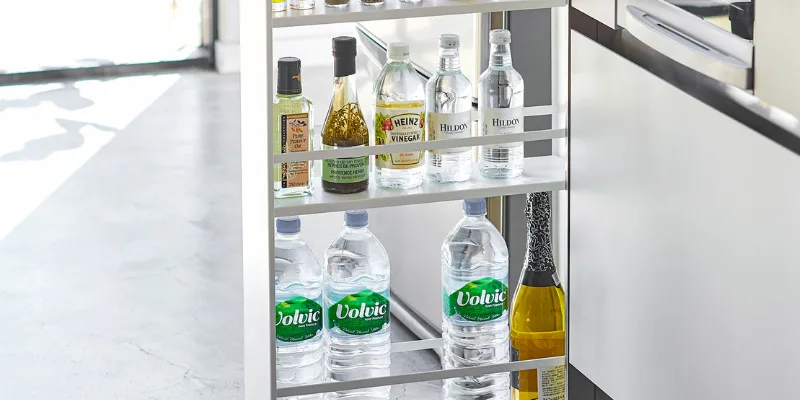
Slim rolling cart for narrow kitchens.
Display Cabinets for Compact Spaces
A display cabinet shows off books, ceramics, or hobby collections without the visual heaviness of a closed wardrobe. In Japanese small apartments, the rule is: glass-fronted, narrow, vertical.
Best cheap display cabinet styles for small apartments
1. Tall narrow glass cabinet (¥15,000–¥35,000)
40–50cm wide, 180–200cm tall. Goes in unused corners or beside doorways. Maximizes vertical storage without taking floor area.
- Nitori Glass Display Cabinet 45cm — ¥17,900
- IKEA BILLY with glass doors — ¥19,990
2. Wall-hung display shelf (¥6,000–¥18,000)
Mounts via tension-pole system (no drilling — important for renters). Provides 3–5 narrow shelves at viewing height. The lightest, most rental-friendly option.
- Nitori Tension-Pole Display Rack — ¥9,900
3. Lighted curio cabinet (¥35,000–¥65,000)
Built-in LED strip lighting illuminates contents. Premium option for collectors. Plug-in (no wiring required), low-power LEDs.
- MUJI Lighted Display Cabinet — ¥42,000
For renters: avoid heavy wood cabinets over 30kg empty weight. Japanese floors can support them, but moving day becomes a nightmare in narrow elevators.
Storage Benches & Hidden-Storage Pieces
A storage bench at the entrance (genkan) of a Japanese apartment is uniquely useful — it serves as both shoe-changing seat and shoe storage in one piece.
Best storage bench options for small apartments
1. Genkan storage bench (¥9,000–¥22,000)
40–50cm tall, 60–90cm wide. Lift-up seat reveals storage for 6–12 pairs of shoes. Standard issue for any Japanese household entrance.
- Nitori Genkan Bench with Storage — ¥12,900
- IKEA TJUSIG bench — ¥7,990
2. Window-side storage bench (¥18,000–¥40,000)
Doubles as window seating in a 1LDK with a bay window. Storage holds blankets, books, or off-season items.
- MUJI Wood Window Bench 90cm — ¥28,000
3. Toy/game storage bench (¥15,000–¥30,000)
For small families. Cubby-style storage with washable upholstered top. Survives kid use without showing wear.
- Nitori Cubby Storage Bench — ¥17,900
For broader rental-furniture rules (what landlords allow you to install vs. not), see our guide to essential rules for large furniture in rental apartments in Japan and under-floor storage options in Japanese rentals.
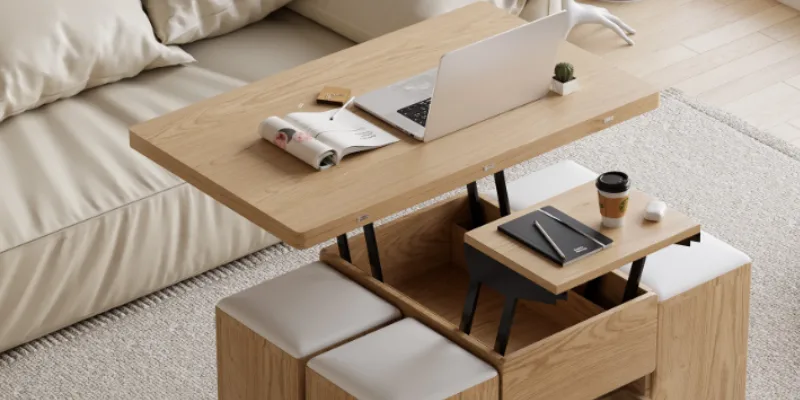
Adjustable lift-top table for remote work.
Where to Buy: Nitori vs. MUJI vs. IKEA Japan
The three big retailers each have distinct advantages. Most Japanese small-apartment dwellers end up combining all three.
Nitori (ニトリ)
Best for: Affordable, pure functionality. Nicknamed “Japan’s IKEA” but with sizes specifically tuned to Japanese floor plans.
- Pricing: Cheapest of the three across most categories
- Delivery: ¥3,300–¥5,500 standard, free over ¥10,000 in some regions
- Assembly: Self-assembly standard; assembly service +¥3,000–¥8,000
- Best categories: Beds, sofas, dining sets, storage
MUJI (無印良品)
Best for: Modular systems, premium minimalist aesthetic, quality wood.
- Pricing: 1.5–2× Nitori for comparable items
- Delivery: Free over ¥5,000
- Assembly: Some pieces pre-assembled
- Best categories: Modular shelving, minimalist beds, kitchenware
IKEA Japan
Best for: Specific products with no Japanese equivalent (loft beds, sectional sofas, modular wardrobes).
- Pricing: Mid-tier, between Nitori and MUJI
- Delivery: ¥5,990 flat rate, free over certain thresholds
- Assembly: Self-assembly only (no in-store service)
- Limitation: Only 12 stores in Japan, so visit-then-buy isn’t always possible
Where to buy used (for budget-tight renters)
For renters trying to keep furniture spend under ¥100,000 total, second-hand can cut costs by 50–70%. See our used furniture in Japan guide for retailers, online marketplaces, and expat sayonara-sale tips.

Popular furniture stores for small Japanese apartments.
Frequently Asked Questions
What is the best multi-functional furniture for a small Japanese apartment?
The four highest-impact pieces are: a storage bed (replaces dresser + bed), a lift-top coffee table (coffee table + work desk + storage), a 30cm-deep sideboard (TV stand + display + storage), and a convertible daybed (sofa + guest bed). Together these four pieces handle 80% of a 20m² apartment’s furniture needs for under ¥150,000 total at Nitori.
What are the top dining table options for small Japanese apartments?
For studios under 22m²: a drop-leaf wall table (folds flat against the wall, projects 5cm) is the best option, ¥9,000–¥18,000. For 1LDK units: a lift-top coffee table that converts to laptop or dining height covers most needs, ¥18,000–¥38,000. For 2-3 person households in 1LDK+: an extendable dining console that compresses to a 30cm-deep table, ¥35,000–¥75,000.
What’s the most popular sideboard style for small apartments in Japan?
30cm-deep, 90–150cm wide, 70–80cm tall is the dominant Japanese small-apartment sideboard format. This profile fits against any wall without obstructing walking paths and works as both a TV stand and a display surface. Both Nitori and MUJI build their entire small-apartment sideboard line around these dimensions.
What are the best daybed options for small apartments?
For solo renters: a compact convertible daybed (90–100cm wide, ¥45,000–¥75,000) replaces both sofa and guest bed. For renters who need extra storage: a storage daybed with hidden compartment (¥65,000–¥120,000). For couples in 1LDK: a modular sectional daybed that breaks into 2 pieces for moving (¥85,000–¥160,000).
What are the best cheap sectional sofas for apartments in Japan?
Look for sectionals under 220cm total length so they fit standard Japanese living rooms. Nitori Roese (180cm, ¥79,900) and IKEA EKTORP (215cm, ¥89,990) are the two most popular budget options. Avoid Western-spec sectionals over 250cm — they often won’t fit through Japanese doorways or elevators.
Where should I buy furniture for my Japanese apartment?
Nitori for affordability and Japanese-spec sizing (cheapest), MUJI for minimalist quality (mid-premium), IKEA Japan for products with no local equivalent like loft beds and modular wardrobes. Most renters end up combining all three. For 30–60% savings, used furniture from retailers like Off-House or Mercari is viable for less critical pieces.
How do I choose furniture that fits through Japanese doorways and elevators?
Standard Japanese rental doorways are 75–80cm wide. Elevator interiors typically measure 120cm × 80cm. Before buying, measure both your route and the furniture’s largest disassembled component — many Western sofas can’t enter Japanese elevators even when the box says it should fit. Nitori, MUJI, and IKEA Japan all design their products around these constraints.
Can I bring my furniture from my home country to Japan?
Generally not recommended. Western beds, sofas, and dining tables are typically too large for Japanese doorways and elevators. Electrical items rated for 120V or 220V won’t function safely on Japan’s 100V outlets without proper transformers. The only categories worth shipping are small items: lamps with replaceable bulbs, decorative pieces, and dining chairs that fit standard cargo dimensions.
What is “Sodai Gomi” and how does it affect my furniture choices?
Sodai Gomi (粗大ゴミ) is oversized trash — anything larger than 30cm. You can’t dispose of a bed or sofa in regular trash. You must buy disposal stickers (¥300–¥3,000 per item) at a convenience store and schedule a pickup. Tip: Choose modular furniture that disassembles into pieces under 30cm so you can dispose of components in regular trash and avoid Sodai Gomi fees entirely.
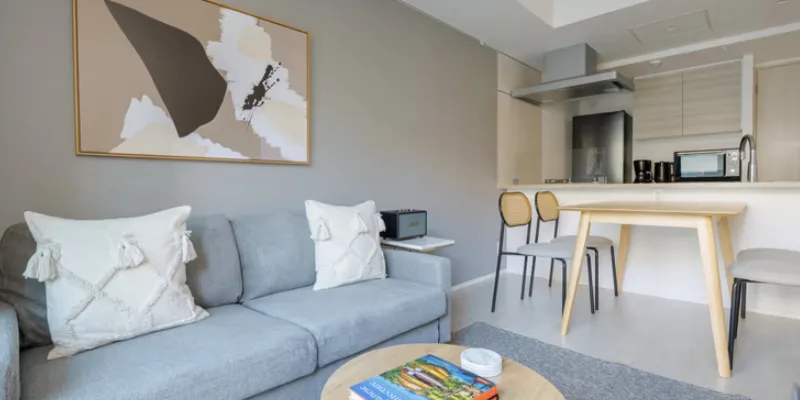
Space-saving sofa bed for small apartments.
Plan Your Apartment Layout Before You Buy
Furniture choices depend heavily on the layout of your specific apartment. Before buying anything, measure your space and verify the layout against your floor plan.
Useful next reads:
- Furniture Layout Tips for Small 1K/1LDK Apartments — placement strategies
- Standard Furniture Dimensions for Japanese Apartments — exact sizing reference
- Used Furniture in Japan — second-hand budget strategy
- Interior Design Guide for Small 1K Apartments — visual styling
- Average Apartment Size for One Person in Japan — size benchmarks
- 1-Bedroom Apartment in Japan Guide — what 1K, 1DK, and 1LDK actually mean
- Apartment for Minimalist Lifestyle in Japan — broader minimalism approach
Contact our bilingual team if you’re house-hunting and want furniture-fit guidance built into your apartment search.
About the Author & Editorial Process
This guide is maintained by the Arealty editorial team, a licensed Tokyo real estate agency . Our staff includes licensed takken-shi (宅建士) who place hundreds of foreign tenants in Tokyo apartments annually. Furniture pricing is verified quarterly against Nitori, MUJI, and IKEA Japan online catalogs.
Update cadence: Pricing benchmarks are refreshed quarterly. Product picks are reviewed when retailers launch new collections (typically March and September).
Pricing shown is from April 2026 catalogs. Confirm current prices directly with the retailer before purchase, as Nitori, MUJI, and IKEA Japan all run periodic promotions that may not reflect listed prices.
Conclusion
Living in a small Japanese apartment does not mean you have to sacrifice comfort or style. By embracing multi-functional furniture for small Japanese apartment, you can turn a modest 20-square-meter room into a sophisticated, highly organized home. Whether you are sleeping, working, or entertaining, your furniture should work for you, not against you.
The key is intentionality. Every piece you bring into your home should have a clear purpose and, ideally, more than one function. With the right strategy, your japan tokyo apartment rent will become a place of rest and inspiration amidst the neon lights of the city.

Real estate advisor at Arealty Japan, specialising in helping foreign residents navigate the Tokyo and Osaka rental markets. Lucy has guided hundreds of international renters — from Working Holiday visa holders to corporate relocations — through Japan’s apartment application process. Her writing draws on firsthand experience with landlord screening, guarantor companies, and foreigner-friendly listings across all 23 Tokyo wards and major Kansai cities.