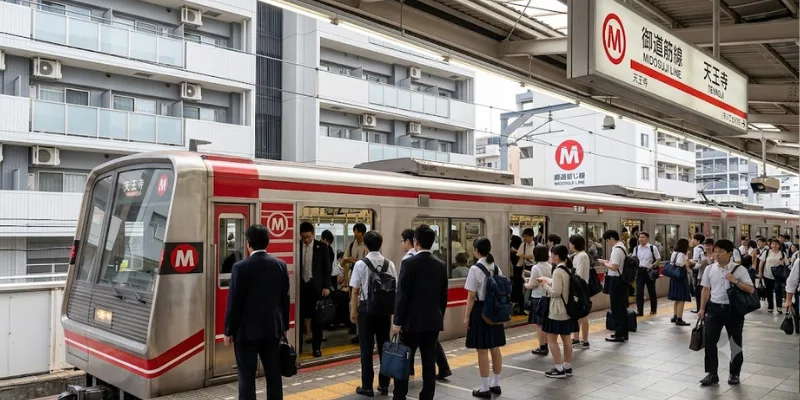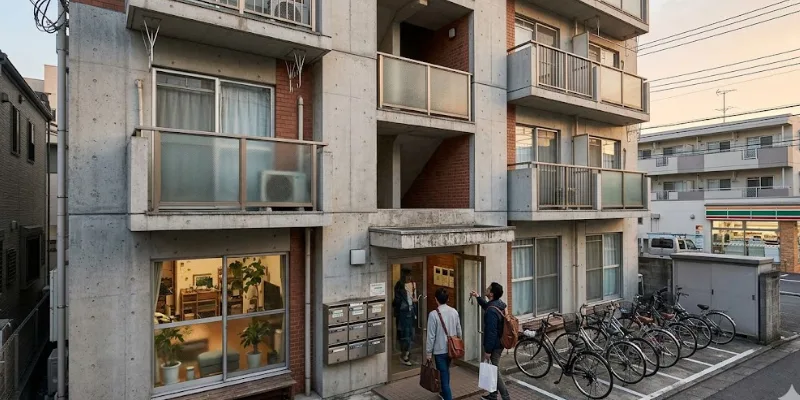

Student apartments in Tokyo cover a wider range than most international students expect before arriving. The ¥45,000–¥110,000/month spread reflects three housing types: share house, private studio, and 1K apartment — each with different application requirements and daily life trade-offs.
This guide covers international students searching for apartments in Tokyo: which areas are closest to major universities, what each housing type costs, and how the application process differs for student visa holders. For the student visa screening process specifically, see the student visa Japan apartment screening guide. For university-specific guides, see the Temple University Japan housing guide and the ISI Language School housing guide. Browse foreigner-friendly Tokyo listings on Arealty.
Student Apartments in Tokyo: Three Housing Types
Share House — Lowest Cost, Fastest Entry
Share houses (シェアハウス) are the most accessible student housing option in Tokyo. Most share houses do not require a residence card, accept international students without Japanese income, and have contracts from 1 month minimum. Monthly cost: ¥45,000–¥75,000 all-inclusive (rent, utilities, Wi-Fi, furnished).
The trade-off is shared living — your own bedroom but shared kitchen, bathroom, and common areas. For students on strict budgets, a share house for the first 1–3 months while building documentation is a practical first step.
Private Studio / 1K — Most Common Long-Term Choice
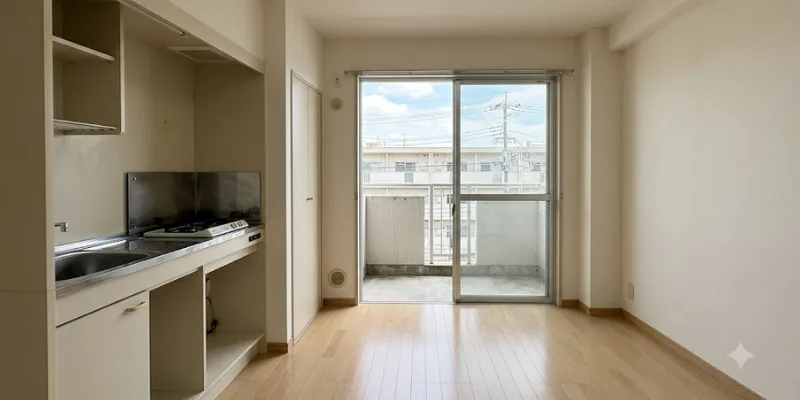
A private 1K apartment (one room with separate kitchen, 18–28 sqm) is the most common long-term student housing choice. Monthly rent: ¥70,000–¥110,000/month in central Tokyo wards, ¥55,000–¥80,000/month in outer wards. Unfurnished — budget ¥80,000–¥150,000 for basic furniture setup (secondhand from Mercari or Junk stores significantly reduces this).
Application requires a residence card, income proof or parental guarantee, and a WH-compatible guarantor company. Approval rate is high with the right documentation — see the student visa screening guide for exactly what landlords and hoshō gaisha check.
University/School-Arranged Housing
Some universities and language schools in Tokyo maintain dormitory spaces or have preferred housing partnerships. These range from on-campus dormitories (rare, high competition) to partner buildings with simplified application processes. Check your institution’s housing office first. Institutional arrangements often offer lower rates and reduced documentation requirements.
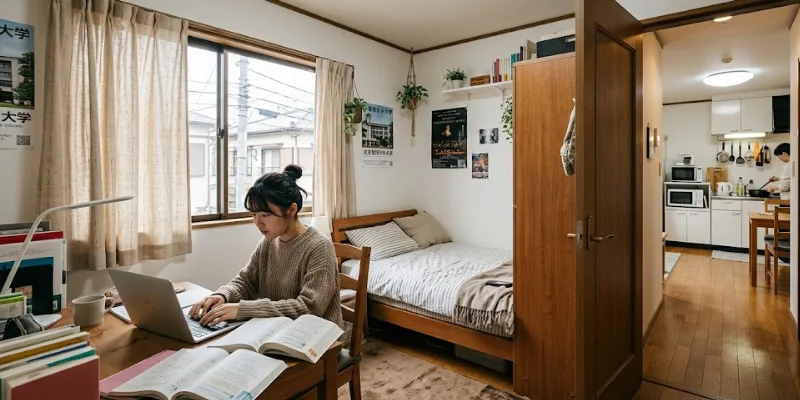
Best Tokyo Areas for Student Apartments by University
Bunkyo-ku — University of Tokyo, Meiji University, Tokyo Medical
Bunkyo-ku is the academic centre of Tokyo: home to the University of Tokyo (Hongo and Komaba campuses), Meiji University (Surugadai), and several medical institutions. Private 1K apartments in Bunkyo run ¥82,000–¥108,000/month. The ward has well-established student rental infrastructure — landlords near Hongo-sanchome and Kasuga stations are experienced with both Japanese and international student applicants.
Bunkyo-ku has the lowest crime rate among Tokyo’s 23 wards — a practical benefit for students arriving without prior Tokyo experience. For the area guide, see the Bunkyo apartments for rent guide.
Shinjuku-ku — Waseda University, ISI Language School
Takadanobaba in Shinjuku-ku is the home station for Waseda University and one of the highest concentrations of language schools in Tokyo including ISI Language School. Private 1K apartments: ¥80,000–¥105,000/month in Takadanobaba. Share houses from ¥48,000/month. The area has the highest density of student-oriented housing in the ward — landlords here deal with international student applicants regularly. See the Shinjuku apartments for rent guide for detailed area coverage.
Toshima-ku — Rikkyo University, Ikebukuro hub
Toshima-ku’s Ikebukuro area is a major hub for students from Rikkyo University and several smaller institutions. Private 1K: ¥78,000–¥100,000/month. Ikebukuro is served by the Yamanote Line and the Seibu and Tobu private railway lines — broad access to multiple university campuses across Greater Tokyo. Strong student foreigner acceptance rates.
Suginami-ku — Hosei University, Chuo University access
Suginami’s Koenji and Asagaya areas have good access to Hosei University and via the Chuo Line to Chuo University in Tama. Private 1K: ¥72,000–¥95,000/month. The ward’s creative character and lower-than-central rents make it a popular choice for arts and design students. See the Suginami apartments for rent guide.
Outer Wards — Budget Options for Commuting Students
Students willing to commute 30–45 minutes find 1K apartments in Nerima, Itabashi, Kita, and Adachi for ¥58,000–¥75,000/month. This works well for students whose schedule concentrates classes on specific days.
Cost Comparison: Share House vs Private Apartment
For a 12-month stay in a mid-range Tokyo location:
| Housing type | Monthly cost | Setup cost | 12-month total | Privacy |
| Share house | ¥58,000 | ¥50,000–¥80,000 | ¥746,000–¥776,000 | Partial |
| Private 1K (outer ward) | ¥68,000 | ¥250,000–¥340,000 | ¥1,066,000–¥1,156,000 | Full |
| Private 1K (central ward) | ¥88,000 | ¥300,000–¥400,000 | ¥1,356,000–¥1,456,000 | Full |
The ¥300,000–¥600,000 gap between share house and private 1K total cost is significant on a student budget. Share house year one, private apartment year two is a common and practical sequence for budget-constrained students.
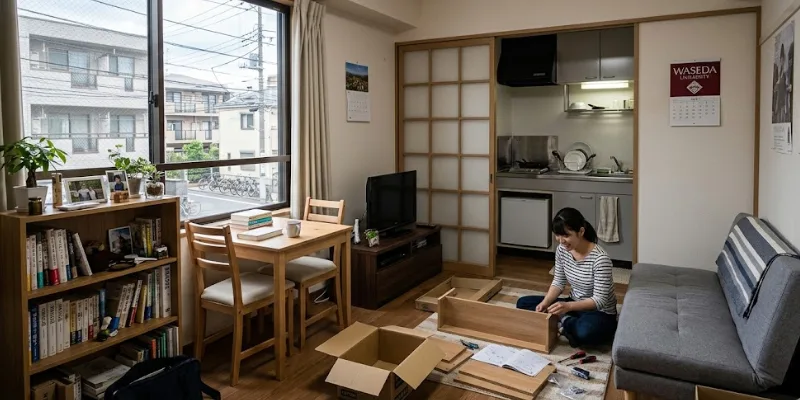
Documents International Students Need
The standard document package for a student visa rental application in Tokyo:
| Document | Where to get it | Notes |
| Residence card (在留カード) | Ward office after arrival | Required for all standard leases |
| Certificate of enrollment (在学証明書) | Your school/university | Confirms student status and expected study duration |
| Certificate of acceptance (入学許可書) | Issued before arrival | Used when applying before enrollment begins |
| Parental income proof | Parent provides | Payslip, tax return, or employment certificate |
| Parental guarantor letter (Japanese) | Agency provides format | Signed by parent confirming financial responsibility |
| Passport copy | Your passport | For ID verification |
| Bank statements (1–3 months) | Your bank | Japanese or home-country account |
The most important document combination is enrollment certificate + parental income guarantee. These two together solve both the “reason to be in Japan” and “income threshold” questions that landlords and guarantor companies assess. For the full screening logic, see the student visa apartment screening guide.
The Parental Income Guarantee — How It Works
Most international students do not have sufficient Japanese income to meet the standard 3× monthly rent threshold. The parental income guarantee (親権者保証) resolves this by substituting a parent’s income for the student’s.
What the guarantor company needs from the parent:
- Income documentation: payslip, tax return, or employment certificate from the parent’s home country
- Annual income that converts to approximately ¥240,000+/month (¥2.88M+/year) at current rates
- A signed guarantor letter in Japanese — Arealty provides the standard format
- A copy of the parent’s ID (passport)
Currency: guarantor companies accept foreign currency income, converted at the current exchange rate. An Australian parent earning AUD 7,000/month (approximately ¥680,000 at current rates) comfortably meets the threshold for most Tokyo apartments.
Timing: the parental guarantee can be prepared before arrival — this is one of the few documents that does not require you to be in Japan. Preparing it in advance significantly speeds up the application process after arrival.
Applying Before Arrival vs After
| Approach | Pros | Cons | Best for |
| Before arrival | Secured housing for arrival date | Needs COE, no residence card yet; limited landlord options | Students with firm start dates, employer/school support |
| After arrival (month 1) | Full document package available, can view in person | Need bridge housing on arrival | Students arriving with flexibility |
| Hybrid: apply before, move in week 2 | Balances certainty with process | Requires short-term housing for first 1–2 weeks | Most practical for most students |
The hybrid approach — arriving with 1–2 weeks of monthly mansion or share house booked, then viewing and applying for a private apartment once your residence card is issued — is the most reliable sequence for international students. See the rent before arriving guide for the full pre-arrival process.
Common Mistakes International Students Make
- Applying to apartments without checking visa acceptance: student visa is accepted by most but not all Tokyo landlords. Confirm before applying.
- Not preparing the parental guarantee before arrival: this document takes time to compile. Starting it from abroad saves 1–2 weeks in Japan.
- Choosing location by price alone: a ¥15,000/month saving in an outer ward adds 45 minutes of daily commuting — over an academic year, that is 270+ hours of commute time.
- Underestimating setup costs: first-time renters often budget for rent only. Factor in ¥250,000–¥400,000 upfront plus ¥80,000–¥150,000 for furniture.
- Skipping the viewing: Japan’s rental process puts viewing before application. An application submitted without viewing raises red flags. If overseas, request a video walk-through. See why apartment photos in Japan can mislead.
Contact Arealty to discuss your university, enrollment date, and document situation — a 15-minute conversation before your search saves significant time in Japan.
Further Reading
Short-term rental options in Tokyo — bridge housing on arrival
Student visa Japan — how landlord screening actually works
Temple University Japan housing guide
ISI Language School July intake housing guide
How to rent before arriving in Japan
1K apartments in Tokyo for rent — 2026 ward-by-ward data
Cheap apartments in Tokyo under ¥70,000

Real estate advisor at Arealty Japan, specialising in helping foreign residents navigate the Tokyo and Osaka rental markets. Lucy has guided hundreds of international renters — from Working Holiday visa holders to corporate relocations — through Japan’s apartment application process. Her writing draws on firsthand experience with landlord screening, guarantor companies, and foreigner-friendly listings across all 23 Tokyo wards and major Kansai cities.