
Quick answer
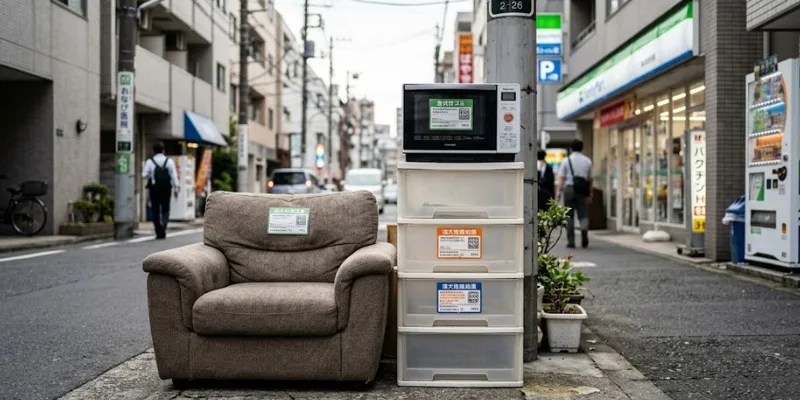
Sodai gomi (粗大ごみ) is oversized household waste in Tokyo: any item longer than about 30 cm on one side, such as furniture, bedding, and bicycles. You cannot leave it at the normal garbage point. You must book a collection with your ward’s Oversized Garbage Reception Center, pay a fee with stickers from a convenience store, and put the item out by 8:00 am on your collection day.
Fees in the 23 wards start at ¥400 for small items and reach ¥3,200 for the largest furniture. Fridges, washing machines, TVs, and air conditioners are not sodai gomi. They go through Japan’s appliance recycling system instead.
At Arealty, clients who are moving out ask us about sodai gomi in Tokyo almost as often as they ask about movers. This guide explains the full process in English, with real 2026 fees and ward contact details.
| Key fact | Detail (2026) |
|---|---|
| What counts as sodai gomi | Household items over about 30 cm on one side |
| Booking | Online 24 hours, or by phone Monday to Saturday |
| Lead time | Book 1 to 3 weeks ahead, longer in March and April |
| Fee range (23 wards) | ¥400 to ¥3,200 per item |
| Sticker types | A ticket ¥200, B ticket ¥300 |
| Put-out time | By 8:00 am on collection day |
| Not accepted | Fridge, washer, dryer, TV, air conditioner, PCs, pianos, tires |
| Self drop-off | About half the collection fee in some wards |
What counts as sodai gomi in Tokyo?
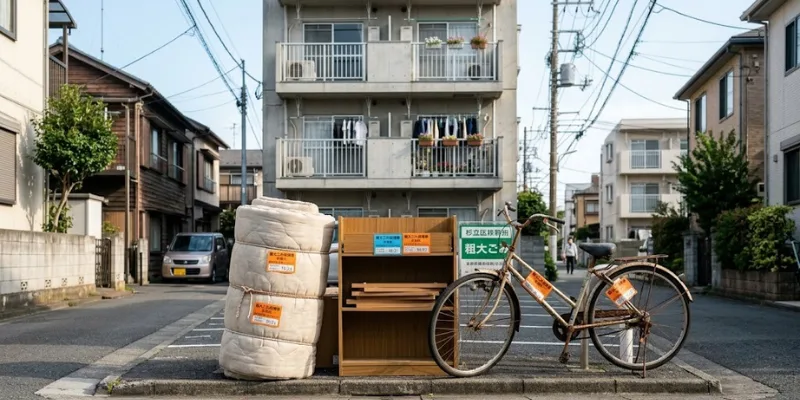
Any household item with one side longer than about 30 cm counts as sodai gomi. Typical examples are beds, sofas, desks, chairs, shelves, futons, bicycles, carpets, suitcases, and microwave ovens. Items smaller than 30 cm go out with regular burnable or non-burnable garbage instead.
There are also size limits. In Shinjuku, items longer than 2.1 m are not collected unless you cut them down, and waste from a business cannot be put out as household sodai gomi.
How do you dispose of sodai gomi in Tokyo?
The process takes four steps and works the same way in almost every ward.
- Book the collection. Apply online through your ward’s Oversized Garbage Reception Center, or call during office hours. Have your address, the item names, and measurements ready. For cabinets and shelves, measure the longest side and the second-longest side, because the fee depends on their total. Shinjuku’s online form accepts up to 10 items per application.
- Note your booking details. The center gives you a reception number, the collection date, the pickup spot, and the exact fee.
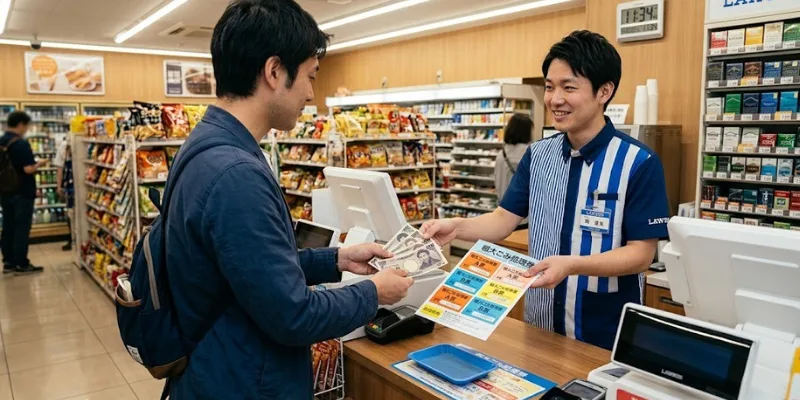
- Pay the fee. Buy sodai gomi stickers (粗大ごみ処理券) at a convenience store or supermarket that shows the ward’s garbage ticket sign. Each ward sells its own stickers, so stickers from another ward are rejected. Many wards now also accept online payment. In that case, you write the reception number and date on a sheet of paper and tape it to the item.
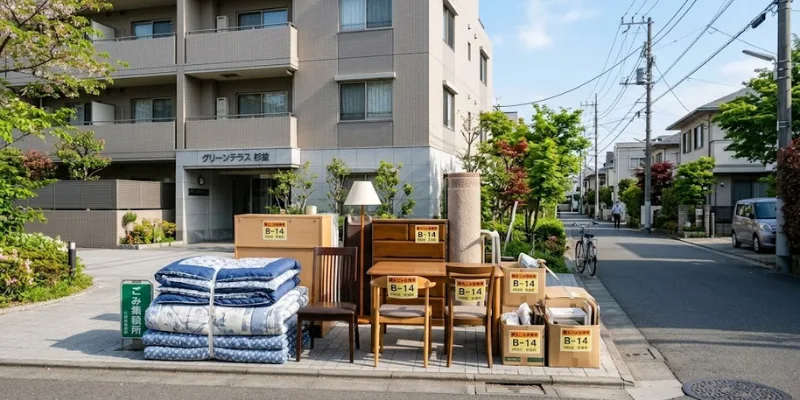
- Put the item out. Write your name or reception number and the collection date on each sticker. Place the item at the agreed spot, usually the front of your building or the building’s garbage area, by 8:00 am on collection day. Collection happens even when it rains.
Before you start, check your building’s rules. Many apartments have their own large-item storage area, and some require you to tell management before putting furniture out. Our guide to rules for large furniture in rental apartments covers what landlords usually allow.
How much does sodai gomi cost in Tokyo?
Most common items cost between ¥400 and ¥2,300. The table below uses Shinjuku City’s official fee list, which applies to applications from October 2023 onward. Other wards in the 23-ward area charge similar amounts, but always confirm the exact fee when you book.
| Item | Fee (¥) |
|---|---|
| Chair (not sofa), suitcase, vacuum cleaner, rice cooker | 400 |
| Futon (one quilt or mattress futon) | 400 |
| Bicycle under 16 inch | 400 |
| Bicycle 16 inch or larger | 900 |
| Electric-assist bicycle (battery removed) | 1,300 |
| Microwave oven | 900 |
| Table under 100 cm (non-glass top) | 400 |
| Desk without drawers | 900 |
| Desk with drawers on one side, or study desk | 1,300 |
| Single bed frame (no mattress) | 1,300 |
| Bed mattress | 1,300 |
| Double or semi-double bed frame | 2,300 |
| Bunk bed | 2,300 |
| Sofa, 1-seater | 900 |
| Sofa, 2-seater | 1,300 |
| Sofa, 3-seater, or sofa bed | 2,300 |
| Shelf or chest, longest + second side up to 135 cm | 400 |
| Shelf or chest, up to 180 cm | 900 |
| Shelf or chest, up to 270 cm | 1,300 |
| Shelf or chest, up to 360 cm | 2,300 |
| Shelf or chest, over 360 cm | 3,200 |
Source: Shinjuku City oversized garbage fee list.
Shinjuku sells two sticker types: an A ticket at ¥200 and a B ticket at ¥300. For a ¥1,300 item, you would attach two A tickets and three B tickets. A typical studio move-out with a bed frame, mattress, desk, chair, and small shelf costs about ¥4,000 to ¥5,000 in disposal fees.
Which items are not accepted as sodai gomi?
Several common household items cannot go out as sodai gomi in Tokyo, even with a sticker.
- Fridges, freezers, washing machines, clothes dryers, TVs, and air conditioners. These fall under the Home Appliance Recycling Law.
- Personal computers and monitors. The manufacturer collects and recycles them.
- Hard-to-process items. Examples include pianos, car or motorcycle parts, tires, fire extinguishers, gas cylinders, and fireproof safes. Ask the retailer or a licensed disposal company.
- Batteries. Remove the battery from electric-assist bicycles and cordless appliances before booking, and recycle it separately.
How to dispose of a fridge, washer, or TV in Tokyo
You pay a recycling fee plus a collection fee. The easiest option is the store where you bought the appliance, or a store where you buy its replacement. You can also book collection through your ward’s appliance recycling desk, or take the item yourself to a designated drop-off site after paying at a post office.
| Appliance | Recycling fee (¥, major makers) |
|---|---|
| Fridge or freezer, 170 L or less | 3,740 |
| Fridge or freezer, 171 L or more | 4,730 |
| Washing machine or clothes dryer | 2,530 |
| TV, 16 inch or larger | 2,970 |
| TV, 15 inch or smaller | 1,870 |
| Air conditioner | 550 to 990 (several makers cut to ¥550 in February 2026) |
Collection usually adds about ¥2,600 to ¥3,700 per item. Disposing of a large fridge can therefore cost ¥7,000 or more in total. Selling or giving it away is often cheaper.
For computers, check for the PC Recycle mark. If the machine has one, the manufacturer collects it free. If you do not know the maker, contact the PC 3R Promotion Association.
How do you book sodai gomi collection in your ward?
Each of Tokyo’s 23 wards runs its own Oversized Garbage Reception Center. The easiest way to find yours is to search your ward name plus 粗大ごみ受付センター. Most centers offer an English option on their website.
| Ward | Phone | Hours | Online |
|---|---|---|---|
| Shinjuku | 03-5304-8080 | Mon to Sat, 8:00 am to 7:00 pm | 24 hours, English available |
| Setagaya | 03-5715-1133 | Mon to Sat, 8:00 am to 7:00 pm (including public holidays) | 24 hours, online payment available |
| Shinagawa | 03-6733-5374 | Check ward website | 24 hours, English available |
If you are choosing where to live next, you can browse rentals in Shinjuku, Setagaya, and Shinagawa. Remember that your old ward handles sodai gomi from your old address, so book before you hand back the keys.
Can you take sodai gomi to a drop-off site yourself?
Yes, in many wards. Self drop-off still needs a booking, but the fee is lower. In Setagaya, it costs roughly half the collection fee. This works well if you are renting a van for your move anyway.
What are the alternatives to sodai gomi?
Throwing away furniture should be your last option. These alternatives often save money and time.
- Sell it. Mercari, Jimoty, and recycle shops buy furniture and working appliances. Some recycle shops collect from your home.
- Give it away. Facebook expat groups and “sayonara sale” groups move items quickly, especially in February and March.
- Ask your mover. Many movers offer disposal or buy-back services. Compare options in our guide to moving companies with English support in Tokyo.
- Use a licensed collector. If you are short on time, a private company can take everything in one visit. Only use companies with a municipal waste license. Setagaya City warns that unlicensed trucks advertising “free” pickup often charge large fees after loading.
Reuse matters more than usual right now. A fire at a bulky waste crushing facility has left Tokyo’s 23-ward storage close to capacity, and wards are asking residents to reuse furniture where possible.
When should you book sodai gomi before moving out?
Book two to three weeks before your move-out date. In March and April, book a month ahead, because collection slots fill quickly during peak moving season.
Plan the order of your last week carefully:
- 3 to 4 weeks before: list the items to sell, give away, or throw away. Book sodai gomi and appliance recycling.
- 1 to 2 weeks before: sell or hand over items. Buy stickers once your booking is confirmed.
- Collection day: put items out by 8:00 am. Keep a mattress or futon until the last day if you still need to sleep there.
- Move-out inspection: leave the apartment empty. Any furniture left behind can be billed to your deposit. Our guide to the apartment move-out inspection explains how to protect your deposit.
Useful Japanese for booking sodai gomi
Most reception centers offer English online, but phone staff may speak only Japanese. These phrases help.
| Situation | Japanese (romaji) | English meaning |
|---|---|---|
| Starting the call | Sodai gomi no moushikomi o shitai desu | I would like to book oversized garbage collection |
| Giving the item | Shinguru beddo o hitotsu dashitai desu | I want to put out one single bed |
| Asking the fee | Ikura desu ka? | How much is it? |
| Asking the date | Shuushuu-bi wa itsu desu ka? | When is the collection day? |
| Asking the place | Doko ni dashimasu ka? | Where should I put it out? |
| Asking for English | Eigo o hanaseru kata wa imasu ka? | Is there someone who speaks English? |
FAQ
In the 23 wards, fees range from ¥400 for a chair or futon to ¥3,200 for very large furniture. A single bed frame costs ¥1,300 and a 3-seater sofa ¥2,300 in Shinjuku.
Buy them at convenience stores and supermarkets that display your ward’s garbage ticket sign. Stickers only work in the ward that issued them.
No. Put items out on the morning of your collection day, by 8:00 am. Items left out early can block walkways and cause complaints.
It will not be collected. Your building management may charge you for removal, and leaving waste illegally is a crime under Japanese law.
No. Fridges, washing machines, TVs, and air conditioners go through appliance recycling, which costs a recycling fee plus a collection fee.
Not always. Online booking pages in wards such as Shinjuku and Shinagawa offer English. Phone lines are mainly in Japanese.
Moving to a new Tokyo apartment?
Clearing out your old place is only half the move. Arealty’s English-speaking team helps foreigners find apartments across Tokyo, explains every lease cost, and supports you through the application. Once you have moved in, follow our post-move-in procedures checklist for the first two weeks.
Sources
- Shinjuku City: Oversized garbage fee list (updated March 2025)
- Shinjuku Oversized Garbage Reception Center (English)
- Setagaya City: Oversized garbage tickets
- Shinagawa Oversized Garbage Online Reception
- Edogawa City: Home appliance recycling fees (updated June 2026)

Real estate advisor at Arealty Japan, specialising in helping foreign residents navigate the Tokyo and Osaka rental markets. Lucy has guided hundreds of international renters — from Working Holiday visa holders to corporate relocations — through Japan’s apartment application process. Her writing draws on firsthand experience with landlord screening, guarantor companies, and foreigner-friendly listings across all 23 Tokyo wards and major Kansai cities.