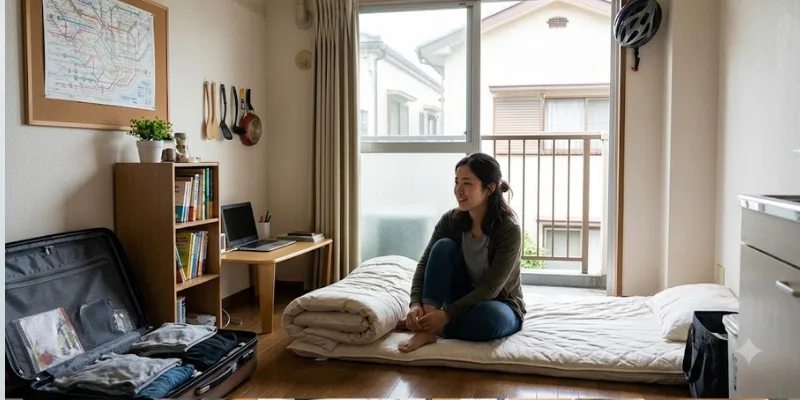

Moving into a language school student Tokyo apartment typically takes 2–3 weeks from starting your search to receiving your keys — faster than most students expect, provided you have your Certificate of Enrollment ready and have chosen the right area relative to your specific school’s campus. For language school students, the most common mistake is either starting too late (less than 4 weeks before arrival) or targeting the wrong ward, spending more on rent than necessary given where their school is actually located.
This guide walks through every step of the language school student Tokyo apartment process: choosing the right area, gathering documents, applying, and what to do in your first week after moving in.
Step 1 — Locate Your Specific Language School Campus
Before searching for a language school student Tokyo apartment, confirm the exact address of your school’s campus — not just the school name. Many major language schools operate multiple Tokyo campuses, and being one stop closer to the wrong campus can mean significant daily commute time.
Major Tokyo language school campus areas:
- ISI Language School — Shinjuku (main), Ikebukuro, Akihabara campuses
- KAI Japanese Language School — Shinjuku, Shibuya campuses
- ARC Academy — Shinjuku, Shibuya, Ikebukuro campuses
- Genki JACS — Shinjuku campus
- ECC Japanese Language Institute — Shinjuku campus
For most Tokyo language schools, the best language school student Tokyo apartment areas are:
| Campus area | Best residential areas | Avg. 1R rent |
| Shinjuku | Nakano-ku, Suginami-ku, Toshima-ku | ¥67,900–¥72,800 |
| Ikebukuro | Toshima-ku, Itabashi-ku, Kita-ku | ¥61,600–¥71,300 |
| Shibuya | Setagaya-ku, Meguro-ku, Nakano-ku | ¥72,800–¥84,000 |
Source: Hato Mark Site rental statistics (Zentakuren), 2026.
For ISI Language School specifically, see our ISI Language School Tokyo housing guide.
Step 2 — Choose: Share House vs Private Apartment
The biggest decision for a language school student Tokyo apartment search is whether to go for a share house or a private 1R/1K apartment.
Share house is typically the right choice when:
- Your program is 6 months or shorter
- You want to move in within days of arrival
- You don’t yet have a Certificate of Enrollment issued (some schools issue only after arrival)
- You’re on a tighter budget (¥45,000–¥65,000/month all-inclusive vs ¥60,000–¥85,000/month for a private apartment)
- You want a ready-made social environment as a newcomer
Private apartment is typically the right choice when:
- Your program is 1 year or longer
- You prioritize quiet study space and complete privacy
- You have your enrollment documentation ready before arrival
- You’re comfortable with the longer 2–3 week application timeline
For more on this comparison, see our share house in Japan for foreigners guide and our student room sharing in Japan guide.
Step 3 — Gather Your Documents
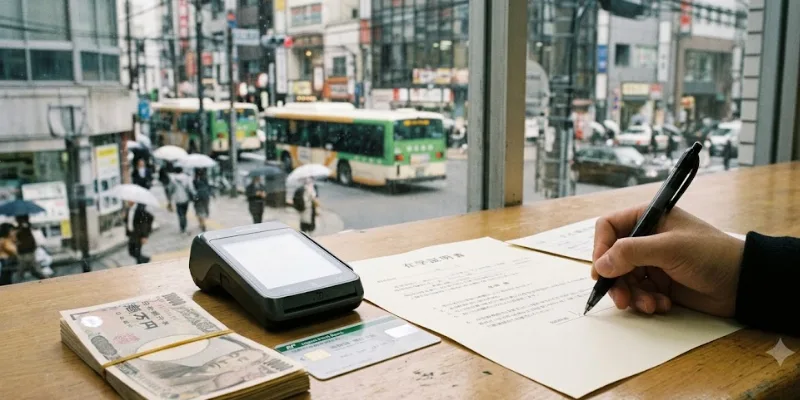
For a language school student Tokyo apartment application, you need:
| Document | How to get it | Timeline |
| Certificate of Enrollment (在学証明書) | Request from your language school after admission confirmed | 1–2 weeks |
| Passport copy | All relevant pages | Immediate |
| Residence Card | Issued at immigration on arrival (airport) | Arrival day |
| Financial support proof | Bank statement (¥500,000+) or sponsor letter | Prepare before departure |
| Guarantee company application | Completed with agency help | During application |
Critical note: Request your Certificate of Enrollment as soon as your admission is confirmed — don’t wait until you’ve booked your flight. Schools during peak intake periods (April, October, January, July) can take 1–2 weeks to process this document.
If you’re applying before arrival and don’t yet have a Residence Card, most agencies can start the application with your passport and Certificate of Enrollment, finalizing it once your card is issued after arrival.
Step 4 — Apply and Complete Guarantor Screening
For a language school student Tokyo apartment, the guarantor step works differently than for employed tenants:
No employment income: Language school students on a student visa are permitted to work up to 28 hours/week under standard work permission, but this income is generally not counted for screening purposes since it’s not guaranteed in advance.
What guarantee companies use instead:
- Certificate of Enrollment (confirms you’re a legitimate student)
- Financial support documentation (bank statement or sponsor letter)
- Visa validity (student visa typically valid for program duration + 3 months)
Recommended guarantee companies for students:
- GTN (Global Trust Networks) — specifically designed for foreign students and workers, widest landlord acceptance
- Roommate — accepts student visas, English-language process
- Leonet — accepts students, slightly stricter financial documentation
Screening typically takes 2–5 business days. Your agency submits the guarantee company application alongside your rental application simultaneously.
Step 5 — Sign and Pay, Then Move In
Once guarantor screening passes, the agency prepares the lease. For a language school student Tokyo apartment, key contract points to note:
Contract length. Most private apartments run on standard 2-year terms, even for students on shorter programs. If your program ends before 2 years, you can exit with the standard notice period (typically 1–2 months) without a break fee.
Initial costs. For a ¥65,000/month 1R in Nakano (close to language school campuses in Shinjuku):
| Item | Amount |
| First month’s rent | ¥65,000 |
| Security deposit | ¥65,000–¥130,000 |
| Key money | ¥0–¥65,000 |
| Agency fee | ¥65,000–¥71,500 |
| Guarantee company fee | ¥32,500–¥65,000 |
| Fire insurance | ¥15,000–¥20,000 |
| Total | ¥242,500–¥416,500 |
Step 6 — First Week After Moving In
Once you have your language school student Tokyo apartment, complete these in week 1:
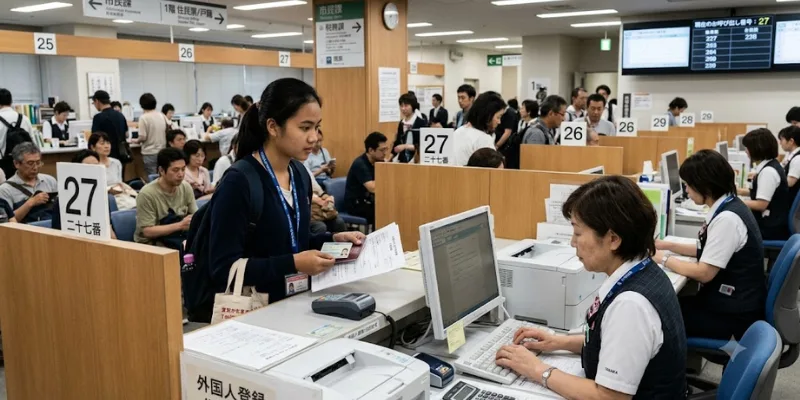
Day 1–2: Register your address at the local ward office (区役所) with your Residence Card — required within 14 days. Bring your lease agreement and Residence Card. This takes 15–30 minutes and gives you a registered address for all subsequent administrative tasks.
Day 2–3: Open a Japan Post Bank account (ゆうちょ銀行). Most landlords collect monthly rent via automatic bank transfer (口座振替) — you’ll need a Japanese bank account set up within your first month. Japan Post Bank is easiest to open without prior Japanese banking history.
Day 3–5: Set up utilities. Electricity and water activate same-day or next-day by phone or online. Gas requires an in-person technician visit — book 3–5 days in advance. Your landlord or agency will provide operator details specific to your building.
Day 5–7: Get a Japanese mobile number. Most carriers (IIJmio, Mineo, Rakuten Mobile) accept foreign nationals with a Residence Card, registered address, and Japanese bank account or international credit card.
See our essential post-move-in procedures Japan guide for the full checklist.
Best Areas for Language School Students in Tokyo by Budget
Based on Hato Mark Site data (Zentakuren, 2026):
| Budget | Best ward | Avg. 1R | Commute to Shinjuku |
| Under ¥65,000 | Itabashi-ku | ¥61,600 | 20–30 min |
| ¥65,000–¥75,000 | Suginami-ku | ¥67,900 | 20–25 min |
| ¥75,000–¥85,000 | Nakano-ku | ¥72,800 | 10–15 min |
| ¥85,000+ | Shinjuku-ku | ¥84,300 | 0–10 min |
Most language school students in Tokyo find the ¥65,000–¥75,000 tier (Suginami-ku, Nakano-ku) offers the best balance of commute time and cost.
Scholarship Housing Considerations
If you’re attending your Tokyo language school on a scholarship, confirm the following before committing to a language school student Tokyo apartment:
- Disbursement timing. Many scholarships pay in arrears or at semester start, which may not align with the lump-sum move-in cost. Having ¥300,000–¥450,000 in accessible savings to cover the upfront payment is advisable even if scholarship funds will eventually cover ongoing rent.
- Can stipends count as income proof? Yes, for most guarantee companies — provide your scholarship confirmation letter alongside the standard documents.
See our scholarship for foreign students in Japan guide for funding options that can help offset housing costs.
School-Specific Housing Resources
- ISI Language School Tokyo housing guide — ISI campus locations and best residential areas
- Waseda University student housing — if you’re planning to transition from language school to university
- International student accommodation Tokyo — broader comparison of all accommodation types for students
- Student housing near ISI Shinjuku — Shinjuku-specific options
FAQ: Language School Student Tokyo Apartment
Can I apply for an apartment before arriving in Japan? Yes — with your Certificate of Enrollment, passport, and financial documentation, most agencies can process an application remotely, with the lease signed digitally and keys ready for collection on arrival day.
What if my school hasn’t issued a Certificate of Enrollment yet? Some agencies accept an admission letter or tuition payment receipt as interim documentation while the formal enrollment certificate is processed. Ask your specific agency about their requirements.
Can I extend my lease if my program extends? Yes — standard 2-year leases auto-renew unless you give notice. You simply continue paying rent and the lease rolls over.
Is a furnished apartment possible on a language school student budget? Yes — monthly mansions and some share houses offer furnished options. Private furnished apartments are rarer in the ¥65,000–¥75,000 budget range but not impossible through short-stay-focused operators.
External reference: Japan Student Services Organization (JASSO) — Language Study in Japan — official resource covering housing for language school students.
→ Browse student-friendly apartments in Tokyo
Managing Daily Life in Your First Language School Student Tokyo Apartment
The first few weeks in a language school student Tokyo apartment involve a learning curve that goes beyond the apartment itself. A few practical points that catch many first-time Tokyo residents off guard:
Garbage sorting. Tokyo’s garbage collection is strictly separated — burnable (燃えるゴミ), non-burnable (燃えないゴミ), recyclables (資源ゴミ), and oversized items (粗大ゴミ) all have specific collection days and locations. Your building management will provide a schedule and rules. Incorrectly sorted garbage gets left behind with a warning tag — a source of neighbourly friction worth avoiding from day one.
Coin laundry etiquette. Many smaller apartment buildings lack in-unit washing machines or laundry hookups. Coin laundry (コインランドリー) is common and inexpensive, but has its own etiquette: don’t leave machines unattended past the cycle completion, and don’t move others’ laundry without asking.
Quiet hours. Most apartment buildings have informal quiet hours (typically 10pm–8am for shared-wall noise) and some have explicit rules against musical instruments, loud TV, or parties. In densely built Tokyo residential areas, sound travels between units more than in purpose-built Western apartment blocks.
Transitioning From Language School to University or Employment
Many language school students use their Tokyo apartment as a base for the transition to the next phase — whether university enrollment or job hunting. For this transition:
If continuing to university: Most major Tokyo universities are in different wards from common language school areas. Waseda is in Shinjuku, Keio Mita in Minato, and Tokyo University in Bunkyo. If your language school apartment’s commute to your target university is more than 30–40 minutes, consider moving at the transition point rather than commuting long-term.
If job hunting from your apartment: Japan’s major job-hunting season (就活, shūkatsu) for new graduates runs roughly October–May of the final year, but ongoing mid-career hiring is less seasonal. Your language school student Tokyo apartment serves as a valid base for job applications and interviews — your registered address on the Residence Card is what matters, not the apartment type.
Language School Networking and Housing
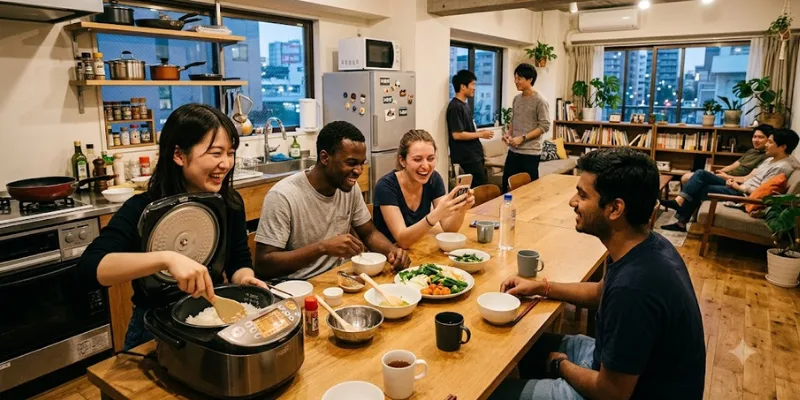
One underrated aspect of a language school student Tokyo apartment is the networking opportunity the housing choice itself creates. Students who live in the same share house or guest house as classmates often form tighter study and social networks than those who live in completely separate private apartments. For language learning specifically, living with Japanese flatmates — possible through mixed-nationality share houses — provides continuous immersion beyond school hours that can significantly accelerate language development.
Internal Resources for Language School Students in Tokyo
- ISI Language School Tokyo housing guide — if ISI is your school
- Student housing near ISI Shinjuku — Shinjuku-area options specific to ISI campus
- Cost of living in Japan for international students — full monthly budget beyond rent
- Working holiday Japan no tax document rent apartment — if you’re on a WHV attending language school

Real estate advisor at Arealty Japan, specialising in helping foreign residents navigate the Tokyo and Osaka rental markets. Lucy has guided hundreds of international renters — from Working Holiday visa holders to corporate relocations — through Japan’s apartment application process. Her writing draws on firsthand experience with landlord screening, guarantor companies, and foreigner-friendly listings across all 23 Tokyo wards and major Kansai cities.