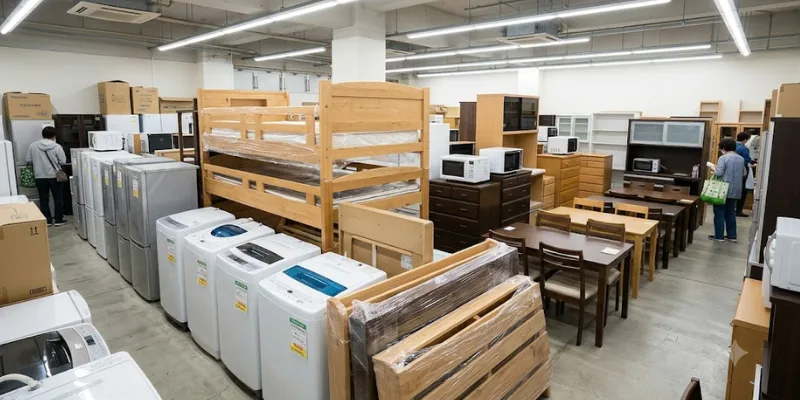

Quick answer: Used furniture in Japan typically costs 20% to 60% of the new price. In Tokyo, the easiest places to buy are recycle shops such as 2nd Street, Hard Off / Off House and Treasure Factory, plus Jimoty and Mercari online. A basic 1K setup costs about ¥29,000 to ¥103,000 second-hand against ¥123,000 to ¥290,000 new. When you leave, fridges, washing machines, TVs and air conditioners must go through Japan’s appliance recycling system, not oversized garbage.
| If you want… | Best option |
|---|---|
| Everything this week, delivered | A recycle shop chain (2nd Street, Hard Off / Off House) |
| The lowest price, or free | Jimoty (local pickup) or expat “sayonara sale” groups |
| A specific item or brand | Mercari or Yahoo! Auctions |
| A new, cheap mattress | Nitori, IKEA or another home store |
| No shopping at all | A furnished apartment in Tokyo |
Why Used Furniture Japan Makes Sense for New Arrivals
Most private rentals in Japan come unfurnished, often without a fridge, washing machine or even ceiling lights. A basic 1K setup needs:
| Item | New price | Used price (typical) |
|---|---|---|
| Single or semi-double bed + mattress | ¥30,000–¥80,000 | ¥5,000–¥25,000 |
| Refrigerator (small, 130–200L) | ¥25,000–¥45,000 | ¥8,000–¥20,000 |
| Washing machine (5–6kg) | ¥30,000–¥60,000 | ¥8,000–¥20,000 |
| Microwave | ¥8,000–¥20,000 | ¥2,000–¥8,000 |
| Dining table and chairs | ¥15,000–¥40,000 | ¥3,000–¥15,000 |
| Chest of drawers | ¥10,000–¥25,000 | ¥2,000–¥10,000 |
| Curtains | ¥5,000–¥20,000 | ¥1,000–¥5,000 |
| Total | ¥123,000–¥290,000 | ¥29,000–¥103,000 |
That saves ¥90,000 to ¥190,000, often enough to cover your guarantor company fee. If you’re staying one or two years and plan to sell everything before you leave, buying second-hand is the obvious choice. See where furniture fits into your total budget in our move-in cost guide.
Where to buy used furniture in Japan: recycle shop chains
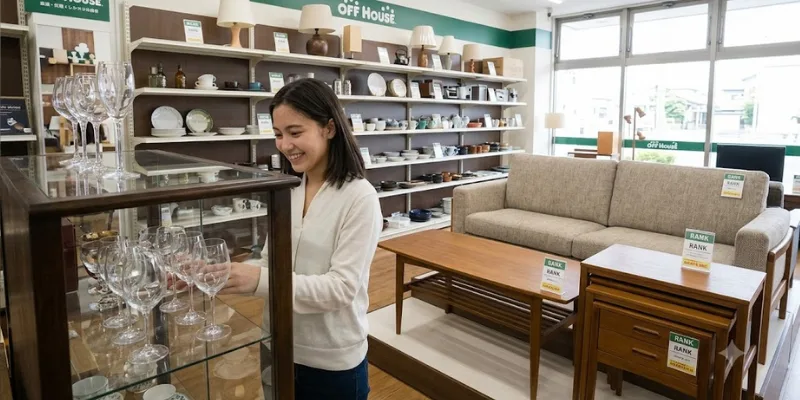
Japan’s recycle shops (risaikuru shoppu) check, clean and price items before they go on the floor, so you can see the condition and often arrange delivery the same week.
2nd Street (セカンドストリート)
Best for: furniture, appliances, clothing and home goods. Price: mid-range.
Run by GEO Holdings, 2nd Street has hundreds of stores nationwide, including many in Tokyo. Stock tends to be neat and well presented, and larger branches carry beds, sofas and appliances.
Hard Off / Off House (ハードオフ・オフハウス)
Best for: appliances, electronics, furniture and bicycles. Price: low to mid.
Hard Off focuses on electronics, and Off House, often in the same building, covers furniture and household goods. Many stores also sell “junk” items very cheaply. These are sold as-is with no guarantee they work, so they only suit buyers happy to take the risk. The bigger branches are mostly in the suburbs.
Treasure Factory (トレジャーファクトリー)
Best for: furniture and general household goods. Price: mid-range.
Treasure Factory runs large general stores and furniture-focused branches across the Tokyo area, and it’s a good place to compare several sofas or dining sets in one visit.
Independent recycle shops
Small local recycle shops are everywhere. Prices can be lower and staff may negotiate on multiple items, but quality and delivery options vary more than at the chains.
Online and local marketplaces
These take more effort but often have the lowest prices.
- Jimoty (ジモティー): a local classifieds site where people sell or give away furniture for pickup. It’s the best place to find free or near-free items, especially in March and April.
- Mercari (メルカリ): Japan’s biggest flea-market app. Most items can be shipped, and Mercari has a delivery service for large furniture. The app has English support, and you can message sellers with a translation app.
- Yahoo! Auctions (ヤフオク): a wider range of unusual or brand-name items, but more complex to use than Mercari.
- Expat “sayonara sale” groups: Facebook groups where foreigners leaving Japan sell their furniture in English, often cheaply and all at once.
When is the best time to buy?
March to April is Japan’s main moving season. Supply is at its peak as students and workers move out, so the choice is widest and free giveaways on Jimoty are common. Demand is also high, so good pieces sell fast. Late September to October is a smaller second season. For the calmest shopping, go early in the week and ask when the shop puts out new stock.
What to check before buying used appliances
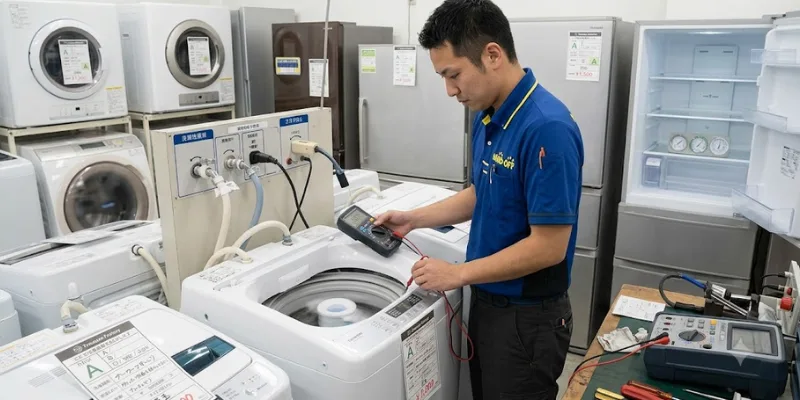
Manufacture year: every appliance has a label with its year of manufacture (製造年). Older models use more electricity, and many shops only buy back appliances that are a few years old, so newer is better if you plan to resell.
Refrigerators: check that it actually cools, the door seals are intact and the freezer freezes.
Washing machines: ask for a test run. Check that the drum spins and drains without heavy vibration. Measure the waterproof pan (bōsui pan), the tap and the doorway before you buy.
Power frequency: eastern Japan, including Tokyo, runs on 50Hz and western Japan on 60Hz. Most modern appliances work on both, but some older ones don’t, so check the label if you buy from another region online.
Mattresses: many recycle shops don’t buy used mattresses or futons for hygiene reasons. A new budget mattress is often the better choice.
For standard sizes of beds, sofas and appliance spaces, see our guide to furniture dimensions for Japanese apartments.
Getting your furniture home
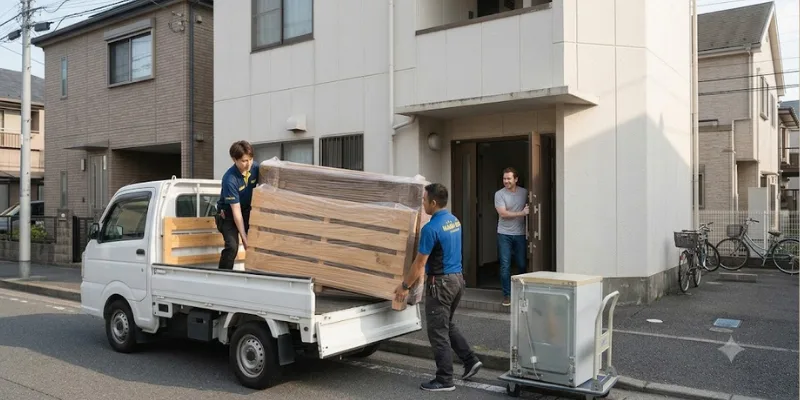
- Shop delivery: most chains deliver within a set area for a fee. Confirm your address is covered before you pay.
- Home-center trucks: some home centers, such as Cainz and Joyful Honda, lend small trucks to customers. You need a driving license valid in Japan.
- Light-truck movers: services such as Akabou (赤帽) move a few large items for a fixed fee.
- Mercari large-item delivery: for furniture bought online, the seller can choose a delivery option that includes pickup and carrying in.
Big items must also fit through your building. Check the rules on moving large furniture in a rental apartment first.
How to get rid of furniture when you move out
From least to most effort:
- Sell it back to a recycle shop. Many shops offer free pickup quotes for several items. You’ll get less than you paid, but it’s quick.
- Give it away on Jimoty or in a sayonara group. Free items usually go within a day or two, and the buyer collects.
- Sell on Mercari. You get the most money back, but it takes time to photograph, list and ship.
- Oversized garbage (sodai gomi). Furniture too big for a garbage bag needs a paid collection. Book through your ward office online or by phone, buy the collection sticker at a convenience store and put the item out on the day. Fees are usually a few hundred to a few thousand yen per item. Book 1 to 2 weeks ahead, or 3 to 4 weeks in March.
- Appliance recycling. Fridges, washing machines and dryers, TVs and air conditioners can’t go out as oversized garbage. Under the Home Appliance Recycling Law, you pay a recycling fee (about ¥2,530 for a washing machine and ¥3,740 for a fridge of 170L or less from major makers) plus a collection fee. Ask the shop you buy a replacement from, or pay at a post office and take the item to a designated drop-off point.
Avoid trucks that drive around offering “free pickup”. Many aren’t licensed and may charge you later or dump items illegally. For everyday rubbish rules, see our garbage sorting guide.
Used furniture by apartment type
1R and 1K (most solo renters): space is the limit, so measure first. Standard bed widths are about 97cm for a single, 120cm for a semi-double and 140cm for a double. See our furniture layout tips for 1K and 1LDK.
1LDK and 2LDK (couples and families): the living room needs a sofa, coffee table and dining set. The sofa shows wear fastest, so it’s worth paying a little more at a better-stocked store for one you’ll use every day.
Save space: loft beds, folding tables and under-bed storage are common in recycle shops. Our guide to multi-functional furniture for small Japanese apartments covers the best space-saving pieces.
Frequently asked questions
Generally, yes. The big recycle shop chains check and clean items before selling them, and many test appliances. Always check the manufacture year on appliances.
Jimoty and expat sayonara sale groups are the best places, especially in March and April when many people move out. You usually have to collect the item yourself.
Chain stores usually stick to the tag price. Independent shops may give a discount if you buy several items.
Not as oversized garbage. Pay the appliance recycling fee plus a collection fee through a retailer, or pay at a post office and take it to a designated drop-off point.
Usually not. Many recycle shops don’t sell used mattresses, and a new budget mattress costs little more.
Related guides for setting up your apartment
- Japan apartment viewing checklist: check appliance spaces and sizes before you sign
- Essential post-move-in procedures: paperwork to finish alongside furniture setup
- Under-floor storage in rental apartments
Still looking for an apartment? Browse furnished apartments in Tokyo to skip furniture shopping, or search unfurnished apartments across Tokyo with English support from Arealty.

Real estate advisor at Arealty Japan, specialising in helping foreign residents navigate the Tokyo and Osaka rental markets. Lucy has guided hundreds of international renters — from Working Holiday visa holders to corporate relocations — through Japan’s apartment application process. Her writing draws on firsthand experience with landlord screening, guarantor companies, and foreigner-friendly listings across all 23 Tokyo wards and major Kansai cities.