
Scholarship housing Japan arrangements — where international students fund their apartment rent using government or private scholarship stipends — are entirely feasible and increasingly common, with Japan’s main government scholarship (MEXT / Monbukagakusho) providing ¥117,000–¥144,000/month for undergraduate and graduate students, according to the Japan Student Services Organization (JASSO) 2025 scholarship guidelines. This covers typical Tokyo student apartment costs comfortably in outer wards, and leaves a meaningful surplus for daily living expenses.
This guide explains how different scholarship types work for rental housing in Japan, how to present stipend income to guarantee companies, and how to manage the timing mismatch between stipend disbursement and move-in costs.
Major Japan Scholarship Programs and Monthly Stipends
Understanding the exact stipend amounts available helps you plan scholarship housing Japan arrangements realistically:
| Scholarship | Type | Monthly stipend |
| MEXT (Monbukagakusho) — Research student | Government | ¥143,000/month |
| MEXT — Master’s or Doctoral | Government | ¥144,000/month |
| MEXT — Undergraduate (national university) | Government | ¥117,000/month |
| JASSO Type II (repayment required) | Government-affiliated | ¥20,000–¥120,000/month |
| JASSO Type I (non-repayable) | Government-affiliated | ¥48,000/month |
| Rotary Peace Fellowship | Private | Varies, typically ¥100,000+ |
| University-specific scholarships | Private/institutional | ¥30,000–¥120,000/month |
Source: JASSO scholarship program guidelines, 2025. See JASSO’s official scholarship guide for current amounts.
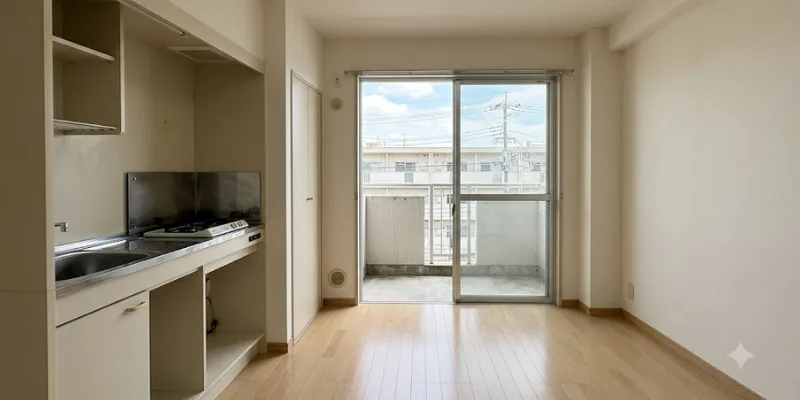
For scholarship housing Japan planning, the MEXT stipend of ¥117,000–¥144,000/month is the most significant — it comfortably covers a 1R apartment in most Tokyo wards outside the premium central areas, with funds remaining for living expenses.
Can Scholarship Stipends Be Used as Proof of Income for Renting?
Yes — but the documentation must be prepared correctly. Guarantee companies and landlords assess scholarship stipends differently from employment income, since stipends:
- Come from an institution rather than an employer
- May have a defined end date aligned with the scholarship period
- Are not subject to standard Japanese income tax withholding
What guarantee companies typically accept for scholarship housing Japan applications:
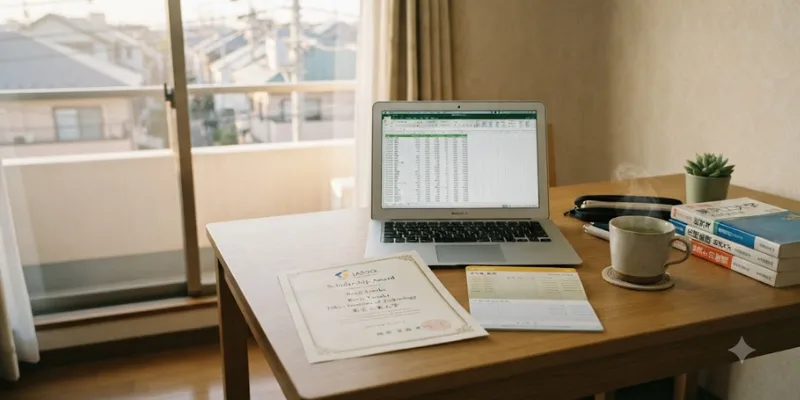
- Official scholarship award letter — from MEXT, JASSO, or the awarding institution, showing your name, scholarship amount, and payment period
- Bank statement — showing recent stipend deposits to verify the scholarship is actively being paid
- Certificate of Enrollment — confirming your student status alongside the scholarship documentation
- Sponsor letter (if scholarship doesn’t fully cover rent) — from a parent or family member confirming supplementary financial support
What doesn’t work: A verbal statement or printed email claiming scholarship income without an official letter. Guarantee companies require documentation that can be independently verified.
For more on what counts as acceptable income proof, see our apartment financial proof Japan guide.
The Timing Problem: Stipend Disbursement vs Move-In Costs
The most common practical challenge in scholarship housing Japan arrangements is timing. Move-in costs for a typical Tokyo student apartment (¥65,000/month 1R) typically run ¥250,000–¥400,000, due upfront. Scholarship stipends are often:
- Disbursed monthly rather than as a lump sum
- Starting from a specific date after enrollment is confirmed
- Sometimes delayed by 1–2 months at program start during administrative processing
This means many students arrive for scholarship housing Japan arrangements expecting to pay move-in costs from savings or travel funds, not from the stipend itself. The stipend then covers ongoing monthly rent once it begins flowing.
Practical approaches to the timing gap:
- Arrive with ¥300,000–¥500,000 in personal savings earmarked for move-in costs
- Confirm exact stipend start date with your institution before arrival
- If your institution provides temporary student accommodation, use it for the first 2–4 weeks while stipend disbursement is set up and move-in costs are assembled
- Some scholarship programs provide a one-time “arrival allowance” (渡航手当) specifically for this transition — confirm with your program whether this applies
Which Wards Are Realistic for Scholarship Housing Japan
Using Hato Mark Site data (Zentakuren, 2026), a MEXT undergraduate stipend of ¥117,000/month leaves the following available for rent after a conservative ¥60,000 daily living budget:
Available for rent: approximately ¥57,000
This puts the following ward price ranges within comfortable reach:
| Ward | Avg. 1R | Budget fit? |
| Katsushika-ku | ¥61,200 | ✅ Comfortable |
| Nerima-ku | ¥61,300 | ✅ Comfortable |
| Itabashi-ku | ¥61,600 | ✅ Comfortable |
| Suginami-ku | ¥67,900 | ✅ Manageable |
| Toshima-ku (Ikebukuro) | ¥71,300 | ⚠️ Tight |
| Shinjuku-ku | ¥84,300 | ❌ Over budget |
For students with a MEXT graduate stipend of ¥144,000/month, the picture improves significantly, making mid-tier wards like Suginami-ku and Nakano-ku comfortably affordable.
Share House as a Bridge for Scholarship Housing Japan
Many scholarship recipients use a share house for the first 1–3 months while their stipend is being set up and their first bank statements accumulate, then transition to a private apartment once they have:
- 3 months of documented stipend deposits to show guarantee companies
- A full Certificate of Enrollment
- The initial move-in lump sum saved from stipend payments
Share houses for scholarship housing Japan situations:
- Require minimal documentation at move-in (enrollment confirmation + passport)
- Cost ¥40,000–¥60,000/month all-inclusive in suitable outer wards
- Allow address registration (confirm with operator before booking)
- Provide flexibility while you identify your preferred long-term neighborhood
For more on this path, see our student housing Japan Tokyo rental guide and our international student accommodation Tokyo overview.
University Dormitory vs Private Apartment for Scholarship Recipients
Most scholarship programs have no requirement that recipients live in university dormitories — the stipend is paid regardless of housing type. However, some points are worth understanding:
University dormitories are typically priced below the scholarship stipend (¥35,000–¥55,000/month including utilities), leaving more monthly surplus for savings or other expenses. The trade-off is limited availability and often a shared-room environment.
Private apartments cost more but offer complete independence and a stable long-term rental address. MEXT and most other government scholarships are entirely compatible with private apartment tenancy — there is no requirement to live on-campus.
For context on how specific universities handle housing for scholarship recipients, see our university-specific guides:
- Waseda University student housing guide
- Keio University student housing guide
- TUFS student housing guide
FAQ: Scholarship Housing Japan
Do guarantee companies in Japan accept scholarship income? Yes — most do, provided you supply an official scholarship award letter and supporting bank statement. GTN and Roommate are the most consistently student-friendly guarantee companies.
What if my scholarship doesn’t cover Tokyo rent fully? Supplement with a sponsor letter from a parent confirming they will cover the gap, alongside your scholarship documentation. Most guarantee companies accept this combination.
Can I work part-time on a MEXT scholarship? MEXT scholars on a student visa can work up to 28 hours/week under the standard student visa work permission — providing additional income beyond the stipend for housing costs.
Is there a MEXT housing allowance separate from the monthly stipend? Some MEXT programs include a one-time relocation/arrival allowance. Confirm the specific terms of your award letter — amounts and conditions vary by program type.
External reference: JASSO — Scholarships for Foreign Students Studying in Japan — official resource for scholarship amounts and eligibility.
→ Browse student-friendly apartments across Tokyo wards
Private and Corporate Scholarship Programs in Japan
Beyond MEXT and JASSO, a significant number of private and corporate scholarships support international students in Japan and can be used for scholarship housing Japan purposes:
Rotary Peace Fellowship: Provides stipends for eligible peace studies students at designated Japanese universities, typically sufficient to cover housing in mid-tier Tokyo wards with budget remaining.
Japan Foundation scholarships: Support Japanese-language and cultural study programs, with stipends generally lower than MEXT but supplementable with part-time work.
University-specific scholarships: Most major Japanese universities offer their own international student scholarships ranging from ¥30,000–¥120,000/month. Importantly, these are often combinable with JASSO Type I non-repayable scholarships, effectively stacking two income sources for scholarship housing Japan arrangements.
Corporate scholarships: Some Japanese companies offer scholarships to prospective foreign employees, which function similarly to sponsorships — contact the international affairs or HR departments of companies you’re interested in working for after graduation.
See our scholarship for foreign students in Japan guide for a comprehensive overview of programs available.
Managing Housing Costs as a Scholarship Recipient Over a Multi-Year Program
For students on longer programs (master’s: 2 years; doctoral: 3–5 years), scholarship housing Japan planning should cover the full program duration:
Year 1: Bridge with university dormitory or share house while establishing credit history and bank account presence in Japan. Use this period to identify your preferred permanent neighborhood.
Year 2 onward: Transition to a private apartment once you have 6–12 months of stipend deposits in your Japanese bank account, making guarantee company screening straightforward. By this point, you’ve also tested out neighborhoods and know which commute is sustainable for your academic schedule.
Renewal and renewal fees: Standard 2-year lease renewal fees (typically 1 month’s rent) fall due mid-program for multi-year students. Budget for this in advance — it won’t be covered by your monthly stipend automatically, requiring either savings accumulation or a short-term financial plan.
Internal Resources for Scholarship Students
- Rental apartments for international students Tokyo — the core student rental guide to pair with this scholarship-specific article
- No guarantor apartments Tokyo foreigners — relevant when scholarship documentation alone doesn’t satisfy guarantee company requirements
- Average cost of apartment Tokyo by ward — use with MEXT stipend figures to identify which wards fit your budget
- Cost of living Japan student guide housing — complete living cost framework beyond rent alone
Combining Scholarship Income with Part-Time Work for Housing
Many scholarship recipients supplement their stipend with permitted part-time work — a practical approach that opens up better scholarship housing Japan options:
Under a standard student visa, international students in Japan can work up to 28 hours per week (increased to 40 hours during designated holiday periods). At a typical part-time wage of ¥1,100–¥1,500/hour (Tokyo minimum wage or above), 15 hours/week generates an additional ¥65,000–¥90,000/month — meaningfully expanding your available housing budget.
Combined income (MEXT undergraduate ¥117,000 + 15h part-time ¥70,000) = ¥187,000/month total, making mid-tier Tokyo wards like Nakano-ku (¥86,000 average 1K) or even parts of Shinjuku-ku (¥103,100 average 1K) comfortably affordable under the 1/3 rent rule. Part-time income is generally not counted toward guarantee company screening on its own, but combined with strong scholarship documentation and 6+ months of bank statements showing consistent positive balance, it forms a compelling overall financial picture.
This approach — combining scholarship stipend with part-time work income and solid bank statement documentation — is the most reliable path to securing mid-tier Tokyo housing on a scholarship budget without family financial support.

Real estate advisor at Arealty Japan, specialising in helping foreign residents navigate the Tokyo and Osaka rental markets. Lucy has guided hundreds of international renters — from Working Holiday visa holders to corporate relocations — through Japan’s apartment application process. Her writing draws on firsthand experience with landlord screening, guarantor companies, and foreigner-friendly listings across all 23 Tokyo wards and major Kansai cities.